
What Does Background Check Mean? a Plain-English Guide
What does background check mean? Get a clear definition, the main check types, FCRA basics, and what nonprofits should expect when screening volunteers.
On this page
A background check is a structured review of a person's records, covering criminal history, identity, employment, education, credit, sanctions, and driving history, used to judge suitability for a role, a license, a lease, or a volunteer position. It works as a regulated decision pipeline rather than a verdict column.
A screening report can confirm that a case exists, that an employer verified a work history, or that an address matches prior records. What it cannot do is decide how much that information should matter for this role, at this organization, under this policy. That judgment belongs to the person reviewing the result.
The risky moment comes when a coordinator opens a report and sees a name, a date, and a courthouse. The details look complete enough to feel final. They are not. A possible match gives the reviewer a lead to verify through identifiers, dates, jurisdiction, and relevance to the duties involved.
Treating a flag as a finished answer can lead to unfair decisions and preventable disputes. Treating it as the start of a documented review keeps the process accurate, consistent, and defensible.
Table of Contents
- What a Background Check Actually Means
- Background Check Types at a Glance
- How a Background Check Works Step by Step
- FCRA Rules Every Screening Program Must Follow
- What a Flag on a Report Really Means
- What Nonprofits Should Expect When Screening Volunteers
- Choose Screening That Fits Your Program
What a Background Check Actually Means
The EEOC's enforcement guidance on arrest and conviction records defines a background check as a structured review of information about an individual, commonly criminal history, employment, education, identity, credit, sanctions, or driving records, used to assess suitability for a role or activity. Two halves live inside that sentence, and many readers only hear the first.
There's the record sources being searched, and there's the decision those records are meant to inform. A check can tell you a case exists in a county court, that a former supervisor confirmed two years of tenure, or that a license number matches a state registry. It can't tell you whether the person should hold the role.
The itinerary, not the review
Think of it as a verified itinerary rather than a travel review. An itinerary lists where someone went, when, and which documents confirm it. A review tells you whether the trip was any good. Screening produces the first. A person working from a written policy produces the second, and that person has to weigh relevance, recency, accuracy, and the actual duties of the role.
The distinction has consequences. A screener who treats a flagged record as a finished judgment skips the exact stage where fairness and accuracy get tested, and that skipped stage is where most legal exposure begins.
Where the law enters
In the United States, when an organization buys the check from a third-party consumer reporting agency, the Fair Credit Reporting Act (FCRA) governs the whole sequence, including disclosure, authorization, accuracy, and adverse-action procedures. Paid employee or unpaid volunteer, the duties are the same.
A criminal record also isn't the same thing as a conviction. The EEOC states that an arrest alone does not establish that criminal conduct occurred, which makes a blanket rejection based on an arrest a risky move. Organizations are expected to weigh whether criminal-history information is job-related and consistent with business necessity, alongside any anti-discrimination rules that apply.
A background check is a regulated decision-support process. The database search is one input, and rarely the deciding one.
Hold that definition and the subject organizes itself: which checks exist, how the process runs from consent to report, what the FCRA demands before any negative decision, how to read a flag without overreacting, and what a volunteer program should budget in time, money, and attention.
Background Check Types at a Glance
A screener doesn't order "a background check." They order a specific set of searches, and the set should match the risk of the role rather than the size of the budget. Here's the menu most programs pick from.
| Check type | What it searches | Typical use | Typical turnaround |
|---|---|---|---|
| National criminal database | County, state, and federal court records aggregated nationwide | Broad first sweep for volunteer and employment screening | Minutes to 24 hours |
| County criminal search | Court records in counties where the person lived, worked, or was charged | Primary-source confirmation of possible hits | 1 to 3 business days |
| Sex-offender registry | Public sex-offender registries across all 50 states | Any role with children or vulnerable people | Minutes |
| Fingerprint / FBI check | FBI national criminal database searched via fingerprints (for example, Live Scan) | Legally mandated roles such as schools, youth sports, adoption | Same day to 1 week |
| Employment verification | Past employers, job titles, and dates of employment | Confirming resume claims in hiring | 1 to 5 business days |
| Education verification | Schools, degrees earned, and dates attended | Hiring, licensing, and credential checks | 1 to 5 business days |
| Address history | Public-record and credit-header address traces | Anchors identity and identifies counties to search | Instant to minutes |
The rows stack rather than compete. A national criminal database search sweeps county, state, and federal sources for possible records, which makes it a fast way to find out where to look. A county criminal search then confirms the hit at the primary source, because that's where cases are filed, heard, and dispositioned. One without the other is either a rumor or a needle without a haystack.
When the narrower check is the better one
Sex-offender registry checks belong in every package for a role that involves children or vulnerable adults. There's no reason to run one for a volunteer who sorts donated books in a locked office, and no excuse for skipping it at a youth camp.
Fingerprint-based FBI checks are usually reserved for roles where state law or your insurer requires them: public school volunteers, youth sports coaches, adoption and foster programs. If a mandate applies, read the statute or the policy language, because a name-based database search doesn't satisfy a fingerprint requirement.
Employment and education verification are resume-integrity checks, not criminal searches. They confirm that a volunteer's claimed credentials are real, which matters most for roles involving finances, medical advice, or instruction.
The rule that keeps programs out of trouble: order the narrowest set of checks that matches the role's actual risk. Over-ordering slows decisions and adds cost without adding safety.
Use the turnaround column to plan your application timeline. A registry check that returns in minutes and a county verification that takes three days belong in the same conversation with a new volunteer, so nobody assumes a silence means bad news.
How a Background Check Works Step by Step
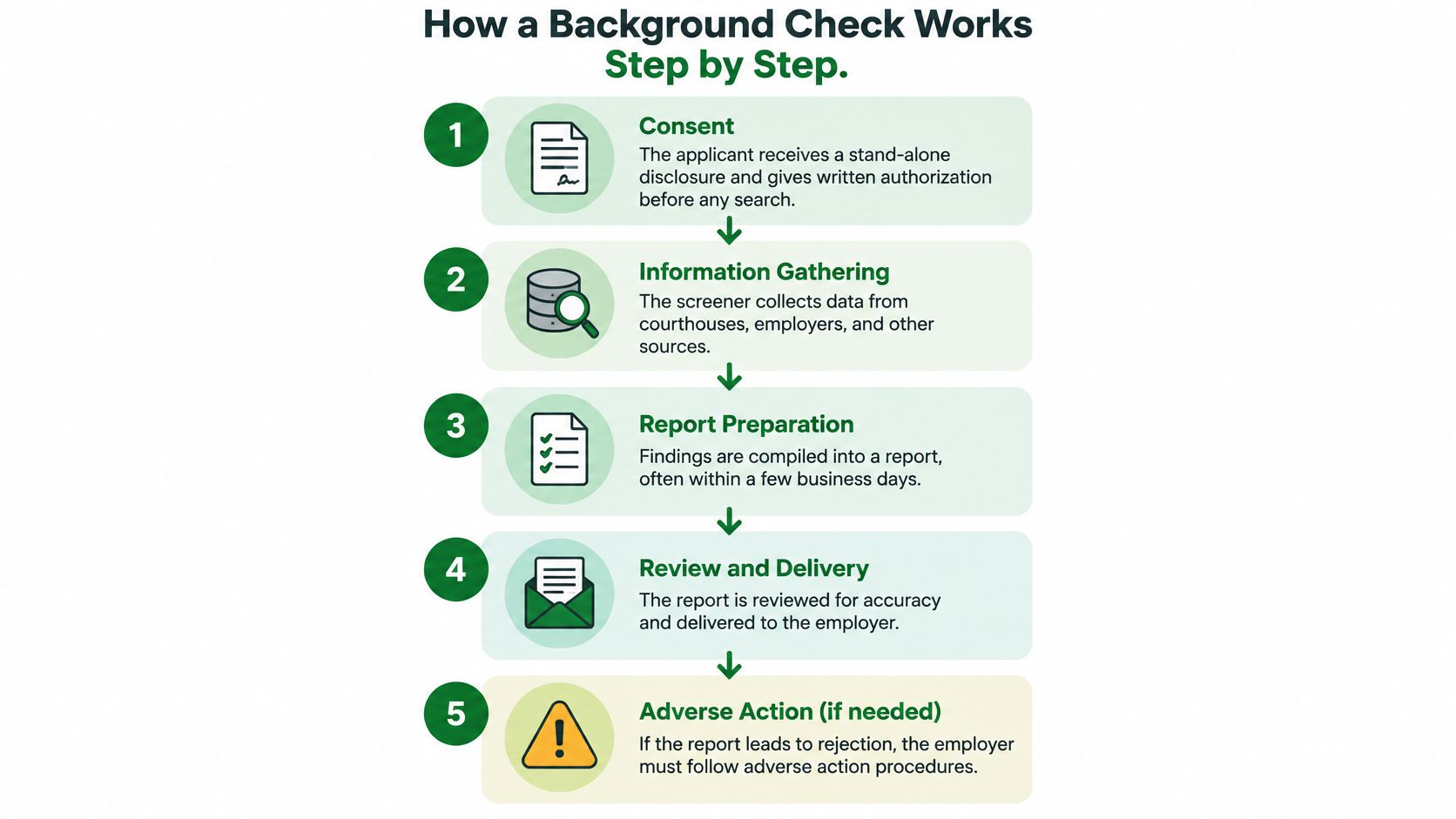
A background check runs as a sequence, and each stage catches a different kind of error. Skip one and the report looks finished while hiding a mismatch that will surface later, usually at the worst moment.
The six stages
- Consent. The applicant receives a stand-alone disclosure and gives written authorization before any search runs. Nothing is ordered first and explained afterward.
- Identity resolution. The provider matches legal name, date of birth, and address history to separate your applicant from everyone with a similar name. NIST's Digital Identity Guidelines describe identity proofing as establishing that a subject is the person they claim to be, with assurance levels tied to the reliability of the evidence and the verification method. Weak matching here is the biggest single source of false positives.
- Database search. National, state, and county sources return possible records, usually within minutes to a couple of days depending on court access.
- Primary-source verification. A person confirms identifiers, dates, and the case disposition with the court or agency holding the file. A database hit is a lead, not proof of anything.
- Plain-language report. Results list the sources searched, the dates, and which entries were verified or cleared.
- Decision routing. Ambiguous or out-of-state hits go to human review, and anything that might disqualify the applicant starts the adverse-action sequence.
A short video walkthrough of the same route from consent to final notice:
Where the process usually breaks
The failures cluster at two stages. At step two, a common name plus a missing middle initial produces a match that belongs to a stranger in another state. At step four, a database entry arrives without a disposition, so a dismissed charge sits in the report looking exactly like a conviction to anyone who doesn't know where to look.
Address-history gaps create their own quiet errors. If a provider only searches the county from the current address, a case filed three moves ago never appears, and the report comes back clean for the wrong reason. Conflicting dates of birth and duplicate identities do the same damage in the other direction, attaching someone else's history to your applicant.
Your written screening policy should name the sources searched, the identifiers used for matching, how discrepancies get resolved, and how long reports are kept. For a fuller operational model of that workflow, this step-by-step volunteer screening guide walks through the same stages with volunteer programs in mind.
Volunteer platforms typically finish the search, verification, and reporting stages in 24 to 72 hours. Fingerprint checks and manual county pulls that require a courthouse visit take longer, so build the wait into your onboarding calendar instead of promising a start date you can't hold.
FCRA Rules Every Screening Program Must Follow
The FCRA applies the moment an organization obtains a consumer report from a consumer reporting agency for a permissible purpose, and it doesn't matter that the person on the other side is an unpaid volunteer. The EEOC's guidance on background checks for employers sets out the practical shape of those duties: disclosure, authorization, an opportunity to respond, and a notice if a decision goes against the applicant.
The distinction that drives most of this is simple. An arrest is not proof of criminal conduct and may be inaccurate or incomplete, while a conviction normally provides stronger evidence but still needs review for accuracy and relevance. Everything downstream depends on which one you're holding.
The sequence for a negative decision
| Step | What you do | Why it matters |
|---|---|---|
| 1. Disclosure | Give a clear, stand-alone notice that a consumer report will be obtained | Ensures the applicant is informed before any search |
| 2. Authorization | Collect the applicant's written or electronic permission | Required before ordering the report |
| 3. Individualized review | Assess the offense's nature, recency, and relevance to the role | Avoids blanket exclusions and disparate-impact risk |
| 4. Pre-adverse notice | Send the report, the Summary of Rights, and the proposed decision | Lets the applicant see and respond to the evidence |
| 5. Dispute window | Wait a reasonable period (often about 5 business days) for corrections | Catches mismatches, outdated records, and errors |
| 6. Final adverse notice | Confirm the decision and the screening agency's contact details | Closes the compliant decision loop |
The relevance review most programs skip
Step three is where volunteer programs get into difficulty, because it requires an actual judgment rather than a rule. Before rejecting anyone based on report information, the program should assess the offense's nature and seriousness, how much time has passed, and how the conduct connects to the responsibilities of the role.
Applying a blanket exclusion to anyone with any record creates disparate-impact risk and sits uneasily with EEOC principles requiring job-related, narrowly focused screening criteria. A policy that says "no one with a felony may volunteer" reads as decisive and is legally fragile. A policy that says which offenses disqualify which roles, and why, is defensible and can be explained to a volunteer without embarrassment.
The written policy is the deliverable. If your criteria live in a coordinator's head, you don't have criteria, you have habits.
The hygiene nobody budgets for
Three operational habits separate a compliant program from a lucky one. Keep reports and notices confidential, stored where only the people making the decision can reach them. Retain them on a defined schedule rather than forever. Route ambiguous, out-of-state, or name-only matches to a human reviewer before anyone drafts a notice.
These steps protect the applicant and the organization in equal measure. They convert a gut-feel judgment into a repeatable process that survives staff turnover, and they're the difference between a decision you can explain a year later and one you can't. This guide to FCRA compliance for nonprofits breaks the same duties down for volunteer-led teams.
What a Flag on a Report Really Means
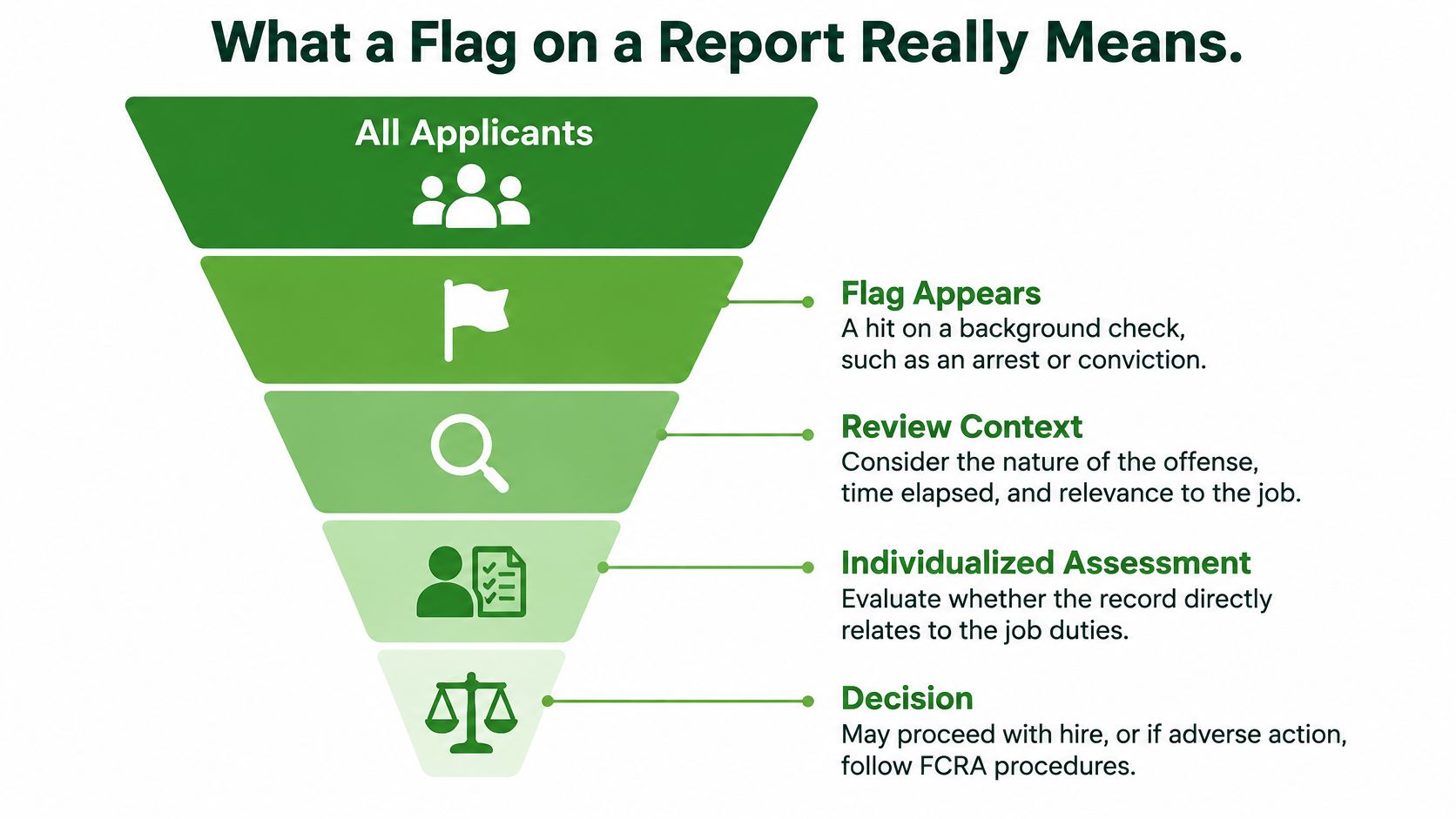
A flagged result does not mean the person is unsuitable, and the federal data makes that point better than any reassurance could. Between fiscal years 2018 and 2020, 22.3% of the 91,852 closed adjudication cases for civil-service positions, some 20,462 cases, were flagged for criminal-conduct issues during the investigation, according to the EEOC's Second Chances report. Yet 76.0% of those flagged adjudications still received favorable determinations, against 84.4% of all civil-service adjudications.
The pattern repeats in the broader set. For positions with an unknown service type, 21.3% of 638,839 closed adjudications, or 135,810 cases, were flagged for criminal-conduct issues, and 88.4% of them still came out favorable, compared with 93.3% overall.
In plain terms: most flags resolve into eligibility once someone looks at the context.
The four factors that decide an individual case
- Nature and seriousness of the offense. A traffic violation and an assault charge are not the same conversation.
- Time elapsed. A ten-year-old matter with no subsequent record carries different weight than a recent one.
- Accuracy of the match. Name-only hits with a mismatched date of birth get cleared, and that happens more often than people expect.
- Relevance to the role's actual duties. A financial crime matters for a volunteer treasurer and far less for a volunteer who waters the church garden.
That third factor deserves its own warning. EEOC guidance for small businesses points out that arrest records can be inaccurate or incomplete, sometimes omitting that charges were never filed or were dismissed. A report can show an arrest and nothing else, which tells you a person was taken into custody and nothing about what happened next.
Sorting which hits usually clear from which ones deserve a second read is the skill worth building, and this breakdown of background check red flags groups them by type so a coordinator can recognize the pattern before drafting anything.
Work the example before you draft the notice
Say a coordinator receives a hit with the applicant's first and last name, a courthouse in a county the person lived in six years ago, and a date of birth that doesn't match the application. The right move is a verification request against the primary record, not a phone call to the volunteer. If the identifiers don't line up, the record belongs to someone else, and the file closes.
Now change one detail: the same report shows a recent offense directly involving the population the volunteer would serve. That deserves closer review, an individualized assessment, and a written rationale either way.
Document the reasoning in every case, including the ones you clear. A short written note explaining what you weighed and why is what makes the decision defensible months later, when the coordinator who made it has moved on.
The EEOC figures come from federal civil-service security adjudications, so treat them as evidence that flags often resolve favorably, not as a benchmark for your volunteer program.
What Nonprofits Should Expect When Screening Volunteers
A volunteer isn't an employee, and that changes none of the disclosure, authorization, or notice obligations when a consumer reporting agency runs the check. It changes only the vocabulary on your forms.
The broader hiring world has normalized screening. In 2025, almost 90% of organizations worldwide reported conducting criminal-record checks on new hires, according to HireRight's Global Benchmark Report, which drew on more than 1,000 HR, risk, and talent-acquisition professionals. Those respondents are employers, not volunteer programs, so read the figure as a norm rather than a requirement. Checking someone before they start is ordinary practice, and a role that puts a volunteer alone with children deserves at least the rigor a warehouse position gets.
A baseline scope for volunteer roles
Most programs do well with a national criminal search plus an all-state sex-offender registry check. That combination covers the records that bear on safety around vulnerable people and returns quickly enough to keep onboarding moving.
Add fingerprint-based checks only where state law or your insurer requires them: school volunteer programs, youth sports leagues, adoption and foster support. A database check works as the primary screen for most roles, but where the law mandates fingerprints it is not a substitute. Add employment or education verification for roles that involve money, medical guidance, or instruction, and treat it as a credentials check rather than a criminal search.
Cost is the question every board asks first, and pricing models differ more than prices do. Some vendors bill per search component, so a national check, a county search, and a registry search arrive as three separate line items. VolunteerBadge charges a flat $5 per background check, every other feature is included free, and credits roll over without expiring. Whatever model you price, compare quotes for the identical scope line by line. A cheap quote for a narrower search isn't a cheaper version of the same product.
The items worth writing down
- Consent at application. Collect the disclosure and authorization as part of the volunteer application, not as a separate errand.
- Identity and address verification before searching. A confirmed address history tells you which counties to search and flushes out mismatches early. Some platforms, VolunteerBadge among them, include it free with every application and spend no credits on it.
- Human review of ambiguous hits. Name-only matches and missing dispositions go to a person who verifies the record before it becomes a decision.
- Confidential storage. Reports live in one restricted place, not in a shared inbox or a printed folder in the break room.
- A written re-screening cadence. Decide now how often long-serving volunteers get re-checked, and put the interval in the policy.
Timelines matter for planning. Database and registry results can take up to 72 hours, while fingerprint appointments and manual county verifications stretch longer. Tell your applicants what to expect so a slow courthouse doesn't read as a problem with their record.
Choose Screening That Fits Your Program
Three points carry out of all this. A background check is a regulated review of records, a pipeline where every result feeds a defined decision. The checks stack from broad national sweeps down to county confirmation and registry searches, and the stack should match the role. A flag is a lead to verify, and the FCRA requires an individualized review before it can become a decision.
The next step is smaller than it sounds. Draft a one-page screening policy this week that names the checks each role requires, the criteria you'll apply when a record appears, who is allowed to see results, and the template you'll use for a pre-adverse notice. One page forces the decisions you've been avoiding, and it gives a new coordinator something better than instinct to work from.
If you'd rather run that workflow on a platform than build it from scratch, VolunteerBadge charges $5 per background check, or less when you buy credits in bulk. The national criminal check searches county, state, and federal courts, sex offender registries in all 50 states, FBI Most Wanted, OFAC sanctions, and global watchlists. When a possible criminal record appears, a real reviewer checks the identifiers, the dates, and the jurisdiction to confirm it belongs to your applicant before the report reaches you.
The same decision pipeline shows up in other sectors, which makes it a useful sanity check on your own process. Landlords weighing an applicant's history ask the same questions about relevance, recency, and verification, and this overview of tenant screening services Maple Ridge shows how that workflow gets structured for a residential decision.
Screening should be fast, fair, and affordable enough that no willing volunteer goes unchecked. Get those three right and the policy stops feeling like a legal burden and starts feeling like the reason your program can say yes with confidence.
VolunteerBadge was built for this workflow: a $5 national criminal check with a free disclosure and authorization, an address history pull before you spend a credit, and plain-English results that flag what needs a human look. When a possible record appears, a reviewer verifies the identifiers first, and the platform generates the pre-adverse and final adverse notices if a decision goes that way. Visit VolunteerBadge to run your first volunteer application and see the whole pipeline end to end.
