
Adverse Action Notice Reasons and What the FCRA Requires
Adverse action notice reasons explained: common triggers, how to state a specific reason, and the FCRA steps employers and nonprofits follow.
On this page
Most organizations get the background check right and the notice wrong. The check is a transaction you can hand off. The notice is a decision you have to explain in your own words, on your own letterhead, to someone who is already upset and has a lawyer's number in their contacts.
That gap shows up in the wording almost every time. A rejection that says "failed background check" reads as final, explains nothing, and hands the applicant nothing to work with. The fix isn't a longer letter. It's a shorter, more specific one, backed by a procedure you can show if anyone asks.
Table of Contents
- What an Adverse Action Notice Means for Your Organization
- Reasons That Typically Trigger an Adverse Action Notice
- Individualized Assessment Before Any Final Decision
- Writing a Specific Reason the Applicant Can Act On
- Who Makes the Decision and Who Writes the Reason
- How to Send the Pre-Adverse and Final Notices in Order
- Confirm the Notice Is Ready Before You Send It
What an Adverse Action Notice Means for Your Organization
Picture a food bank in the third week of a volunteer drive. A coordinator gets a report back on a warehouse applicant, sees something in it, and decides not to place him. She sends a two-line email saying the organization is going another direction. Two days later he writes back asking what the report said and whether he can correct it. What started as a scheduling decision is now a compliance question, and the answer depends on what the report contained and how the organization used it.
An adverse action notice is the message an organization sends when it denies an opportunity, or makes it less favorable, wholly or partly because of information in a consumer report. That definition covers a lot of ground: turning down a volunteer, pulling someone off a youth roster, declining a foster placement, or moving an applicant from a solo-driving route to a supervised role.
The notice has two jobs, and both matter.
The two jobs: it tells the applicant that a report influenced the decision, and it gives them a route to see that report and dispute what's wrong in it.
A routine rejection email does neither. It doesn't name a source, doesn't attach a report, doesn't mention dispute rights. That's the difference between a note that closes a conversation and a notice that opens a process.
Whether the FCRA applies to a specific volunteer role depends on how you obtain and use the report. The statute is written around employment, credit, housing and similar decisions. Most nonprofits running formal screening treat volunteer applicants the same way they'd treat employees, because a paid screener is a consumer reporting agency and the report is a consumer report. Confirm that with counsel before your first live notice rather than after an applicant complains.
Everything that follows turns on one question. Can the applicant read your reason and know exactly what to dispute?
Reasons That Typically Trigger an Adverse Action Notice
Six triggers produce most of the notices a volunteer program will ever send. The right-hand column matters as much as the middle one, because a reason built on an unverified record is worse than no notice at all.
| Trigger | Specific reason to state | Check before sending |
|---|---|---|
| Verified criminal conviction | Conviction for theft in 2019, relevant to cash-handling duties | Confirm name, date of birth, county and conviction date |
| Pending or dismissed charge | Pending charge involving a minor, relevant to a youth mentor role | Confirm the charge is reportable and not dismissed |
| Sex offender registry match | Listed on a state registry for an offense involving minors | Confirm identifiers match the registry entry exactly |
| Address history gap | Two years at an unlisted county address that the criminal search did not cover | Verify the address, then let the applicant explain |
| Unresolved identity match | None; do not state it as a reason | Treat the record as unresolved and do not use it |
| Driving record for a driving role | Two moving violations within three years, relevant to driving duties | Confirm the role requires driving and the dates are current |
Walk the rows in the order they show up
A verified conviction is the most common trigger, and the easiest to get wrong. The record must be tied to this applicant, in this jurisdiction, on this date, before it becomes a reason. When a possible criminal record appears, a real reviewer checks the identifiers, the dates and the jurisdiction to verify whether it belongs to the applicant. That is not a formality. It's the step that keeps a same-name match off a rejection letter.
Pending and dismissed charges rank second, and they're where organizations overreach. Many screening products report case status, and a dismissed case carries a different weight than an open one. If the record shows the matter was resolved or withdrawn, the reason has to reflect that, or it shouldn't be sent.
Registry matches and address gaps come next. A registry hit needs an exact identifier match, not a similar name in a nearby county. An address gap is the odd one out: it isn't misconduct at all, it's a coverage limitation in your search. Say that plainly and invite an explanation, because the applicant usually has one.
Unresolved identity matches shouldn't produce a reason. If you can't tie the record to the person, you don't have a fact to act on.
Driving records only belong in a notice when driving is part of the role. If you're still working out which report items count as adverse, what counts as adverse information is a useful starting point.
To use the table, find the trigger that matches your record, adapt the middle column's pattern to your own facts, and run the check in the third column before you draft a single sentence.
Individualized Assessment Before Any Final Decision
A record is not a verdict. The same 2019 theft conviction can end one volunteer conversation and barely register in another, and the decision has to come from the role, not from the database row.
EEOC guidance asks organizations to identify the position's essential requirements, consider the actual circumstances of the work, and carry out an individualized assessment before excluding anyone. The EEOC's guidance on arrest and conviction records sets out that framework in detail.
The same record carries very different weight depending on what the volunteer does.
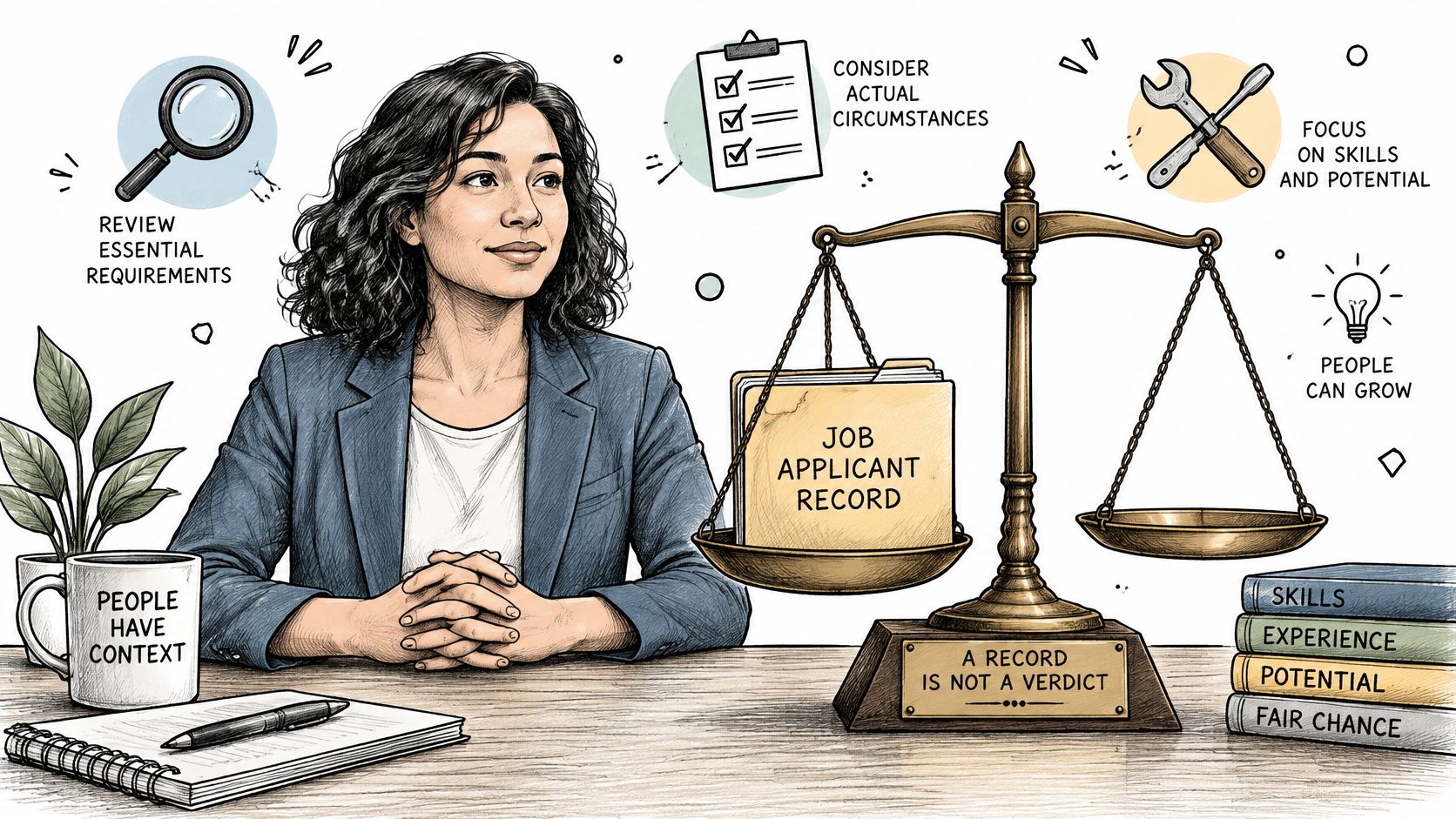
The comparison below shows how far apart two outcomes can sit for the same record.
| Role | Contact with those served | Question to ask of the record | Likely decision path |
|---|---|---|---|
| Youth mentor | Direct, often unsupervised contact with minors | Does the offense relate to child safety? | Exclusion more likely if the record is relevant and recent |
| Food bank driver | Drives alone and handles goods and vehicles | Does the record involve driving or theft? | Restrict driving or handling duties and review fit |
| Bookkeeper | Handles money with no direct service contact | Does the record involve fraud or theft? | Exclude from cash duties; other roles may remain open |
| One-day event helper | Short, supervised, public setting | Would the record affect safety at this event? | Often a supervised placement with little or no exclusion |
Five questions every record has to answer
Work through these in writing before anyone communicates a decision.
- Is the record accurate? Dates, charges, and dispositions get misreported more often than people expect.
- Does it belong to this applicant? Common names and shared birth years produce false matches.
- Is it legally reportable? Some records fall outside what a consumer reporting agency may report at all.
- How old is it? Recency changes the risk calculus for almost every role.
- Does it create a real risk here? Not in general. In this role, with these duties, in this setting.
A generic label like "criminal history" hides all five questions inside one phrase. It tells the applicant nothing about which fact drove the decision, and it tells a reviewer nothing about whether the decision was sound.
A database hit is not conclusive evidence on its own. Write the assessment down before you communicate anything, and keep it with the report. That document is what turns a screening result into a defensible decision, and it's the first thing anyone will ask for if the applicant pushes back. If you want a method for reading the report itself, this guide to how to read a background check walks through the sections line by line.
Writing a Specific Reason the Applicant Can Act On
A vague reason fails twice. It gives the applicant nothing to dispute, and it gives your organization nothing to point to when someone asks why.
The lending side of compliance has already settled this argument. In CFPB Circular 2022-03, published in 2022, the agency stated that creditors must disclose the actual principal reasons for adverse action even when complex algorithms, artificial intelligence, or machine-learning models are involved, and that no principal factor may be omitted merely because its relationship to creditworthiness is difficult to explain. Generic explanations such as "failed to meet internal standards" or "the system rejected the application" don't satisfy it.
That's a credit rule, not a screening rule, but the principle travels well. Apply it as an analogy and your notices get sharper.
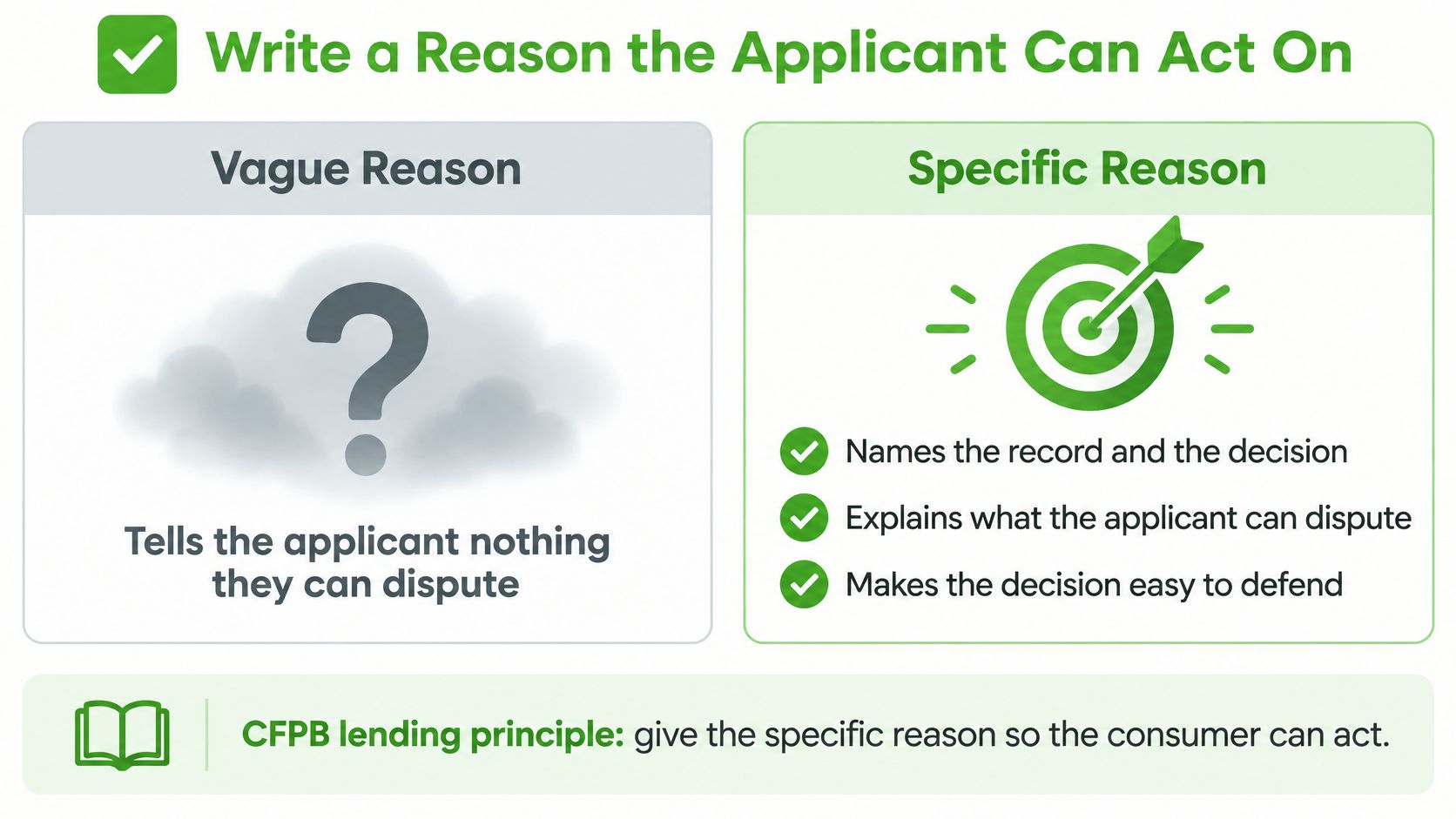
Write the reason so a stranger could find the same line in the report you sent.
A five point checklist
- Name the record fact. The offense, the date, the jurisdiction, or the specific mismatch. Not the category.
- Name the role duty it bears on. Cash handling, unsupervised contact with minors, driving alone with equipment.
- Delete the boilerplate. "Failed background check," "did not meet internal standards," and "the system rejected the application" are all the same non-answer.
- Pick the principal factor. When three items appear in the report, state the one that drove the decision. Attach the rest for context if you want, but don't turn the notice into an inventory.
- Cross-check against the report. Could the applicant open the copy you sent and find that exact item? If not, the wording isn't finished.
The before and after is the whole lesson.
Before: "Failed background check."
After: "Verified 2019 theft conviction, which conflicts with the cash-handling duties of this role."
The second version tells the applicant what to dispute, tells a reviewer what you relied on, and survives being read aloud in a meeting. The first version does none of those things, and it's the one most organizations send.
Who Makes the Decision and Who Writes the Reason
Applicants assume the screening company decided. So do plenty of coordinators, who call the provider expecting an explanation for the rejection. That's backwards, and the misunderstanding causes real damage when an applicant calls the provider and gets told the provider can't help.
The FTC is direct about it. The employer makes the adverse action decision, while the consumer reporting agency must be identified in the notice and described as an entity that cannot provide the employer's specific reason. The FTC's guide to background checks for employers lays out that division and the applicant's rights around it.
Take a church youth program. The screening provider returns a report with two records. The ministry's volunteer committee reviews the role, the records, and the applicant's response, then decides the volunteer can't work with children. That decision, and the reason behind it, belong in the organization's notice. The provider's report supplies facts. It doesn't supply the judgment.
Keep the two separate in the letter itself, in clearly labelled sentences:
- The source: "This decision was based in part on a consumer report provided by [screening company], [address], [phone]."
- The decision-maker: "Our volunteer committee made this decision. The reporting agency did not make it and cannot explain our reasons."
- The reason: Your own factual statement, in your own words.
Before any final action, the applicant should receive a copy of the report and information about disputing inaccurate or incomplete data. That package is what makes the reason actionable.
Hard cases and what the notice should say
- Several records in one report: state only the principal record that drove the decision, and attach the rest for context.
- Unresolved identity match: resolve the match before drafting. No verified record means no reason to state.
- Policy-based exclusion: if the exclusion rests on your own policy rather than a record, say so as your policy. Don't attribute it to the report, because the report didn't make that call.
- "Failed background check": never send it. It describes a process, not a decision.
How to Send the Pre-Adverse and Final Notices in Order
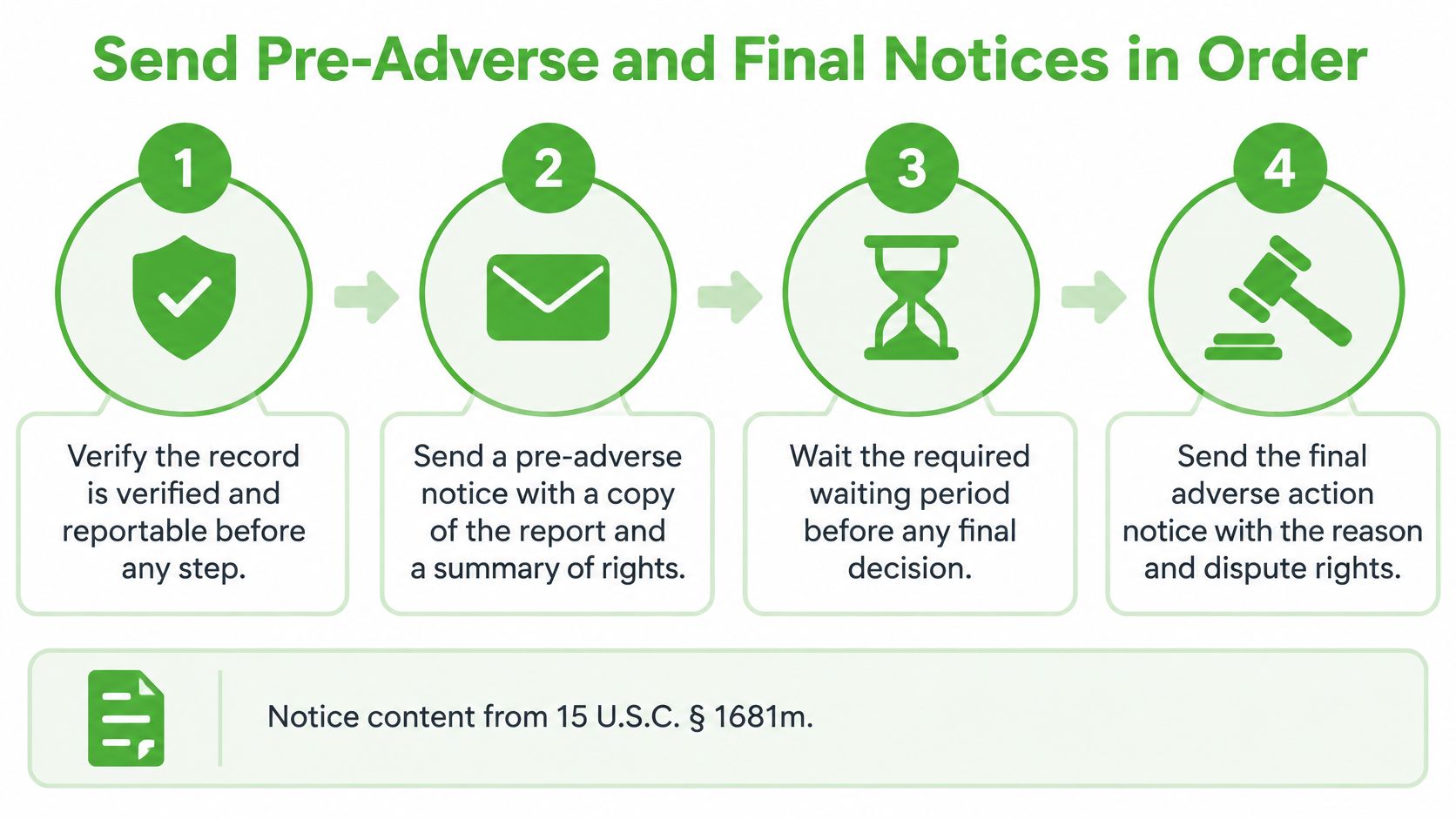
A coordinator sends a final denial two hours after the report lands. No pre-adverse notice, no response window, no copy of the report in the applicant's hands. The decision itself might have been sound, but the file is now indefensible, because the order of the steps is what gives the applicant a real chance to correct an error before the decision hardens.
The infographic below shows the four stages the process collapses into.
The sequence in six steps
- Verify before you start. Confirm the record is verified, reportable, and tied to this applicant. Nothing downstream fixes a bad match.
- Send the pre-adverse notice. Include a copy of the report and the FCRA summary of rights. The pre-adverse requirement comes from FCRA section 604(b)(3), 15 U.S.C. 1681b(b)(3), not from agency guidance.
- Wait. A reasonable period gives the applicant time to respond or dispute. Five business days is a defensible default. The statute doesn't set a fixed number, so document why you chose yours.
- Review the response. A dispute, an explanation, or a corrected report can change the outcome. Record what came back and what you did with it.
- Send the final notice with the statutory content. Under 15 U.S.C. § 1681m, the notice must identify the consumer reporting agency that supplied the report, give its address and telephone number, state that the agency did not make the decision and cannot explain the specific reasons, and inform the applicant of the right to a free copy of the report and to dispute inaccurate information. The same section gives the applicant a 60-day window to request the reasons when the notice doesn't state them directly.
- Add your own reason. The statutory language is the floor. Your specific, role-related reason is what makes the notice useful.
When a screening result requires adverse action under FCRA, VolunteerBadge generates the notice and the customer reviews and sends it, and the workflow guides you through the waiting period required between the pre-adverse and final versions.
That sequencing matters most where turnaround is slow or records arrive in pieces. Hiring teams verifying overseas engineering candidates deal with a version of the same problem, and the fix is identical: a written step order that keeps the decision from outrunning the evidence.
The video below walks through the notice requirements in plain language if you want a second pass before you draft.
Keep a dated log of every step: the date the report arrived, the date the pre-adverse notice went out, the date the response period closed, what the applicant said, and the date the final notice was sent. If the process is ever challenged, that log is your answer.
Confirm the Notice Is Ready Before You Send It
Most notice failures aren't legal mysteries. They're process gaps: a reason written by someone who never read the report, a letter sent the same afternoon the report landed, a file with no record that the applicant ever had a chance to respond.
Five checks close most of that gap. The assessment is individualized and written down. The record is verified as belonging to this applicant. The reason names the principal factor and follows the wording checklist. The consumer reporting agency's contact details and the rights statement appear in the letter. The waiting period has passed and any response has been reviewed and logged.
That's a short list, and it's the difference between a defensible file and an empty one.
Make it routine, not heroic
Adopt a written adverse action procedure for your organization. It should name who drafts the notice, who approves it, how long the response window runs, and where each document lives. Then assign one reviewer who signs off on every notice before it leaves. One name, not a committee, because a shared approval is no approval.
Keep each notice and its dates in the applicant's file alongside the report, the assessment, and any correspondence. If your state or locality restricts how background results may be used in volunteer or employment decisions, add that check to the procedure itself rather than relying on memory. Several states and cities impose their own limits, and a step in the workflow is more reliable than a step in someone's head.
If you'd rather see the whole compliance picture before you write your procedure, this walkthrough of FCRA compliance for nonprofits covers the surrounding obligations. Organizations without in-house counsel sometimes hire virtual legal assistants to review notice templates against state rules and to pressure-test the wording before the first live notice goes out.
Have counsel review your procedure for your state, your roles, and the way you obtain reports. Do that before the first notice, while the conversation is hypothetical and the deadline is nobody's problem yet.
When a volunteer screening result requires adverse action, VolunteerBadge generates the pre-adverse and final notices and walks your team through the waiting period step by step, with a free FCRA adverse-action workflow and no monthly fees. You review each notice, add your organization's specific reason, and send it yourself, so the decision stays yours and the wording matches the role. Visit VolunteerBadge to see how the screening and notice process fits a volunteer program.
