
What Can Make You Fail a Background Check
Find out what can make you fail a background check, from criminal records and sex-offender listings to identity mismatches and OFAC hits, plus how to respond.
On this page
A volunteer coordinator opens a screening report expecting a routine clearance. The applicant has supplied a familiar name, a current address, and no concerns on the application. Then a red flag appears. The immediate question is often, “What can make you fail a background check?” The better question is, what does the flag represent, and has the organization confirmed it before making a decision?
A background check can raise concerns because of a criminal record, an identity mismatch, an incomplete address history, or a mistake in the organization's own process. A report doesn't make the final decision. The nonprofit, employer, school, or volunteer program must interpret the information against the role, its written policy, and applicable law.
Table of Contents
- What Failing a Background Check Means
- The Six Disqualifying Record Types You Should Know
- How the Seven-Year FCRA Reporting Rule Shapes Results
- Identity and Address-History Mismatches That Cause Silent Failures
- How Pre-Adverse and Adverse Action Notices Work
- Remediation and Appeal Steps for Applicants
- Compliance Errors Organizations Should Watch Out For
- A Practical Checklist for Volunteer Coordinators
What Failing a Background Check Means
A volunteer coordinator may receive a report marked “failed” even though the applicant's form looked complete. That label usually reflects the organization's eligibility decision, not a verdict issued by the screening company. The provider gathers and reports information. The organization decides whether the information relates to the volunteer role and its written policy.
A screening process can combine several checks:
- Criminal record searches: County, state, and federal court records may show convictions, pending matters, or other reportable information.
- Registry screening: Programs may check sex-offender registries for roles involving children or vulnerable people.
- Watchlist screening: OFAC and other government or global watchlists can create a separate compliance concern.
- Identity verification: Names, dates of birth, Social Security numbers, aliases, and other identifiers help match records to the correct applicant.
- Address-history tracing: Previous locations help identify the county or state repositories that may require additional searches.
Each layer works like a checkpoint. A clean application can still produce a flag if an address is missing, an identifier conflicts with a record, or a search returns information requiring confirmation. A flag means information needs review. It does not automatically mean rejection, a permanent ban, or proof that the applicant did something wrong.
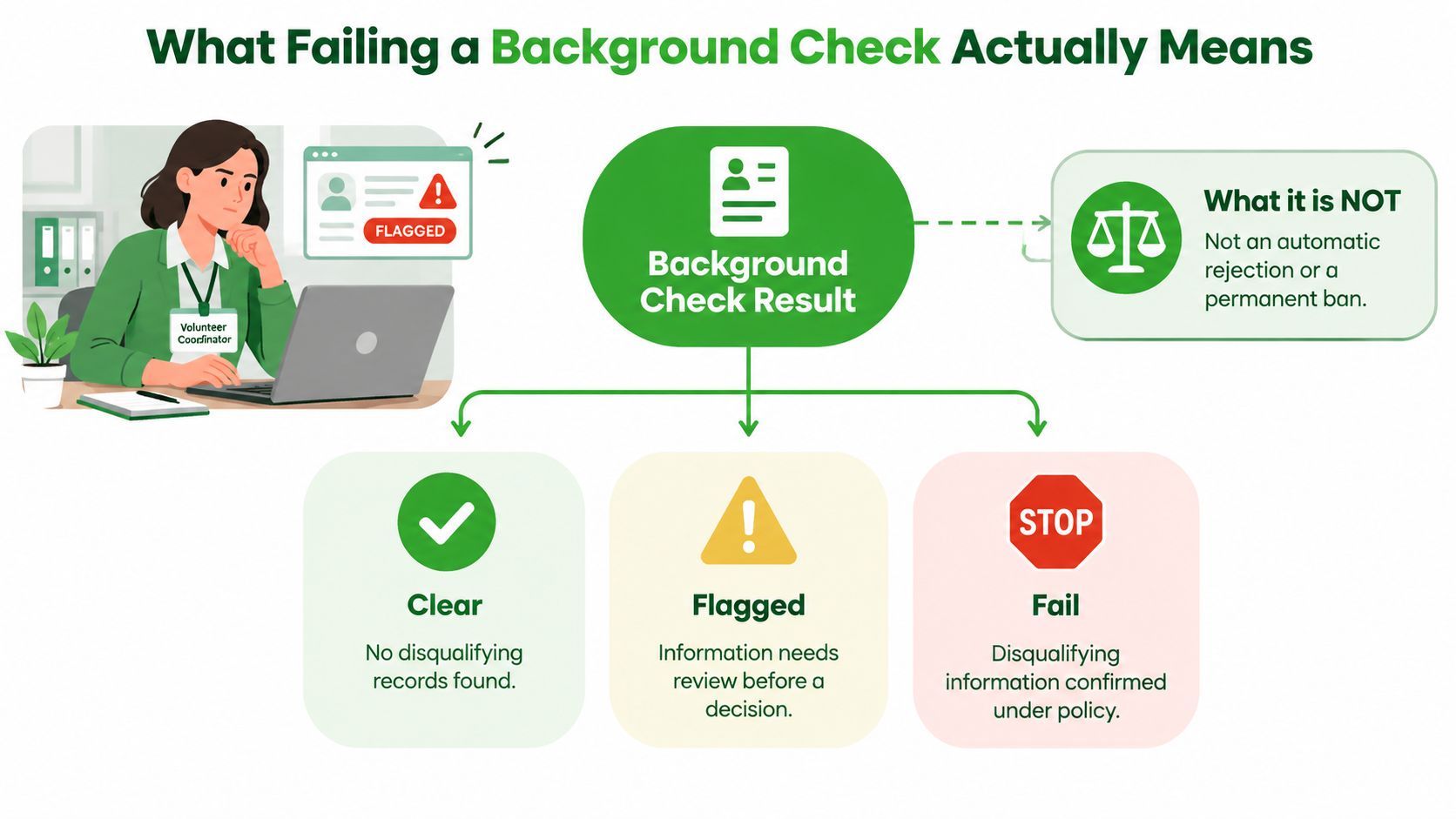
Who starts the process
The organization generally defines the role, tells the applicant that a consumer report will be used, and obtains authorization. A consumer reporting agency then gathers information from relevant sources and sends the report to the authorized organization.
The Federal Trade Commission's guidance for employers using consumer reports explains the steps required before an organization takes adverse action based on a consumer report. Volunteer programs using these reports must apply the same care.
Practical rule: Treat “flagged” as a request for verification, not as a verdict.
A failed result can have three broad causes. The report may contain a confirmed record that the role's policy treats as disqualifying. The information may be inaccurate, incomplete, or linked to another person. The organization may also have missed a required disclosure, authorization, notice, or review step.
For programs researching background checks for fostering, the same discipline applies: identify the reported information, confirm that it belongs to the applicant, and assess it under the rules governing the role. When a clerical mismatch or process error caused the flag, correcting that issue can change the result.
The Six Disqualifying Record Types You Should Know
A screening result is a starting point for review, not an automatic decision. Each record type raises a different question: does the information belong to the applicant, does it relate to the volunteer role, and does the organization's written policy allow it to affect placement?
Criminal convictions
A court record can function like a library record. It identifies information in a file, but the organization still must determine whether the history relates to the duties involved.
A conviction may receive closer review when a volunteer works with children, vulnerable adults, money, transportation, or unsupervised participants. The same record can have different significance across roles. A theft or fraud conviction may matter more for a treasurer position than for a supervised groundskeeping assignment. For a fuller example of how offense details can affect screening interpretation, see how robbery affects background check results.
Pending charges and warrants
A pending matter has no final court outcome yet, but it can still appear within the search scope and trigger policy review. The organization should identify the case status before treating it as a disqualifying record.
A warrant can create an immediate safety or compliance question, particularly when the organization's policy requires additional review before placement. The report should show enough identifying information to distinguish the applicant from another person with a similar name.
Sex-offender registry listings
A registry listing connects a person's identity to a regulated public record. Youth programs, schools, childcare settings, and roles involving vulnerable participants often apply strict rules to confirmed registry matches. Staff should verify the identity and review the requirements that apply to the program and jurisdiction.
Identity and Social Security number mismatches
A name match alone does not establish that a record belongs to the applicant. The date of birth, Social Security number, address history, or other identifiers may conflict.
A mismatch can result from a reporting error, an alias, identity theft, incomplete applicant information, or another person's record. Until the discrepancy is resolved, the report may not reliably identify the individual. Treating an unresolved mismatch as a final failure can unfairly exclude a qualified volunteer.
OFAC and global watchlist hits
A potential watchlist match requires the organization to pause and confirm identifiers before proceeding, because similar names are common. Review may involve the applicant's full name, date of birth, address, and other available details.
The practical issue is whether the result is a confirmed sanctions or identity match, rather than whether a similar name appeared in a database. Roles involving funds, regulated activity, or controlled access may receive closer scrutiny.
Undisclosed or misreported information
Information in the application can conflict with employment dates, credentials, addresses, or other verification results. An incorrect job date may be a clerical mistake. A deliberately false credential or omitted conviction can raise a separate concern about the accuracy of the application.
The coordinator should give the applicant a way to explain the discrepancy and should distinguish an innocent error from intentional misrepresentation. That distinction matters because a mistaken entry may be corrected, while deliberate deception may affect the organization's trust assessment.
| Record Category | Typical Source | What It Means | Roles Most Affected |
|---|---|---|---|
| Criminal conviction | County, state, or federal court records | A court outcome may require role-specific review | Finance, youth programs, vulnerable-person services |
| Pending charge or warrant | Court repositories and related records | The matter remains unresolved or requires action | High-trust and safety-sensitive roles |
| Registry listing | Sex-offender registry | The identity may match a regulated registry entry | Youth, school, childcare, and care roles |
| Identity mismatch | Identity databases, SSN trace, applicant records | The report may not reliably identify the person | Any role screened through a consumer report |
| Watchlist hit | OFAC and global watchlists | A possible sanctions or identity match needs confirmation | Roles involving funds, regulated activity, or access |
| Misreported information | Application and verification checks | Claimed information conflicts with verifiable records | Credentialed, financial, and leadership roles |
Review every category against the role, jurisdiction, record accuracy, time passed, and written policy. A blanket rule can produce unfair results and create compliance problems.
How the Seven-Year FCRA Reporting Rule Shapes Results
A volunteer coordinator receives a report showing a dismissed misdemeanor from years ago. One report excludes it, while another sends the record for review. That difference does not automatically mean either report is wrong. The result depends on the record type, the reporting period, the search method, and the law that governs the screening.
The Consumer Financial Protection Bureau's 2024 background-screening guidance explains that a non-conviction criminal charge generally can't be reported beyond seven years under FCRA section 605(a)(5). The reporting period generally begins with the adverse event, and later events do not restart that clock.
An arrest, dismissed charge, and conviction can therefore receive different treatment. An older arrest or dismissed case may fall outside the scope of a consumer report, while a conviction may remain reportable, depending on the record type, jurisdiction, and applicable law. The rule limits what a consumer report may contain. It does not change the underlying court history or authorize an organization to use information that the law prohibits it from considering.
Why the same history can look different
Suppose a person had a dismissed misdemeanor several years ago. One consumer report may omit it because the applicable federal or state reporting period has expired. Another search may surface a courthouse record for review because its search method or governing legal rules differ.
Before treating the result as a volunteer-screening failure, the coordinator should ask:
- What type of record is it?
- When did the reporting period begin?
- Does state or local law provide greater protection?
- Is the report being used for a role or position with a different legal framework?
- Has the record been sealed, expunged, or otherwise suppressed?
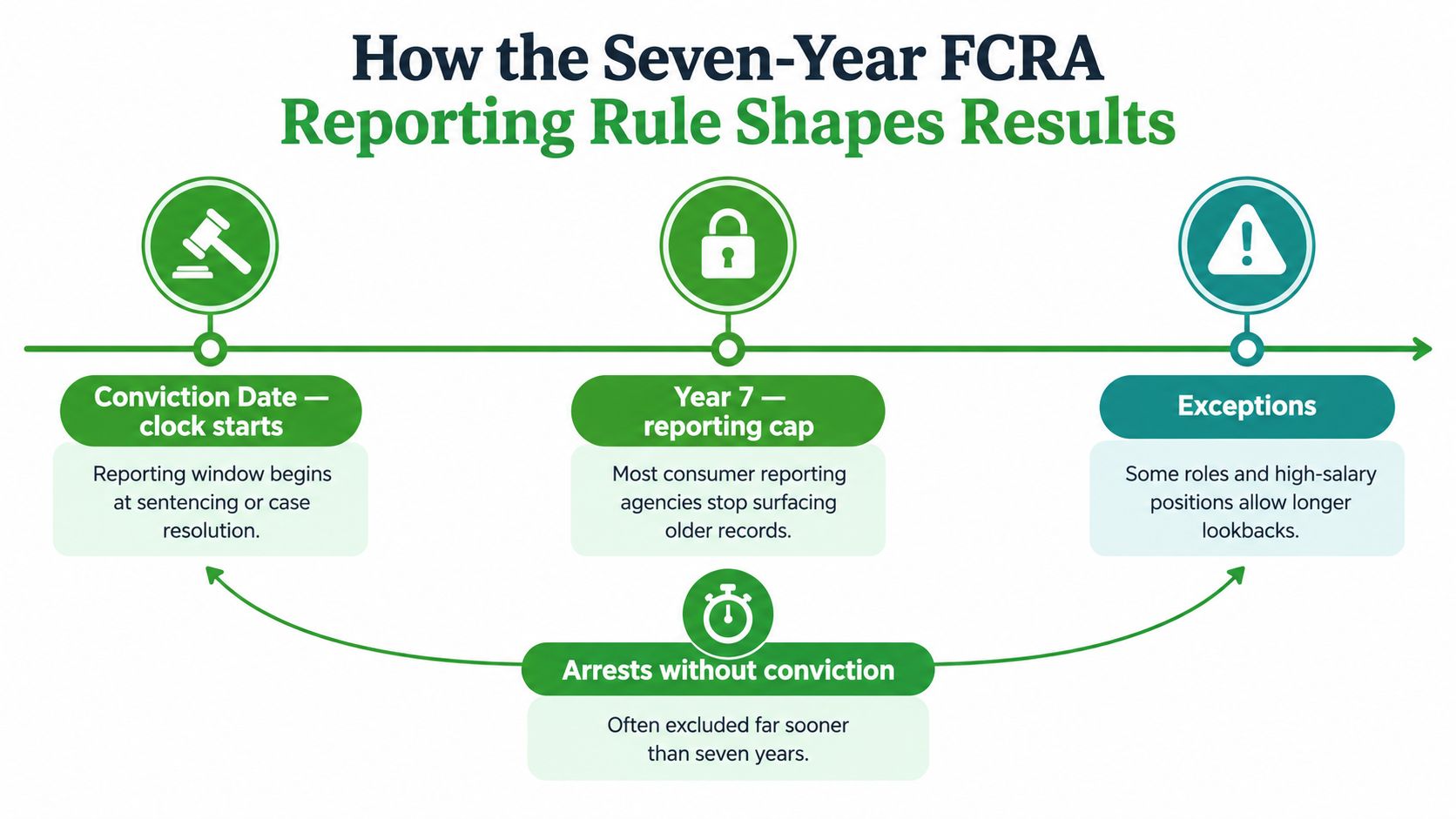
Use the rule as a review checkpoint
A coordinator should not flag an old record merely because it appears in a database. First determine whether the item is reportable and legally usable for the role. This background check lookback period guide can help organize that review, but the nonprofit must still verify its state and local requirements.
The practical lesson is simple: record age, record type, and reporting law work together. A “seven-year check” does not promise that every older item disappears, and it does not permit use of every item a search happens to find.
Identity and Address-History Mismatches That Cause Silent Failures
Two applicants can share a surname, first name, and birth year. If a screening system receives incomplete identifiers, it may attach a court record to the wrong person or fail to locate the correct county entirely. The applicant then experiences the result as a failed check, even though the underlying issue is a data-match problem.
Identity matching typically compares combinations of name, date of birth, Social Security number, aliases, and address information. A typo in the Social Security number, a recent legal name change, a transliterated name, or the use of a nickname can interrupt that match. Common names create the opposite risk, where a record appears plausible but belongs to someone else.
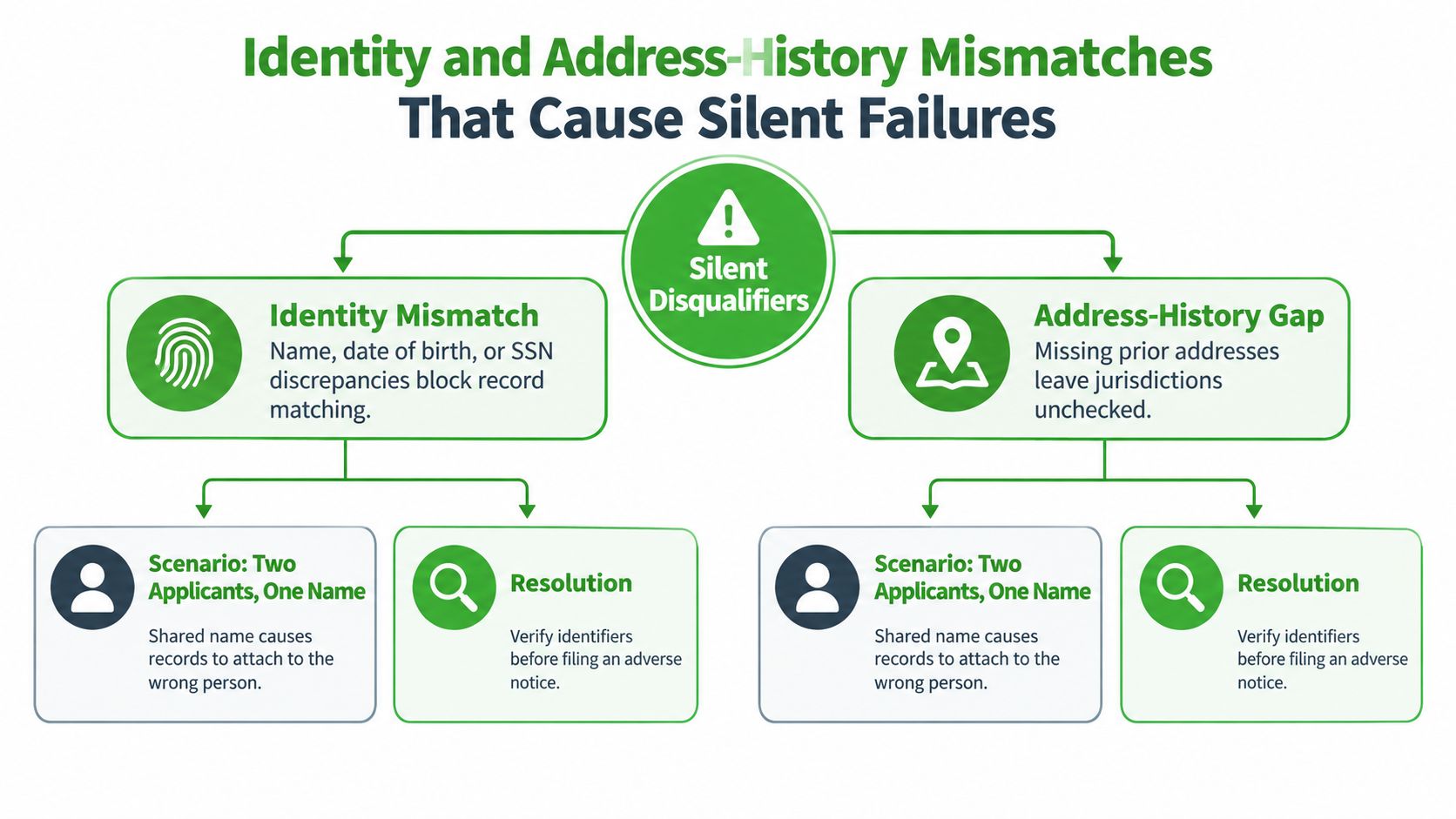
Address history is part of the search map
An address history isn't just an administrative detail. It helps the screening team identify which local courts and repositories may contain relevant records. If the applicant leaves out a prior residence, the search may not reach the jurisdiction connected to that location, or the system may pause the report for verification.
Rural counties and repositories with weaker identifiers can make this harder. A missing address may look like a clean result when it really means the search footprint was incomplete. Recent screening coverage also describes automated address-history pulls and continuous screening as operational responses to this problem, but those tools still need human review when the data conflicts.
The coordinator's response
Don't treat an identifier discrepancy as proof of dishonesty. Ask the applicant to confirm the legal name used during the relevant period, prior addresses, date of birth, and the Social Security number supplied for screening. Then ask the screening provider to reinvestigate or correct the report before making a final decision.
The address-history background check resource offers a practical reference for this review. A coordinator should also document what was checked, which identifier caused the issue, and whether the corrected report supports the original concern.
How Pre-Adverse and Adverse Action Notices Work
A volunteer coordinator sees a report that may affect placement. The next action is not an immediate rejection. Under the FCRA, the organization must give the applicant a meaningful chance to review the information and challenge errors before reaching a final decision.
Follow the sequence
- Review the report internally. Locate the exact record, confirm its relevance to the volunteer role, and check whether the information is reportable and legally usable.
- Send a pre-adverse action notice. Include the consumer report and the applicable Summary of Rights. Identify the consumer reporting agency, and explain that it did not make the organization's decision.
- Allow time for a response. The applicant needs a real opportunity to explain or dispute the information. The organization's policy and applicable law shape the response period. Some jurisdictions set minimum response windows, so check your state's rule before finalizing.
- Reassess any dispute. If the applicant provides a court disposition, identity document, or other evidence, pause the final decision while the report is corrected or clarified.
- Send the final notice if the decision remains negative. The adverse action notice should state that the organization made the decision, provide the consumer reporting agency's contact information, and explain the applicant's right to dispute inaccurate information.
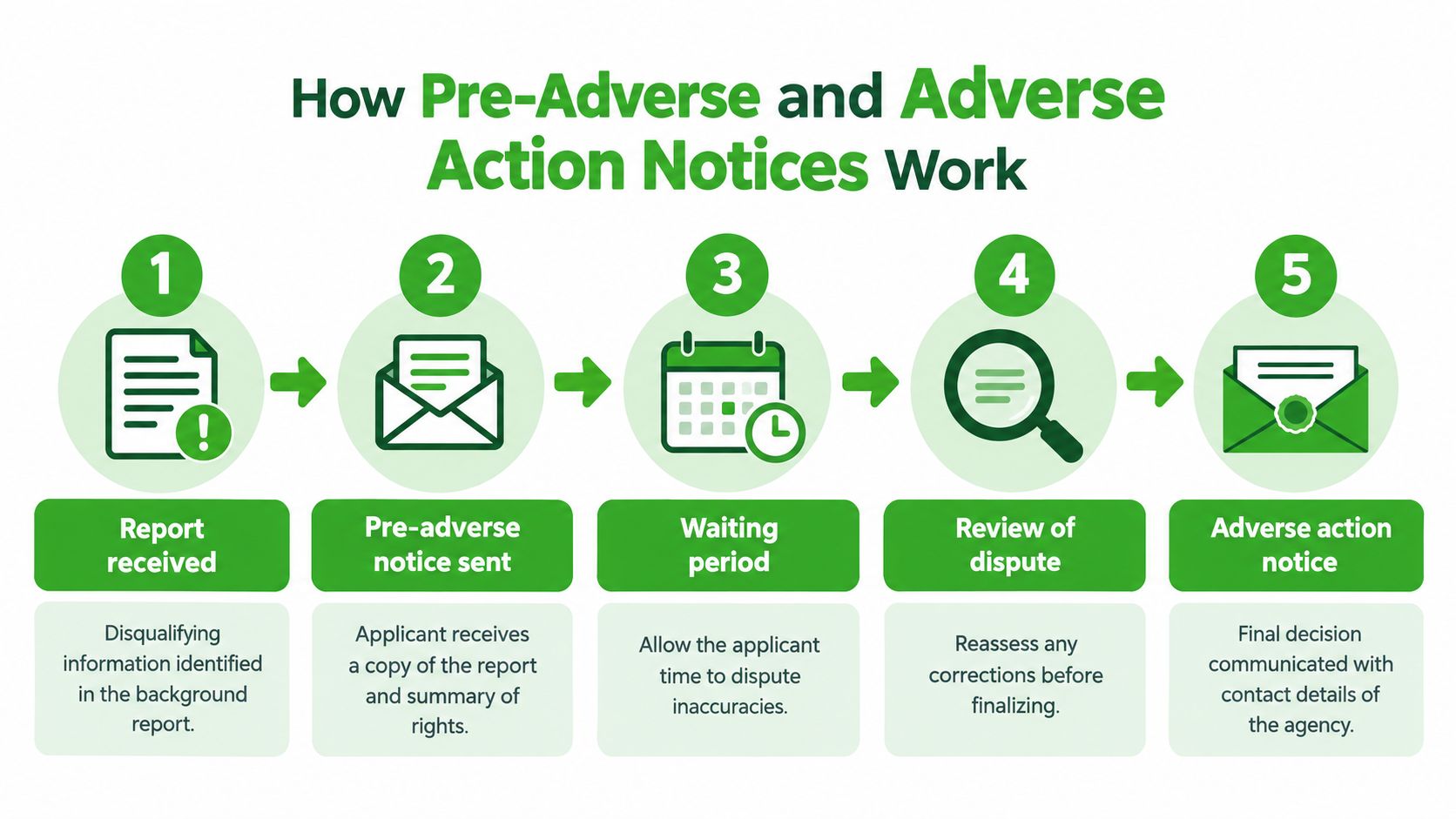
Process safeguard: A pre-adverse notice is the applicant's opportunity to correct the record before the organization acts on it.
The federal workflow is only a starting point. State and local rules may add timing or notice requirements, so a nonprofit should check the applicable jurisdiction before sending a final decision. The CFPB's Summary of Rights document can help coordinators understand the applicant's rights during the process.
This short video shows the sequence:
For a working document, coordinators can adapt this adverse action notice template, then have counsel review it for each jurisdiction where the organization operates. Store the report, notices, response, reinvestigation result, and final decision together in a restricted volunteer screening file.
Remediation and Appeal Steps for Applicants
A flagged report doesn't leave the applicant powerless. The fastest path is to replace a vague objection with a documented correction request.
Start by requesting the complete report and identifying the exact entry that caused concern. Under the FCRA, an applicant can request file information from the consumer reporting agency and dispute inaccurate or incomplete information directly with the agency that supplied the report. If the problem came from a specialty screening provider, disputing only with a major credit bureau may not resolve it.
Build a correction packet
Useful supporting material can include:
- Court disposition documents: Show the final outcome, such as dismissal, acquittal, or a corrected case status.
- Identity evidence: Confirm the legal name, date of birth, and other identifiers used during the search.
- Address documentation: Clarify where the applicant lived during the period connected to the record.
- Expungement or sealing orders: Demonstrate that a court has restricted the record.
- Identity-theft documentation: If the record belongs to another person, an IdentityTheft.gov report may support the dispute.
The applicant should answer the pre-adverse notice within the organization's response window, explain the error in plain language, and attach copies rather than original documents. The applicant can also ask the nonprofit to reconsider placement after the CRA completes its reinvestigation.
A dispute generally must be investigated within 30 days under FCRA timelines, subject to the circumstances described in the statute and applicable guidance. The applicant should keep copies of every submission, note the date sent, and request a corrected report when the investigation ends.
If the record is accurate but old, the applicant may need a different remedy. That could include an expungement or sealing petition through the court involved, a state-specific correction process, or a request for an individualized review under the organization's policy. Accuracy and eligibility are separate questions, so correcting the file doesn't guarantee placement, but it prevents the organization from relying on someone else's history.
Compliance Errors Organizations Should Watch Out For
A volunteer coordinator can reject a qualified applicant before reviewing the record at all. A missing authorization, an identity mismatch, or a notice sent too late can turn a routine screening into a compliance problem.
Consent must match the screening
The disclosure and authorization should plainly state that the organization will obtain a consumer report for the volunteer screening. The document should identify the role and the check being ordered. Hiding the disclosure among onboarding papers makes it harder to show that the applicant understood what they authorized.
The authorization should stand on its own rather than being combined with unrelated application language, such as a broad liability waiver. The CFPB's background-screening compliance guidance addresses this disclosure requirement. A signature from an earlier assignment may not cover a new role or a different type of search.
Before ordering the report, confirm the timing rules that apply where the volunteer will serve. Some jurisdictions limit when an organization may ask about criminal history or order a search. Copying a process from another state can create a violation even when the same form worked elsewhere.
Notice failures create avoidable exposure
Operational shortcuts can break the process at several points:
- Skipping pre-adverse action: The coordinator sends a denial without first providing the report and rights summary.
- Rushing the response period: Staff finalize the decision before the applicant has a meaningful chance to identify an error.
- Omitting agency details: The notice fails to name the CRA or explain that the CRA did not make the placement decision.
- Using the wrong report: Staff rely on an outdated, incomplete, or superseded version after a correction.
- Failing to document review: The file does not show which role-related criteria the organization applied or who approved the result.
A report can be accurate yet still be used incorrectly. The organization must connect the finding to its written volunteer criteria, follow the required notices, and preserve the record of that review.
Audit question: If the applicant challenged this decision tomorrow, could the coordinator produce the authorization, report, notices, response, reinvestigation, and policy used?
Vendor oversight remains part of the organization's job. A CRA error does not excuse weak review or poor data handling. Restrict access to screening files, retain them under the organization's policy and applicable law, and securely dispose of them when retention ends.
A Practical Checklist for Volunteer Coordinators
Print this workflow and use it for every screened placement. The purpose isn't to make every decision identical. It's to make every review deliberate, traceable, and fair.
- Define the role. Ask, “What duties justify screening, and what findings are relevant to them?”
- Collect the disclosure and authorization. Ask, “Does the form describe this exact volunteer role and the consumer report?”
- Check local timing rules. Ask, “Can this organization order the search at this stage in this jurisdiction?”
- Review the report line by line. Ask, “Is this a conviction, pending matter, registry entry, watchlist match, mismatch, or application discrepancy?”
- Verify identity and address history. Ask, “Do the name, date of birth, Social Security number, aliases, and prior locations belong together?”
- Apply reporting limits. Ask, “Is this record inside the applicable reporting window, and does state law impose a stricter rule?”
- Send the pre-adverse package. Ask, “Did the applicant receive the report, rights summary, CRA information, and a real chance to respond?”
- Resolve and document. Ask, “Was the response investigated, was the report corrected if needed, and who approved the final outcome?”
Create a simple escalation path. The screening contact receives disputes, a designated compliance lead approves exceptions, and the program director signs off on final placement decisions. When a report changes, order or obtain the corrected version, record the new result, and update the retention date.
VolunteerBadge is one screening option for nonprofits that need a workflow combining identity and address-history checks with criminal court, registry, and watchlist searches, plus FCRA-oriented disclosure and adverse-action steps. Visit VolunteerBadge to review how its screening process can help your team catch clerical issues before they become unfair volunteer decisions.
