
What Does a Background Check Show for Volunteers
What does a background check show for volunteers? Learn what national, county, and watchlist searches reveal, FCRA limits, and how to make compliant decisions.
On this page
A volunteer coordinator opens the screening dashboard and sees one word: pending. The applicant is scheduled to help at Saturday's youth program, the program director wants an answer, and the coordinator is wondering, “Does a background check show whether this person is safe?”
Not by itself. A background check isn't a magic verdict, and a “clear” result doesn't create absolute certainty. It's a risk-management process built from identity matching, database searches, courthouse records, watchlists, consent, and fair decision-making. The quality of the result depends on how those pieces fit together.
For volunteer programs, the right question is not just whether a check returns a record. Ask what sources were searched, whether the result belongs to the right person, whether the underlying record was verified, and what your organization will do if a record appears.
Table of Contents
- The Reality of Volunteer Screening Results
- The Layers of a Volunteer Background Check
- Why National Databases Miss Critical Records
- Navigating FCRA Rules for Volunteer Programs
- Making Fair Decisions When Records Surface
- Choosing the Right Screening Provider Model
- Building a Sustainable Screening Policy
The Reality of Volunteer Screening Results
The coordinator in the opening scenario may receive a report that says “clear,” “review,” or “pending.” Those labels are useful workflow signals, but they aren't complete conclusions about a person's character or future conduct. A pending status may mean that a possible record needs county-level verification, that an identity detail is incomplete, or that a court source hasn't finished responding.
A background check combines separate searches rather than producing one definitive document. Depending on the provider and the role, the process can involve national criminal database pointers, state and federal court searches, county courthouse retrievals, sex offender registries, sanctions lists, and address-history matching. Each source has different coverage, update practices, and limitations.
Practical rule: Treat the report as evidence to evaluate, not as an automatic admission ticket or automatic rejection.
That distinction matters when a volunteer's name resembles someone else's. It also matters when a database lists an arrest without a final disposition, or when a possible match appears on a watchlist but lacks enough identifying information to confirm that it belongs to the applicant. A coordinator who treats every hit as proof can reject a qualified volunteer unfairly. A coordinator who treats every clear result as proof of safety can overlook gaps in the search.
Screening manages risk, not certainty
Volunteer screening became far more common in the 2000s and 2010s, but the modern framework developed from earlier legal and social changes. The Cornell policy review of criminal background checks traces the federal framework to the Fair Credit Reporting Act in 1970 and notes that the National Child Protection Act in 1993 authorized criminal background checks for people working with children in employee or volunteer roles.
Adoption was incomplete even after those changes. The same review describes a 2008 survey in which 12% of nonprofit organizations reported no volunteer screening, while one in three U.S. nonprofits conducted no volunteer background checks. Those figures describe historical adoption, not a reason to skip screening today. They show why a written, consistent policy matters more than informal judgment.
Your objective is narrower and more practical: verify identity, search relevant sources, assess role-related risk, comply with applicable law, and document the decision. That approach protects participants while giving volunteers a fair opportunity to explain inaccurate or incomplete information.
The Layers of a Volunteer Background Check
A serious volunteer check has several layers, and each answers a different question. Match the package to the role, then verify any pointer before treating it as evidence. A search result is not a pass or fail decision by itself.
Start with broad pointers, then verify the source
A national criminal database search is usually a pointer search, not a complete court record. It scans large databases and indexes for possible records, but the data may lack complete identifiers or final dispositions. A potential hit should direct the provider to the relevant county or court source. It is not enough by itself to support an adverse decision, as explained in the Consumer Financial Protection Bureau market snapshot on background screening.
County-level searches can retrieve records closer to the original source. State and federal court searches add jurisdictional coverage, while sex offender registry searches address a separate safety concern. A provider may also search the FBI Most Wanted list, OFAC sanctions lists, and other watchlists. These sources serve different purposes, so a coordinator should not present them as interchangeable.
OFAC screening commonly uses fuzzy name matching to increase the chance of finding a possible match. That improves recall but creates false positives as well. Require a manual match-quality review before blocking or rejecting an applicant.
For a plain-English explanation of common report fields, read this guide to what shows on background checks.
| Data Source | What It Shows | Key Limitation |
|---|---|---|
| National criminal database | Possible records across broad databases and indexes | Often lacks complete identifiers and final dispositions, so a hit requires verification |
| County courthouse search | Records from a specific local court source | Requires the correct jurisdiction and may take more operational effort |
| State or federal court search | Cases filed within the relevant state or federal system | Coverage depends on the jurisdiction and the search scope |
| Sex offender registry | Registration information maintained by applicable jurisdictions | A generic database search may not confirm that the relevant official registry was checked |
| OFAC and other watchlists | Possible sanctions or wanted-person matches | Fuzzy matching can produce false positives that require human review |
| Identity and address history | Details used to connect a person to jurisdictions and records | Incomplete or inconsistent information can leave search gaps |
Ask what you're paying for
A provider's label, such as “national check,” does not tell you enough. Ask which sources are searched, how the applicant is identified in each source, whether county records are retrieved directly, and how unresolved matches are handled. Industry research on volunteer screening programs shows that organizations commonly combine criminal record checks with sex offender searches rather than relying on one source. The share of organizations using a particular check says nothing about the quality of an individual report.
A full package is not the right package for every volunteer. Someone with unsupervised access to children, residents, money, or sensitive records presents a different operational risk from someone attending a supervised one-day cleanup. Set the search depth according to the person's access and duties. The provider should support that decision instead of just selling the broadest package.
Why National Databases Miss Critical Records
A fast national search can be useful for finding leads. It is dangerous when a coordinator treats it as the final answer.
National databases often point toward possible records rather than supplying a complete court file. They may not include final dispositions, may contain limited identifying information, and may not reflect every county's reporting practices. A “clear” result can therefore mean that the search found no reportable match in the searched data, not that no relevant record exists anywhere.

Address history is the bridge to the right courthouse
A provider needs a reliable way to identify where the applicant has lived and which jurisdictions deserve a closer search. Names alone create mistaken-identity risk, especially when common names appear in multiple counties. Date of birth, Social Security number, driver's license information, and other personal identifiers can help distinguish the applicant from someone with a similar name.
Independent nonprofit guidance recommends asking which sources were checked, how the person was identified in each source, and whether relevant identifiers were used. The Iowa volunteer screening guidance also cautions organizations not to rely too heavily on one source and urges them to confirm whether the DOJ's National Sex Offender Public Website was checked rather than assuming a generic national database includes it.
Use a county search when a pointer, address history, or other identifier directs you there. A county criminal records search can provide source-level information that a database-only result may not contain.
A “clear” result still needs interpretation
The coordinator should ask three questions before closing a report:
- Was the right person matched? Confirm that the identifiers align and that the provider investigated potential similarities.
- Was the source verified? Determine whether a possible record was checked against the relevant courthouse or official registry.
- Is the coverage appropriate? Check that the search includes the jurisdictions and registries relevant to the person's history and role.
That standard doesn't promise perfect knowledge. It creates a defensible process that reduces blind spots and avoids turning incomplete data into a confident but unsupported conclusion.
Navigating FCRA Rules for Volunteer Programs
When a consumer reporting agency runs a volunteer check for employment purposes, the Fair Credit Reporting Act applies. “Employment purposes” includes volunteer roles, so a nonprofit can't avoid the workflow merely because the applicant isn't paid.
The process has distinct stages. Keep them separate in your records, because the organization must be able to show what the applicant authorized, when the report was received, and how any adverse decision was made.
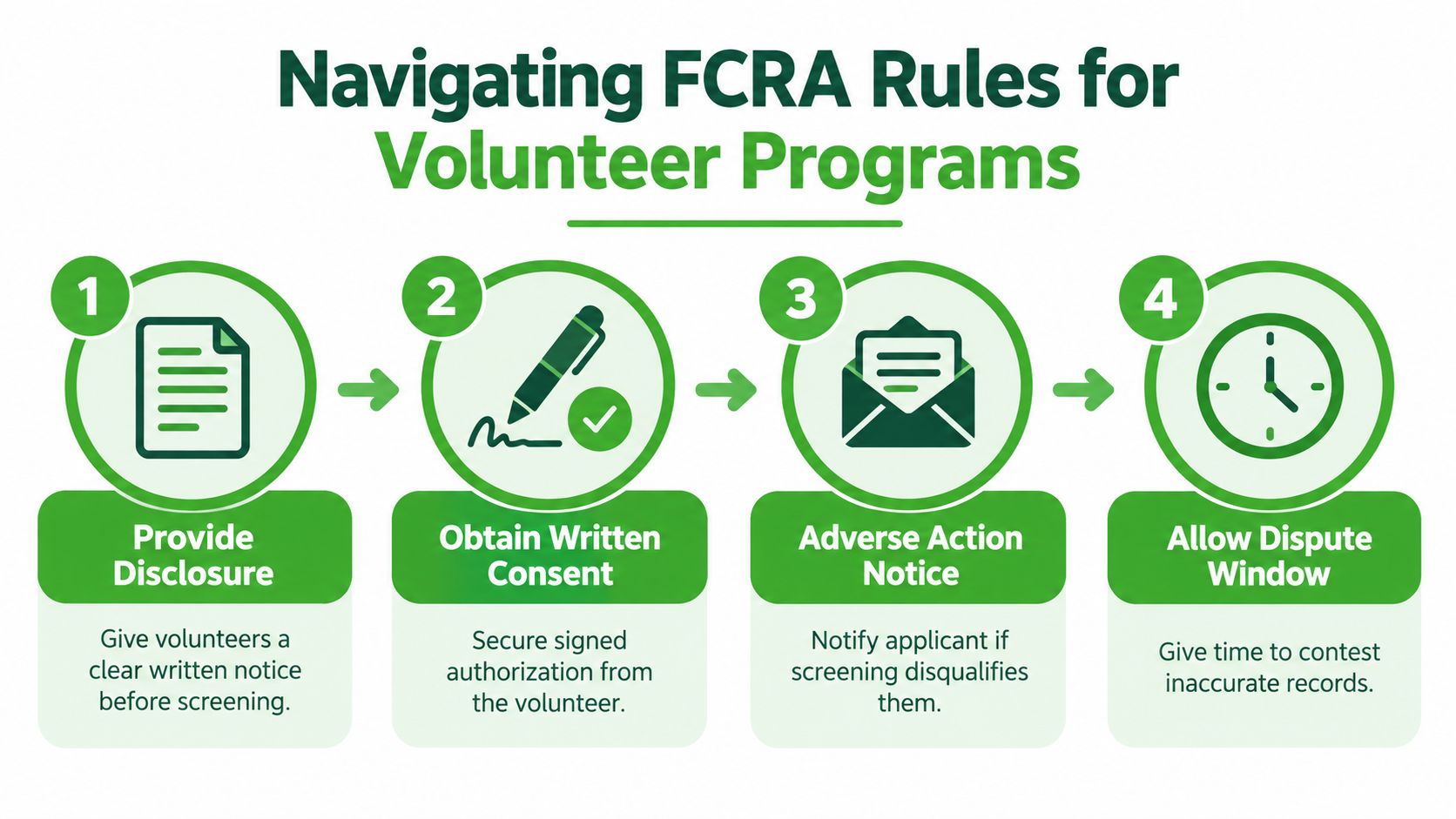
Follow the workflow in order
Provide a clear written disclosure. Give the volunteer a standalone written notice that a consumer report may be obtained for screening. Don't bury the disclosure in unrelated onboarding language.
Obtain written authorization. Secure the volunteer's written consent before the provider starts the check. Store the authorization with the application record.
Issue pre-adverse action materials when necessary. If the report may lead to rejection, removal, or another unfavorable decision, provide the volunteer with a copy of the report and a summary of rights before making the final decision.
Allow the dispute process to run. Give the volunteer time to challenge inaccurate or incomplete information. Investigate the dispute rather than treating the original report as conclusive.
Send the final adverse action notice if the decision remains. If the organization still rejects or removes the volunteer, provide the required final notice after the pre-adverse process. Record the decision and its basis.
The FCRA volunteer screening companion guide describes this sequence and explains why accurate data doesn't cure a defective process. If the disclosure, authorization, notices, or timing are mishandled, the screening outcome can create compliance exposure even when the underlying record is accurate.
Separate retrieval from decisioning: The person who reviews a possible record shouldn't make an automatic decision before identity, disposition, relevance, and dispute rights have been addressed.
Use a checklist or screening platform that preserves timestamps and document versions. If your team communicates by email, templates for background check emails can help standardize consent reminders, status updates, and dispute communications, but templates don't replace legal review or the required report and rights disclosures.
For a focused explanation of the volunteer context, review whether FCRA applies to criminal background checks.
Making Fair Decisions When Records Surface
A record isn't an automatic disqualification. The coordinator's job is to determine whether the verified information creates a relevant risk for the particular volunteer assignment.
Start with the conduct, not the label. Consider the nature of the offense, the time that has passed, the final disposition, and the duties the person would perform. A nonviolent, old offense may have little connection to a supervised administrative role, while conduct involving violence, abuse, theft, or exploitation may require a much closer review when the role involves children, vulnerable adults, money, or private information.
Use role-based criteria
Write the criteria before a record appears. That reduces the chance that an uncomfortable conversation will drive an inconsistent decision.
- Access: Will the volunteer have unsupervised contact with children or vulnerable adults?
- Responsibility: Will the person handle cash, medications, transportation, or confidential data?
- Relevance: Does the conduct relate directly to the duties and the trust the role requires?
- Recency and disposition: Is the matter old, dismissed, unresolved, or supported by a final conviction?
- Mitigation: Has the volunteer provided context, rehabilitation information, or evidence that corrects the report?
The VolunteerHub screening guide reflects the important principle that a misdemeanor doesn't automatically disqualify someone from volunteering. It also points toward role-specific screening and rescreening for higher-risk assignments, rather than treating one check as a permanent judgment.
Document the reasoning
Write a short decision record that identifies the verified information, the role duties, the relevant policy criteria, and the conclusion. Avoid moral language and avoid adding assumptions that aren't supported by the report.
If the organization may reject the applicant because of the report, follow the FCRA pre-adverse and final adverse action process described above. A volunteer must have a meaningful chance to dispute inaccurate information before the organization finalizes the decision. Fair treatment isn't a soft extra. It improves accuracy, limits bias, and gives the nonprofit a defensible explanation for its action.
Choosing the Right Screening Provider Model
A provider choice shapes the entire screening workflow. It determines who collects consent, which sources are searched, how identity gaps are handled, and whether your organization can explain its decision if a volunteer disputes a result.
Nonprofits generally choose among internal searches, government portals, and specialized consumer reporting agencies. Each model can work, but none is automatically sufficient. Base the decision on screening volume, staff capacity, role risk, jurisdiction coverage, and the organization's ability to meet FCRA requirements.
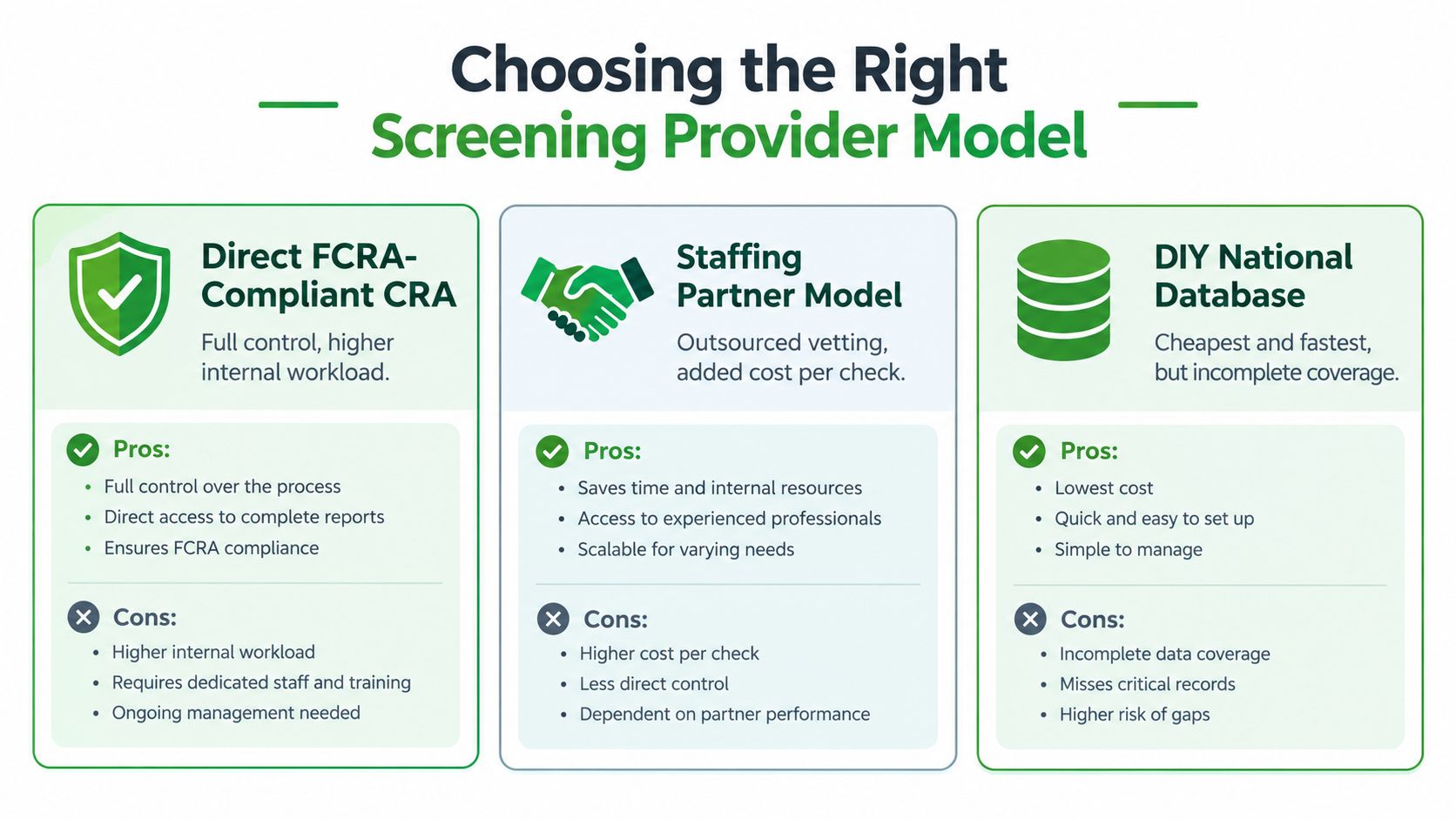
Compare the operating trade-offs
In-house screening gives staff control over searches and records. It also makes them responsible for selecting sources, matching identities, securing data, issuing disclosures and authorizations, sending notices, and managing disputes. That burden grows quickly when coordinators process many applicants or lack experience reading court records. A database pointer is not a final finding, so staff must verify any potential match at the relevant source.
Government portals may provide direct access to official records, but they often require separate searches across jurisdictions. Different accounts, manual data entry, and inconsistent record formats can leave staff reconciling names, dates, and dispositions. The organization still needs a documented, FCRA-compliant process if those results influence a volunteer decision.
A specialized consumer reporting agency can combine searches with identity review and compliance support. Ask whether the provider is a licensed CRA, verifies pointer hits at the source, addresses incomplete identifiers, searches relevant registries and watchlists, and supports both pre-adverse and final adverse-action notices. Confirm who remains responsible for each step.
The Sterling Volunteers report found that 53.61% of surveyed organizations used an external third-party provider, 26.31% went directly to a government source, and 15.98% conducted checks in-house. It also reported that 92% used criminal record checks and 73% used a sex offender search. These figures describe common approaches, not proof that every provider or workflow meets the same standard.
VolunteerBadge is one provider model built for nonprofit screening, combining national, county, state, and federal searches with disclosure, authorization, and adverse-action support. Review the contract, source coverage, dispute process, and assigned legal responsibilities before selecting any provider.
Building a Sustainable Screening Policy
A sustainable screening policy gives coordinators a repeatable way to handle database pointers, identity gaps, and verified records. Start with each volunteer role, then match screening and approval requirements to the access and risk involved.
A written policy should answer the question volunteers ask most often: why is this check required? The Cornell review provides useful context, but your policy must translate that context into clear role-based expectations. State the legal basis, the information you may review, and how the organization will protect applicants from decisions based on an unverified database hit.
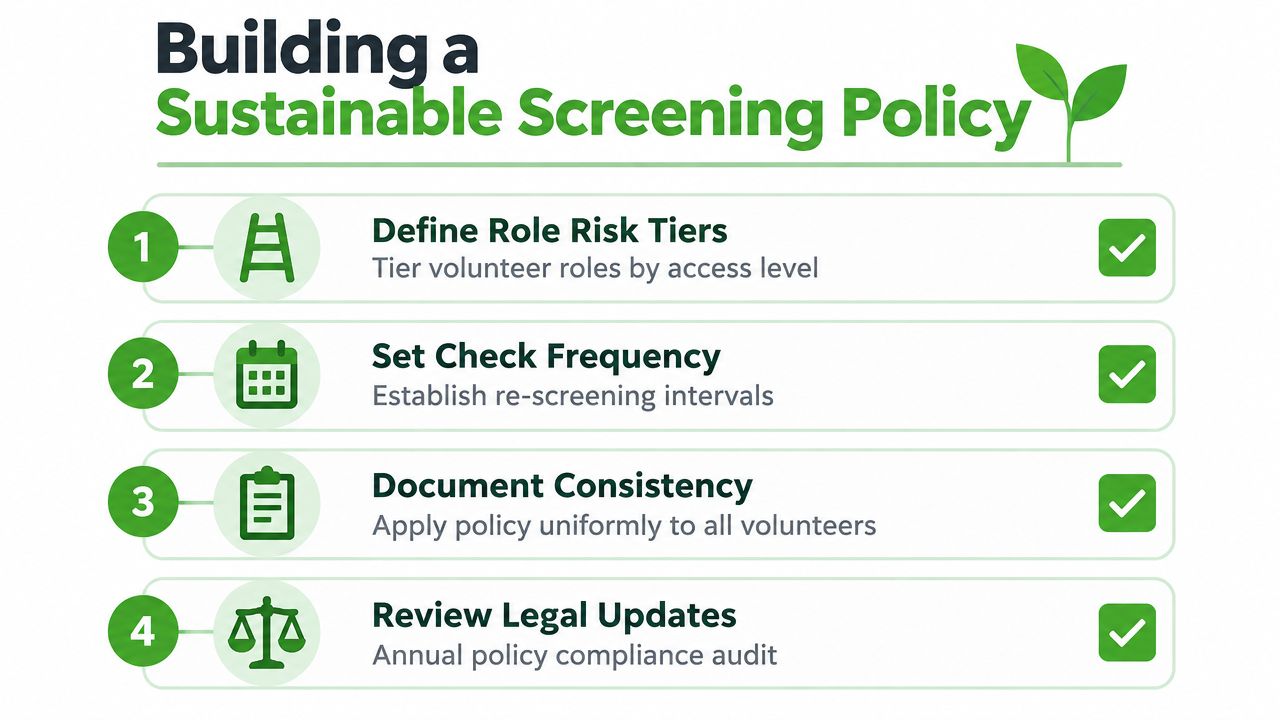
Build the policy around four decisions
Define role risk tiers. Separate supervised, low-access assignments from roles involving children, vulnerable adults, transportation, money, medications, or confidential information. Specify the searches, review standards, and approval authority for each tier.
Set check frequency. Decide when the initial check occurs and when higher-risk roles require rescreening. Record the schedule and apply it consistently.
Document the decision process. Use the same disclosure, authorization, identity-verification steps, review criteria, dispute process, and decision record for comparable roles. Restrict access to authorized staff and store records securely.
Review legal updates. Assign responsibility for an annual review of federal, state, and local requirements, provider practices, retention rules, and fair-chance requirements.
Explain the process before requesting consent. Tell volunteers why screening is required, which sources may be searched, who reviews results, how disputes work, and which role-specific factors affect a decision.
Measure performance by process quality. Every applicant should receive the same steps, every possible match should be verified at the source, and any adverse decision should follow the required notice and dispute workflow.
VolunteerBadge supports nonprofit screening with written disclosure and authorization, address-history review, source-based criminal searches, and automated pre-adverse and final adverse-action notices. Visit VolunteerBadge to review a workflow for consistent, FCRA-aware decisions.
