
Sex Offender Registry Wisconsin: Search Steps and Limits
Sex Offender Registry Wisconsin explained: how to search it, what each result field means, and what a clean search does not prove for volunteer screening.
On this page
Only about 24.3% of Wisconsin's registered population was under active community supervision in the June 30, 2021 snapshot published in the Wisconsin Department of Corrections' fiscal-year report. That distinction matters: a registry listing and active supervision aren't the same thing, and neither tells a volunteer coordinator everything needed to make a placement decision.
A Wisconsin sex offender registry search answers a narrower question: whether the identifiers you searched return a public registry record at that moment. Responsible screening means searching the official source, resolving possible matches, understanding the record, and documenting a decision about the actual volunteer role. A clean result isn't proof that someone is safe.
Table of Contents
- How to Search the Wisconsin Registry Step by Step
- Who Is Listed on the Wisconsin Registry
- What Each Registry Field Tells You
- How to Decide When a Name Matches a Record
- What a Clean Search Cannot Confirm
- Why Local Residency Rules Change the Answer
- Set a Rechecking Policy Before the Next Volunteer Starts
How to Search the Wisconsin Registry Step by Step
The Wisconsin Department of Corrections maintains the registry, according to the Wisconsin Legislative Council's registry information memorandum, which explains that it was established in June 1997 following Wisconsin Act 440. Start with that official source rather than a copied list, an old download, or a search-engine preview.
Registration coverage follows statutory eligibility and registration status. It isn't another view of current court cases, so don't substitute a court-record search for a registry lookup.
Follow a consistent search sequence
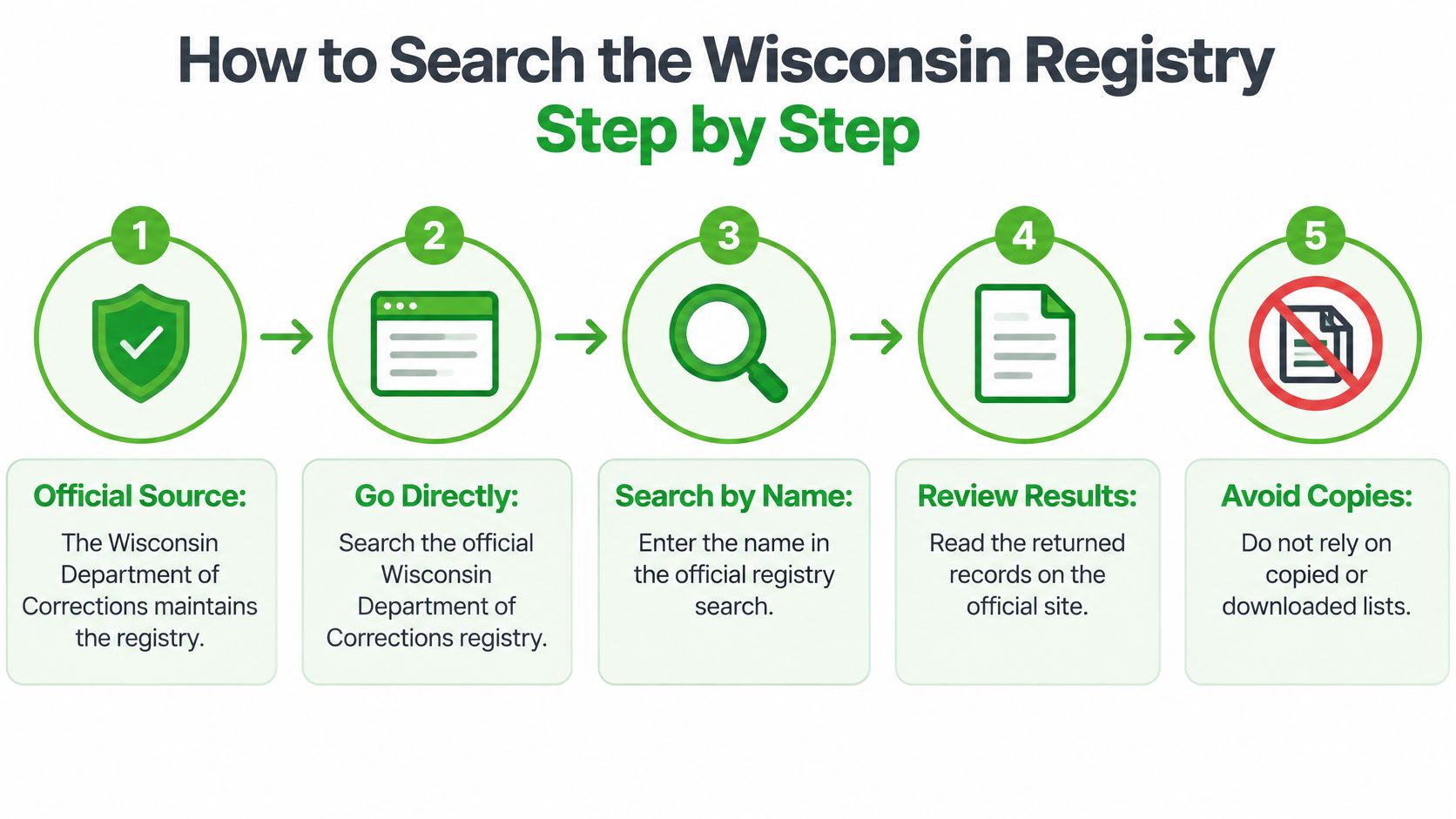
Open the official registry search. Go through the Wisconsin Department of Corrections website to its public sex offender registry. Confirm that you're using the department's search service rather than an unrelated directory with a similar name.
Enter the applicant's full name. Use the spelling supplied on the application, including a middle name when the search supports it. Search known previous surnames separately so your notes show which names you checked.
Add supported identity information. Enter a date of birth or another identifier if the interface allows it. More identifying information helps distinguish applicants from unrelated people who share their names.
Use location filters deliberately. Apply city, county, or ZIP code filters only where offered and relevant to your question. Don't narrow an identity search to the program's neighborhood just because that's where the applicant wants to volunteer.
Open and compare each plausible result. Review the record against the applicant's identifiers, not merely the displayed name. A similar name is a reason to investigate, not a reason to label the applicant a registrant.
Preserve the search evidence. Save or print the result, including the date, time, search terms, and available record details. For a no-match result, preserve the search confirmation rather than writing only that the applicant passed.
Assign a review status. Mark an unresolved result as pending identity review instead of approved or excluded. Keep the search result separate from the eventual placement decision.
The infographic summarizes the official-source workflow.
Keep the search reproducible
A useful search record lets another authorized reviewer understand what you did without guessing. Include the source, identifiers entered, filters used, and whether you opened any possible matches.
Don't assume every search field described in an older guide remains available. Confirm the current search options and instructions on the official site before each use, and record any limitation that prevented a complete search.
Who Is Listed on the Wisconsin Registry
Wisconsin's registry contains people with different legal histories and monitoring statuses. Listing depends on a qualifying legal basis and an ongoing registration obligation, not just on whether someone is currently incarcerated.
The Department of Corrections' historical snapshot introduced above helps explain that distinction. Its registered population included adults and people whose cases involved a juvenile adjudication or minor classification, while active community supervision described a separate status.
Registrants by status at the June 30, 2021 snapshot
| Group | Registrants | Share of total |
|---|---|---|
| Adults | 25,263 | About 97.6% |
| Juvenile adjudication or minor classification | 620 | About 2.4% |
| Under active community supervision | 6,288 | About 24.3% |
| Total registrants | 25,883 | 100% |
These are historical figures from the Department of Corrections report, not a current registry count. The supervision row overlaps the population categories; don't add it to the adult and juvenile/minor rows as though it represents an additional group.
Say a youth-program coordinator opens a record and sees registration information but no clearly current supervision period. The coordinator shouldn't conclude that the record is invalid, nor assume that a supervising agent currently oversees the person. Registration and supervision need to be read separately.
Interpretation rule: A registry listing establishes a registration record. It doesn't establish that every listed person has the same history, restrictions, or current risk.
A confirmed listing therefore needs an individual review of the underlying offense, legal status, and proposed duties. The population totals can't tell you whether a particular applicant may transport participants, handle supplies, or attend a program site.
For organizations operating across state lines, Law Offices of Angel Lugo's registry guide from The Law Offices of Attorney Angel Lugo offers Connecticut-specific context. Treat it as a separate jurisdictional resource, not an explanation of Wisconsin eligibility or restrictions.
Before quoting the size of Wisconsin's registry in training materials or board reports, obtain the latest official figures. Train coordinators to distinguish registration, incarceration, and community supervision rather than treating those terms as interchangeable.
What Each Registry Field Tells You
Read a registry result as a collection of fields, not a single yes-or-no answer. Each field supports a particular comparison, and none should be stretched beyond what it records.
Wisconsin's notification framework connects registry information with places where a registrant lives, works, or attends school. The Wisconsin registry statute(e)1.) addresses information sharing and registry disclosures, including identifying, conviction, location, supervision, and registration information.
What each registry field tells you and how to use it
| Registry field | What it tells you | How to use it |
|---|---|---|
| Identity descriptors | Physical characteristics listed on the record | Compare with the applicant to support or question an identity match |
| Aliases and other names | Names the registrant has used | Search and compare every listed alias before deciding on a match |
| Registered address | Location recorded for the registrant | Compare with program locations as one input, not a final answer |
| Conviction statute | The statute under which the offense was recorded | Read the statute to understand the offense category |
| Conviction date and county | When and where the conviction was recorded | Compare with the applicant's history and relevant jurisdictions |
| Supervision dates | The recorded period of community supervision | Read the dates and confirm current status separately |
| Registry order information | Terms of the registration requirement | Confirm whether the requirement still applies |
Identity descriptors and aliases support identification. A listed alias may explain why an applicant's previous surname differs from the main name on the record. It doesn't resolve identity by itself, and physical characteristics shouldn't outweigh a clear conflict in stronger identifiers.
An address is a recorded location, not independent proof of where someone is physically present today. Use it to identify questions requiring verification, rather than declaring that proximity to your program permits or prohibits volunteering.
Separate offense information from status information
The conviction statute identifies the legal offense category. Read it before interpreting a short offense label, and obtain the underlying disposition when needed to understand what the court decided.
Conviction date and county help locate the relevant case and distinguish records. They don't supply a complete account of the conduct or explain every later legal development.
Supervision dates and registry-order information address different obligations. A supervision period may have ended while a registration requirement remains, so don't treat the end of a displayed date range as permission for unrestricted participation.
Finish the review with a field-by-field note: what matched, what conflicted, what wasn't displayed, and what remains unverified. Keep the disposition and jurisdiction with that note, then use a written, role-specific decision policy rather than an impression formed from the profile.
How to Decide When a Name Matches a Record
A name hit starts a review; it doesn't settle identity. Even an exact name and date-of-birth match deserves verification before the organization makes a decision affecting an applicant.
Search freshness matters too. Under Wisconsin Administrative Code DOC 332.06, registrants provide information annually or at 90-day intervals, depending on the applicable requirement, and changes to required information must generally be reported within 10 days. Use a current search rather than assuming a previously saved record still describes the same circumstances.
Resolve identifiers before evaluating the role
| Situation | What it usually means | Next step |
|---|---|---|
| Name and date of birth both match | Possible identity match | Hold for verified identity review before any decision |
| Name matches, date of birth differs | Probably a different person | Document the verified mismatch and close the match if no conflicting evidence remains |
| Name matches, identifiers missing | Search is incomplete | Request more identifiers before deciding |
| Identity confirmed as a listed registrant | Listing confirmed | Apply the written, role-specific policy and record the reasons |
Begin with the strongest available identifying information. Compare the applicant's verified details with the record, and resolve discrepancies rather than selecting whichever field supports the easiest conclusion.
For example, a common name with a different verified birth date usually points to another person. Record that reason for closing the possible match; don't leave a vague notation suggesting the applicant has an unresolved registry record.
Identity verification requires a deliberate comparison of the actual record.
Keep identity and placement decisions separate
When identifiers are missing, ask the applicant for the information needed to complete the comparison through your approved screening process. Don't request unnecessary sensitive information by ordinary group email or circulate the registry profile among program volunteers.
Once identity is confirmed, document the offense, conviction county, statute, and verified supervision status. Then evaluate the proposed duties, access to participants, applicable restrictions, and organizational policy.
Decision boundary: Confirming whose record it is and deciding whether that person may perform a particular role are separate tasks.
A confirmed listing requires policy evaluation, not an unsupported automatic exclusion. Equally, a coordinator shouldn't waive an applicable restriction because the applicant is well known to the organization.
When using a consumer report, have counsel confirm the applicable disclosure, authorization, dispute, and adverse-action procedures before acting. Don't assume a public lookup and a screening company's report create identical procedural responsibilities.
Schedule identity review before the volunteer's start date, with enough room to request clarification. While a material match remains unresolved, keep the application pending rather than allowing the person to begin duties that haven't been approved.
What a Clean Search Cannot Confirm
A clean search means no matching public record was found using the search you performed. It doesn't establish that the applicant has never committed an offense, has no relevant criminal history, or presents no safeguarding concern.
Public access also isn't the same as access to the complete information held by authorities. The Wisconsin Legislative Council's issue brief on sex offender registration and notification explains the public-disclosure framework and its limits.
Separate the gaps
- Identity coverage. An incomplete name history, misspelling, or missing identifier can prevent a useful comparison. A no-match result doesn't prove the person couldn't be listed under another recorded identity.
- Timing. Your saved result describes the lookup you completed, not changes occurring afterward. A recent location change may also require clarification rather than an assumption that the displayed address is current.
- Public visibility. A public profile exposes selected information. An absent field isn't proof that the department holds no information about that subject.
- Jurisdiction. A Wisconsin lookup doesn't clear records in other states. Someone listed elsewhere may not appear in the Wisconsin results you reviewed.
Don't equate a completed search with ongoing monitoring. Unless you've verified exactly which events an alert service covers, don't assume it will notify you about later employment, school attendance, or other changes relevant to your program.
A church may search an applicant before a seasonal event and later assign that person to an ongoing youth program. The original result doesn't evaluate the new responsibilities or confirm that nothing has changed since the lookup.
Use broader screening without promising certainty
For volunteers with an out-of-state history, define a multistate search scope rather than repeating only the Wisconsin lookup. A national sex offender registry search guide can help coordinators distinguish a state-specific search from broader registry coverage.
Registry research should complement relevant county, state, and federal criminal-record research. Those sources answer different questions, and none replaces references, training, supervision, conduct rules, or a clear reporting process.
Use precise clearance language in internal files. Record that the specified searches were completed and reviewed under your policy, rather than describing the volunteer as proven safe. That wording keeps the organization's conclusion aligned with the evidence it obtained.
Why Local Residency Rules Change the Answer
A registrant's recorded address doesn't answer whether that person may volunteer at your program. Residency restrictions, supervision conditions, and restrictions on activities are distinct questions.
The Wisconsin Legislative Council's memorandum on residency restrictions explains that restrictions can arise through state law, local ordinances, and supervision conditions, with most residency restrictions imposed by municipalities. Local ordinances commonly address proximity to schools, daycares, and playgrounds.
Start with the actual locations
Use a location-first checklist before deciding whether a proposed arrangement is permissible:
- Identify the municipalities. Record the exact municipality of the program site and the volunteer's home. Don't rely on a postal city name or county alone.
- Review the applicable rules. Read the relevant ordinance and distinguish rules about residing somewhere from rules about entering a place or participating in an activity.
- Clarify individual conditions. When lawful and necessary, seek confirmation from the supervising authority about conditions affecting the proposed duties.
- Describe participant access. Specify whether the volunteer would encounter children, enter restricted spaces, transport participants, or communicate directly with them.
- Document the determination. Record who reviewed the rules, which location and duties were considered, and any unresolved questions requiring legal advice.
A general guide to sex offender registry restrictions can help organize the questions. It shouldn't replace the applicable local ordinance or an individual's actual supervision conditions.
Evaluate each site on its own facts
Say a faith ministry operates sites in municipalities on opposite sides of a county line. A volunteer proposes sorting donated goods at one site and assisting with a family event at the other.
Those arrangements involve different locations and different participant access. Approval for the warehouse task shouldn't automatically authorize attendance at the family event, and a residence-related rule shouldn't be treated as an employment prohibition without reviewing its wording.
Permission to live at an address isn't permission to perform every volunteer activity nearby.
Give reviewers a concrete role description instead of asking only whether a registrant can volunteer. Include the site, schedule, participant population, duties, supervision arrangements, and access boundaries.
A documented determination for each location is more defensible than a blanket assumption that one statewide registry profile supplies the answer everywhere. If a material legal question remains unresolved, don't improvise permission.
Set a Rechecking Policy Before the Next Volunteer Starts
Adopt the screening policy before reviewing the next difficult application. Coordinators need a repeatable process, not a fresh set of rules whenever a result feels uncomfortable.
The policy should connect screening requirements to actual access. A volunteer handling donations without participant contact and a volunteer transporting vulnerable participants shouldn't receive identical assignments merely because both completed the same application.
Put responsibility and evidence in writing
- Define screening by role. Specify which duties require registry searches and which require broader criminal-history screening. Describe the access that justifies each requirement.
- Write the match rule. Require verified identity review, documented findings, and an authorized decision-maker. Include a route for correcting inaccurate or disputed information.
- Standardize the file. Keep the search timestamp, identifiers used, results, review notes, and final role decision together. Limit access to people responsible for screening and placement.
- Choose a recheck schedule and event triggers. Set an interval appropriate to your program and applicable requirements. Require an additional review when a volunteer moves, changes duties, or joins a new site.
- Assign an owner. Name the person responsible for renewal dates, unresolved reviews, and escalation. Define what happens when a check expires before renewal is complete.
Make renewal an operational task
Set the next review date when you approve the placement, not when someone remembers to audit the roster. Include temporary volunteers and returning seasonal participants in the same responsibility structure.
Don't confuse a scheduled recheck with continuous surveillance. Your policy should explain what volunteers must report between checks and who evaluates a change in duties or circumstances.
Draft the policy this week, assign its owner, and obtain board or leadership approval before the next volunteer starts. A documented process won't eliminate uncertainty, but it will make clear who reviewed the evidence, what they decided, and when another review is due.
We offer volunteer background screening that combines criminal-record research with sex offender registry searches across all states. Our re-screening alerts arrive 30 days and 7 days before a check expires, and a one-click re-run reuses the volunteer's existing profile. Visit VolunteerBadge to connect your written screening and renewal policy with a practical checking workflow.
