
What Is a Social Security Trace? a 2026 Guide
What is a social security trace? Learn what address history it reveals, how it differs from a criminal background check, and its limits.
On this page
A Social Security trace is an identity-verification search that uses an applicant's name, Social Security number, and related identifying information to locate address-history records and names associated with that identity. It is a pointer to records, not a criminal check or proof of identity, and it is not evidence that a person has a criminal record or that every address belongs to the applicant.
You're a volunteer coordinator staring at an application for a new youth mentor. The form lists one address in your county. The applicant passed a gut-check interview. Now you're asked whether to spend money on a background check, and you wonder what a Social Security trace will tell you. The honest answer: it will show you where to look, not what you'll find. Think of it as a coverage map. It flags counties, states, names, and date ranges that should feed your search plan. That map matters because criminal records live in specific courthouses, and you can't search a courthouse you don't know exists.
Table of Contents
- What a Social Security Trace Actually Is
- What Address History a Trace Can Reveal
- How a Trace Differs from a Criminal Background Check
- How Nonprofits Turn a Trace into a Search Plan
- Where a Social Security Trace Stops Being Useful
- What to Do When a Trace Comes Back Unexpected
What a Social Security Trace Actually Is
A Social Security trace is an identity-verification search that uses a name, Social Security number and related identifiers to locate address-history records and names linked to that number. Screening providers run it as an investigative starting point: it surfaces the records associated with an identity so a reviewer knows where a deeper search should go.
A trace works like a library index. The index tells you which shelves may hold a file. It does not pull the file, read the pages, or tell you what the file says. When a trace returns an old address in a county three states away, that county becomes a shelf worth searching. The criminal background check is the step that opens the folder and reads the court record.
The Social Security number earned this pointer role because it has been embedded in American records for nearly a century. The Social Security Administration began assigning nine-digit numbers in 1936 to track workers' lifetime earnings and administer benefits, and the identifier spread quickly through federal systems. Over the following decades it became a standard identifier well beyond Social Security itself, so the same number now sits in credit, banking, utility, school, property, and employment records. Each of those records can carry an address, and a trace gathers them under one identifier.
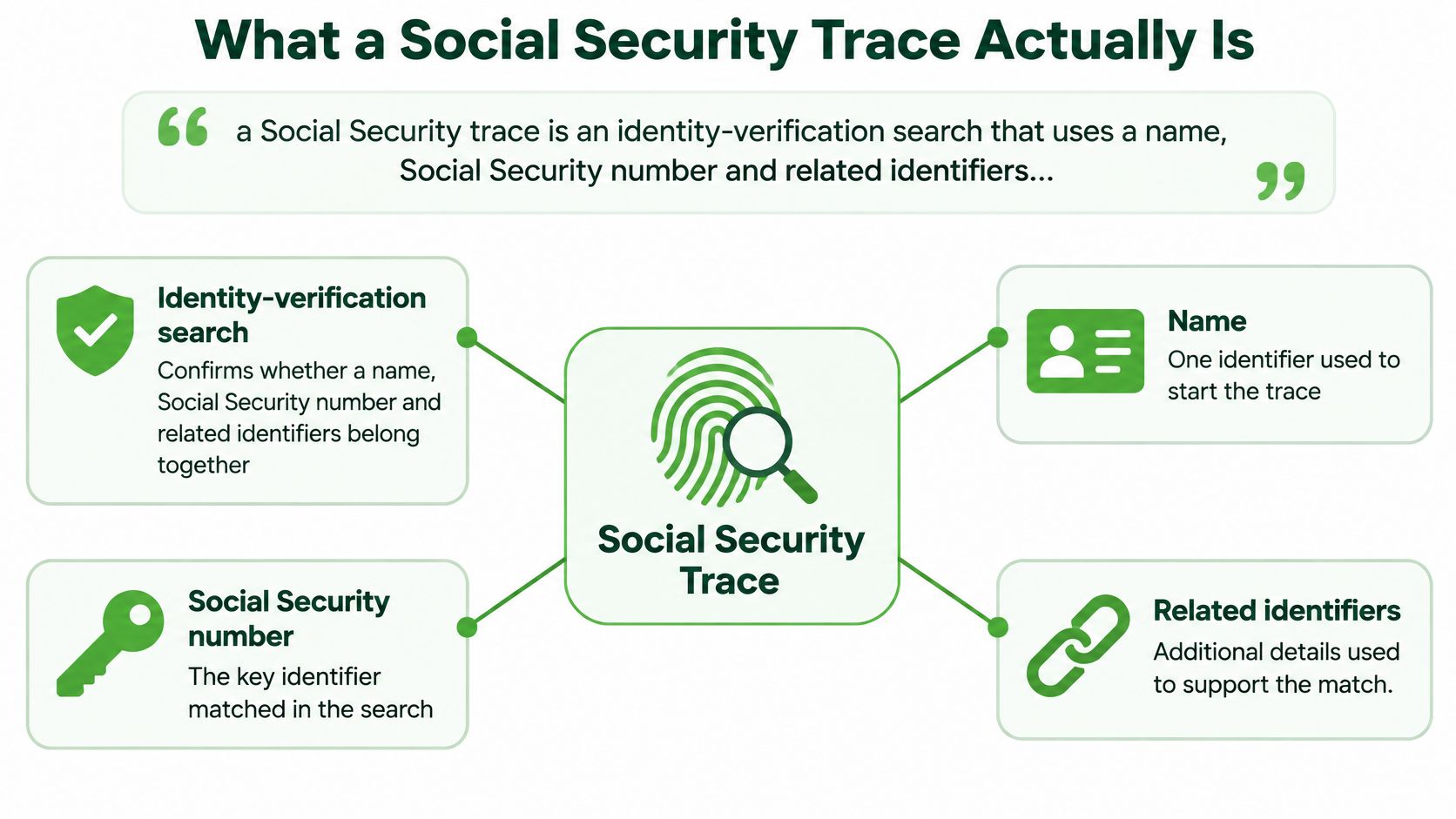
A trace typically returns four outputs: names and aliases, addresses, date gaps, and geographic clusters. None of those outputs is a conclusion on its own, and some will be outdated or point at records that do not belong to your applicant at all. That is normal for a coverage map. A trace is a map of where to look next, not a verdict on the person.
What Address History a Trace Can Reveal
A trace returns a bundle of pointers, not a single answer. Read it like a map legend: each field narrows where you should search, and no field settles the question by itself. The table below breaks down the standard outputs.
| Trace output | What it typically shows | What it does not tell you |
|---|---|---|
| Names and aliases | Names associated with the SSN in credit, utility, banking, property, school or other records | That every name is an alias the applicant has used or that any name is current |
| Addresses | Street addresses with reported date ranges, often spanning several years | That every address is a residence or belongs to the applicant |
| Address gaps | Periods with no reported address or overlapping dates | Why the gap exists or that the applicant hid something |
| Geographic clusters | Counties and states where the applicant appears to have lived or received mail | That a criminal record exists in those jurisdictions |
| SSN match signal | Whether the number appears in records with a loosely matching name and date of birth | That the SSA has verified the number or the applicant's identity |
Start with names. A maiden name, a former married name, or a hyphenated variation is common and usually explained in one sentence. A name you've never seen attached to the applicant deserves a question, not an accusation. The same SSN can appear in records with a household member's name, a data-entry error, or a name a former employer mangled. Treat every name as a lead to follow, never as a lie to punish.
Addresses deserve the same restraint. A credit-header address is often a mailing address, a former residence, a relative's home, or a data-entry mistake. If the trace shows a P.O. box in a state where the applicant never lived, ask how that box came to be there. Don't convert the address into a conclusion about residency.
Date ranges are the easiest field to misread. A gap between two reported addresses could mean the applicant was unhoused, studying abroad, living with family, or off the grid for a few years. It could also mean the database that held that period's records stopped reporting. A gap is a question to ask, not a black mark to log.
Geography is the highest-value output for a screening coordinator. A cluster of counties in a state the applicant never mentioned is a coverage clue. It tells you which courthouses to add to the criminal search. If you're pulling records for a volunteer program in Ohio, for example, county-level address history can point you toward jurisdictions the application didn't reveal. Where a local address history check gets thin, requesting North Carolina voter files from doornoc can supplement gaps in a coverage map, especially for volunteers who've moved across state lines. A full address history background check can show you what a standard trace misses, but the trace itself is just the first pass.
Reading rule: no single field is a conclusion on its own. Treat each item as a hypotheses to test, not a fact to record.
The strongest signal from a trace is an address or name the applicant didn't disclose and can't explain. Even that signal needs verification before anyone acts on it.
How a Trace Differs from a Criminal Background Check
A trace and a criminal background check do different jobs. Neither replaces the other. The trace draws a map of possible counties and states. The criminal check goes into those places and looks for court records. You'd never send a search party into the woods without a map, and you'd never frame a map as proof that the woods are safe.
| Question | Social Security trace | Criminal background check | Why the difference matters | Best use |
|---|---|---|---|---|
| Primary purpose | Links an SSN to names and addresses | Finds criminal records in courts and registries | One maps coverage while the other finds cases | Plan where to search |
| Data sources | Credit header, utility, banking, property, school and similar databases | County, state and federal courts, sex offender registries and watchlists | Different databases answer different questions | Build a search plan |
| Output | Address history, name variations, gaps and possible matches | Case records, charges, dispositions and registry matches | A trace cannot confirm or clear a criminal record | Locate records |
| Coverage | Nationwide pointer to possible jurisdictions | Only the jurisdictions and databases searched | A national criminal check is not every courthouse | Verify county coverage |
| Identity proof | No, it is a pointer search | No, records still need identifier matching | Both need date of birth, name and human review | Review every match |
| Legal role in screening | Coverage and discrepancy tool, not an adjudication | Consumer report when used for employment or volunteers | FCRA duties attach to the report and the decision | Follow FCRA steps |
| Best next step | Decide which counties and states to search | Verify any possible record before acting | Use them together, not as substitutes | Sequence the work |
Two points in that table can't be carried by the table alone. First, a trace can point to a county but cannot tell you whether a case exists there. It has no access to court dockets. Second, a criminal check is only as complete as the jurisdictions searched. If the application hides three years in Nevada and the trace doesn't return a Nevada address, a Nevada case will never surface in a one-county search. That's why address history matters before you spend a search credit.
The usual volunteer screening sequence is: pull the trace, compare it with the application, add missing jurisdictions to the criminal search, then verify any possible record by name, date of birth, and other identifiers. If you want detail on what a criminal search returns, a guide to what a criminal background check looks like is worth reading before you run the check.
The verdict is this: use the trace to decide where to look, and use the criminal check to find out what is there.
How Nonprofits Turn a Trace into a Search Plan
Before any trace runs, collect the applicant's written disclosure and authorization, and confirm your organization has a permissible purpose for the check. Without those, the trace can't inform an employment or volunteer decision legally, and you've lost your paper trail. SSN validation is a separate function from a trace. The SSA provides employer-facing services that verify whether a name and SSN match its records, including a consent-based service for enrolled private organizations and government agencies. A commercial trace should never be represented as direct SSA verification, according to the SSA's randomization FAQ.
Once authorization is in hand, use the trace as a coverage-control and exception-management mechanism. A returned address history can expand the search plan to counties and states that aren't apparent from the current application, while gaps, conflicting dates, or unfamiliar addresses can trigger manual review or a request for clarification before a report is completed.
Here's a worked example. A youth sports volunteer lists two addresses in the same county over seven years. The trace returns a third address in Ohio for 2019 to 2021. The coordinator adds that Ohio county to the criminal search and asks the applicant for a written explanation of the missing period. If the applicant says they lived with a family member during a job transition, the county search still runs, and the explanation lives in the file. If the applicant can't explain the address, the coordinator investigates the discrepancy before deciding anything.
Four moves turn this into a repeatable process:
- Compare line by line: set the application next to the trace and mark every name, address, and date range that doesn't match.
- Add credible counties and states: every jurisdiction the trace surfaces goes into the criminal search plan, whether or not it made the application.
- Flag gaps and overlaps: send a written request for explanation when a period is missing or two addresses conflict.
- Document the matching logic: record which identifiers you used, which discrepancies you found, and how you resolved each one. Preserve the disclosure and authorization records.
Practical rule: an address association may be a residence, mailing address, household member, data error, or identity theft. It should not support an adverse decision on its own.
The SSA guidance is explicit on this point: the output should be interpreted probabilistically, and trace-derived information that contributes to a consumer report or decision carries FCRA permissible-purpose, accuracy, reinvestigation, and adverse-action obligations. For a step-by-step process that covers this workflow, see volunteer screening guidance. The trace tells you where to spend the next search, not whom to reject.
Where a Social Security Trace Stops Being Useful
The most common assumption about a trace is also the most dangerous: that it verifies identity. It does not. A trace is a coverage map, not a verdict. It links an SSN to possible names and addresses pulled from credit, banking, utility, school, and property databases, so it can show which jurisdictions deserve a real search. It cannot confirm that the number is valid, that it belongs to the applicant, or that the address list is complete. Checkr's help center draws the same line: a trace can identify where follow-up county, state, or federal searches may be appropriate, but it cannot by itself establish that a volunteer has or lacks a criminal record.
| Common belief | What is actually true | What to do instead |
|---|---|---|
| A trace verifies the applicant's identity | It links an SSN to possible names and addresses; it is not SSA verification | Confirm identity with government ID and date of birth |
| Every address belongs to the applicant | An address may be a mailing address, a household member, a data error or identity theft | Ask about unexplained addresses before concluding anything |
| An address gap means the applicant hid something | Gaps can come from incomplete data, name changes or unreported records | Request a written explanation and check the missing jurisdiction |
| The SSN prefix shows where the applicant was born | SSN randomization began in 2011, so the first three digits no longer reliably indicate issuing location | Do not use the prefix as a location test |
| A trace can clear or flag a criminal record | It finds no criminal record by itself; it only points to places to search | Run criminal searches in the relevant jurisdictions |
| A clean trace means the SSN was never misused | A clean trace does not prove there was no identity theft or misuse | Separate an ordinary mismatch from suspected identity theft |
Two habits push the map past its edge. The first is the prefix test, the old check of whether the number matches the applicant's state. Since randomization, the first three digits no longer show where a number was issued, so any conclusion built on geography is a false territory claim. The second is exact-name matching. Dropped middle initials, maiden names, and hyphens create small variations that cause matching systems to miss records that exist and to surface records that belong to someone else. A missed match removes a county that needed checking; a false one sends the search to a jurisdiction with nothing to find.
Practical rule: a clean trace is not proof that an SSN has never been misused, and an inconsistent trace is not proof of criminality.
The trace earns its place by showing where to look. Ask it to prove who someone is or whether they have a record, and it has nothing left to give.
What to Do When a Trace Comes Back Unexpected
When a trace returns something you didn't expect, separate three scenarios before you react. The pathway from trace to decision is a series of gates, and each gate changes what you do next.
Scenario 1: an ordinary database mismatch. The address is a typo, a former mailing address, or a name variation. Ask the applicant to explain it, correct the file, and continue. Most discrepancies fall here.
Scenario 2: a screening record that needs review. The trace surfaces an address or name tied to a jurisdiction with a possible criminal record. Verify name, date of birth, address, and jurisdiction in the relevant court or registry before acting. Then follow FCRA pre-adverse and adverse-action steps if the information contributes to a decision. Never reject on the trace alone.
Scenario 3: suspected identity theft. Unauthorized SSN use can affect employment and tax records, government benefits, credit, loans, medical information, and other accounts. The risk has grown sharply: the FTC reported that older adults' reports of losing at least $10,000 to impersonation scams increased more than fourfold from 2020 to 2024, while reports involving losses above $100,000 rose nearly sevenfold and reported losses in that category increased eightfold to $445 million, according to a Bitdefender analysis of Social Security identity theft. When identity theft is a real possibility, the FTC directs consumers to report through IdentityTheft.gov, and the Social Security Administration recommends protective measures such as its direct-deposit fraud-prevention block and contacting the FTC when an SSN is used to open accounts or make purchases.
A clean trace is not proof the SSN was never misused. If the trace is suspicious, tell the applicant the result may reflect misuse rather than wrongdoing, then direct them to the identity-theft resources.
For a nonprofit, the next step is consistent documentation. Make the trace the first step in a screening workflow with a written record of each discrepancy and its resolution. Identity matches can be anchored to an SSN trace, address history, and date of birth, with government ID and a live selfie, and a free address history check is included with every volunteer application at no extra cost. A workflow that runs through VolunteerBadge keeps that documentation step tied to the organization's own records.
The decision rule is simple: investigate the discrepancy, not the person's character. A trace that surprises you is a data event, not a moral judgment.
A Social Security trace belongs at the start of every volunteer screening workflow, not as the final word but as the map that decides where you search next. VolunteerBadge includes an SSN trace with every check, pulls address history the moment an applicant submits, and flags gaps or forgotten addresses before you spend a search credit, so an incomplete map never becomes an expensive surprise. When you're ready to turn a coverage map into a defensible screening process, visit VolunteerBadge to see how the trace, the search, and the FCRA steps fit together in one workflow.
