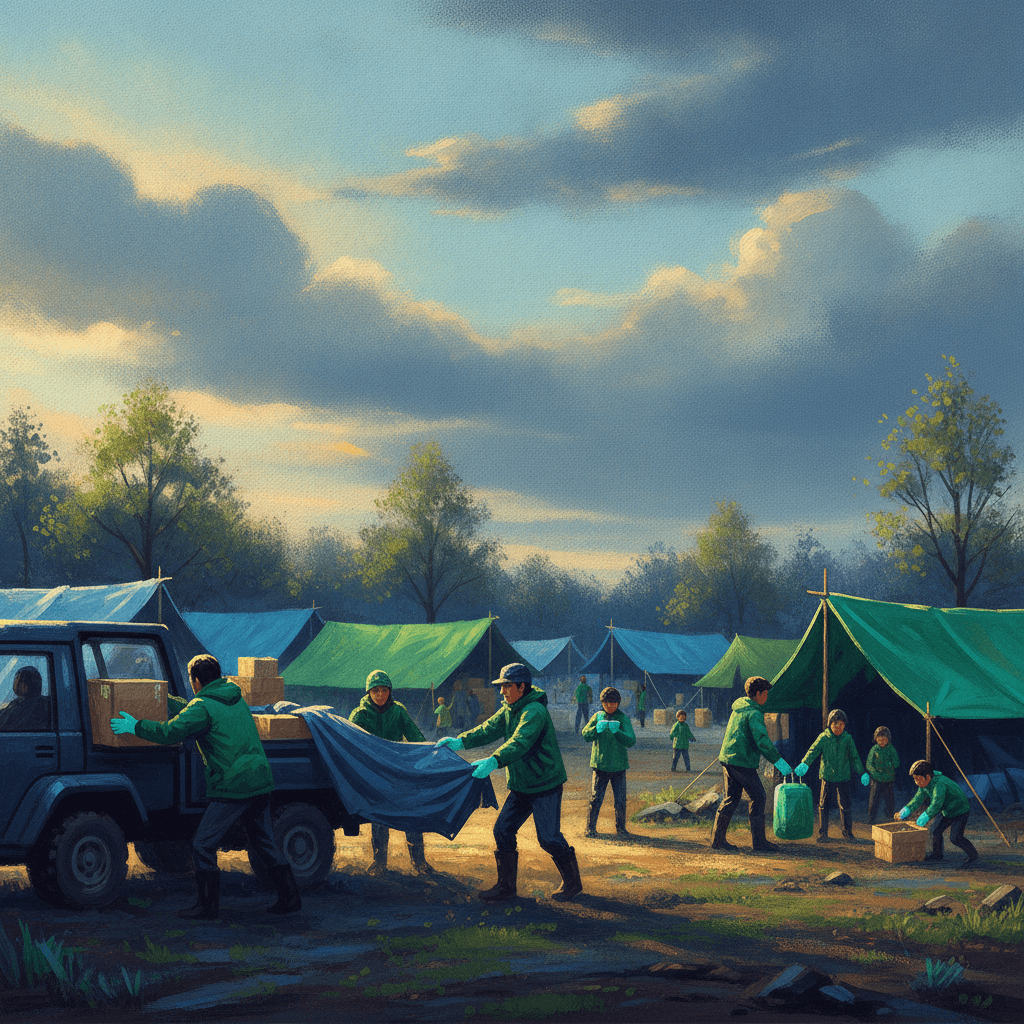
How to Plan, Launch & Run a Hurricane Relief Volunteer Program: The Complete Nonprofit Leader's Guide
Step-by-step guidance for nonprofit leaders planning volunteer hurricane relief: timelines, budgets, recruiting, screening, safety, logistics, and day-of execution.
Hurricanes arrive with little warning and leave behind months of work. If you lead a nonprofit, you may be asked to mobilize volunteers for relief before you have a plan, a budget line, or a single trained shift lead. This guide is for two kinds of readers: aspiring or early-stage leaders who want to build a hurricane relief effort from zero, and experienced directors who want to tighten up a program that has grown faster than its processes. By the end, you should be able to scope a relief effort, build a planning calendar, budget and raise money, recruit the right people in the right numbers, assign roles, screen and protect volunteers, run logistics, and execute a shift from the first briefing to the final debrief.
Throughout, we'll rely on the public guidance that emergency managers and experienced disaster organizations have published, along with practical lessons from volunteer leaders. For the numbers behind the recommendations, see the data behind this in our hurricane relief volunteer statistics report. If you are new to running volunteer operations at all, you may also want to start with our broader nonprofit volunteer management primer before reading the sections on disaster-specific execution.
Table of contents
- Why hurricane relief matters and who it serves
- Setting goals and defining scope
- Timeline and planning calendar
- Budgeting and fundraising
- Recruiting volunteers and marketing your effort
- Roles and structure
- Volunteer screening, waivers, and safety
- Logistics and operations
- Community outreach and partner coordination
- Day-of execution and the run of show
- Measuring impact and thanking volunteers
- Common mistakes and advice for scaling organizations
- Screen your volunteers the easy way
- Frequently asked questions
- Sources & references
Why hurricane relief matters and who it serves
Hurricane response is really two jobs that happen on overlapping schedules. The first is immediate: getting water, food, shelter, and medical care to people while the storm is still fresh. The second is long-term: helping households and neighborhoods rebuild. Short-term efforts aim to restore essentials like water, food, and medical care, while long-term work focuses on rebuilding structures the storm destroyed. That long-term phase is easy to underestimate. FEMA has noted that long-term recovery can take up to five years. A nonprofit that plans only for the first week will leave its community short when the second and third years arrive.
Your effort will serve several groups at once: residents who have lost power, water, or housing; older adults and people with disabilities who need assistance getting supplies; families who are displaced into shelters; and the local organizations that already know the neighborhood. Volunteers themselves are a beneficiary too. Veteran disaster responders consistently say that a well-run shift is far more meaningful than a chaotic one, and that poorly supported volunteers can become a burden. Points of Light has warned that without proper training and mental health support, volunteers can become added challenges within a disaster site.
There is also a federal framework behind the volunteer question. Emergency management guidance has long recognized that unaffiliated, spontaneous volunteers are inevitable after a major storm, so they must be anticipated, planned for, and managed rather than ignored. In other words, the realistic question is not whether people will show up. It is whether your organization will have a structure ready when they do.
Setting goals and defining scope
Before you recruit a single volunteer, decide what your effort is actually going to do. Hurricane relief programs fail most often when they try to do everything: distribute supplies, run a call center, gut homes, staff a shelter, and fundraise, all with a team of twelve. Define your scope using three questions.
- What phase are we in? Immediate response (meals, water tarps, supply distribution, debris clearing) needs very different volunteers than recovery work such as mucking out homes or repairing roofs. Phase determines who you need and how long they stay.
- Who is our service population? Name the neighborhoods, zip codes, or shelter sites. Identify whether you will serve households directly or route assistance through a partner agency that already holds client records.
- What is our capacity? Be honest about your staff hours, your vehicles, your storage space, and your existing relationships. A small organization that runs a clean, two-site supply distribution will do more good than one that promises six sites and delivers three.
Write these answers into a one-page operating charter. Include a one-sentence mission for the effort ("We will distribute cleaning kits and water to residents of the three neighborhoods on the east side for the next six weeks"), the start and end date you expect, your geographic boundary, and the three things you will explicitly not do. The "not do" list matters. It protects your volunteers from mission creep and gives you a clear reason to decline well-meaning requests that fall outside your lane.
Next, check whether your effort should be standalone at all. Experienced responders often find it more efficient to plug into an existing structure. In many places, a local Voluntary Organizations Active in Disaster (VOAD) group or community coalition already coordinates volunteers. FEMA's volunteer guidance encourages organizations to form and join disaster coalitions such as local VOADs and Citizen Corps councils to promote coordination between agencies. If a coalition exists, your goal may be to become a dependable partner with a defined role, not to run an independent operation.
Finally, write SMART-style targets for the effort. Examples include "distribute 2,000 cleaning kits in 30 days," "place 40 trained shift volunteers per week," or "close 95% of volunteer shifts with a screened, oriented person 24 hours in advance." Targets like these shape every later decision, from how many volunteers to recruit to how many shelters you can staff.
Timeline and planning calendar
Hurricane season in the United States runs from August through November, and residents of hurricane-prone areas are advised to stay alert during that window for significant storms. That means the best time to build your plan is in the off-season, when you have time to recruit, train, and sign agreements. The calendar below assumes you are preparing for the season ahead, with a compressed version for a storm that forms with a few days' notice.
| When | Focus | Key deliverables |
|---|---|---|
| Off-season (roughly December to March) | Partnerships and policy | Written MOUs with partner agencies, insurance review, liability waiver template, screening policy, roster system chosen |
| Eight to twelve weeks before season opens | Volunteer pipeline | Recruitment page live, application template built, first cohort of "standby" volunteers identified, training curriculum drafted |
| Six weeks before season | Readiness drills | Tabletop exercise with partners, equipment inventory, storage and transport confirmed, call tree tested |
| Four weeks before season | Training and screening | Background checks completed for core roster, orientations scheduled, shift-lead training finished |
| Storm watch (typically three to five days out) | Activation | Activate call tree, confirm sites and hours, send volunteer alert with safety instructions, pre-stage supplies |
| Storm passes (first 72 hours) | Assessment | Safety check of sites, damage reconnaissance, pause volunteers from unsafe areas, publish first shift schedule |
| Weeks one through four after landfall | Sustained response | Daily shift rhythm, weekly leadership huddles, supply reorders, screening of new arrivals |
| Months two through six | Recovery transition | Shift from supply distribution to rebuilding projects, hand off to long-term partners, plan for reduced volunteer pool |
| Post-event (within 30 days) | Closeout | Debrief, financial reconciliation, hours report, thank-you cycle, lessons-learned document |
A few notes on this calendar. First, the off-season work is the part most organizations skip, and it is the part that determines whether you can react quickly. Second, the storm-watch window is shorter than most leaders expect. If your call tree lives in one person's phone, you will lose time the moment that person is also evacuating. Third, post-event closeout deserves real time on the calendar. Donors, partners, and auditors will ask for records weeks later, and a team that disbands on day one of recovery has no institutional memory.
For a second layer of guidance on phased planning, the food pantry organizing guide walks through the same kind of distribution-site planning that many hurricane supply operations rely on, including flow design and inventory cycles.
Budgeting and fundraising
Most nonprofits underestimate the cost of a disaster response because they only count the things they buy. Real budgets also include time, transportation, insurance, and the administrative load of screening and record keeping. Build your budget in three columns: direct costs, in-kind contributions, and contingency.
The table below lists the categories you should budget for and what drives each cost. We deliberately do not publish dollar ranges here, because prices shift quickly with fuel, supplier availability, and regional labor markets. Get at least two written quotes for each major line item and update the figures when you activate.
| Budget category | What drives the cost | Planning notes |
|---|---|---|
| Supplies and relief goods | Quantity, local versus shipped purchasing, shelf life | Buy locally when you can; the most useful gift is often cash for purchasing what is actually needed |
| Transportation and fuel | Distance, number of vehicles, driver hours, rental versus owned | Confirm drivers' insurance and commercial coverage in advance |
| Storage and warehousing | Square footage, climate control, length of storage | Secure a backup site; don't assume a donated space will stay available |
| Volunteer support | Meals and water, shade or shelter, portable restrooms, first aid, parking | Volunteers who are hungry or hot make mistakes; budget for hydration and rest areas |
| Screening and compliance | Number of volunteers, background-check fees, identity verification, waiver printing | Use a per-check model so you pay only for volunteers you actually place |
| Insurance and legal | Event-specific riders, vehicle coverage, general liability, legal review of waivers | Ask your agent about emergency coverage riders before the season |
| Communications | Phone lines, text alerts, signage, printing, radios | Plan for cell congestion and budget for battery packs and radios |
| Contingency | Unplanned sites, extended operations, price spikes | Hold a meaningful reserve; relief budgets rarely end where they started |
Two budget principles deserve emphasis. First, volunteer time is real money even when no cash changes hands. Grant reporting and in-kind match tracking both benefit from careful hour logs. Nonprofits commonly multiply logged volunteer hours by the Independent Sector rate to produce a dollar value for impact reports. Second, a local partner may be able to match your volunteer hours toward a federal cost-share requirement. Volunteer time that is tracked and documented can count toward the local match required after federally declared disasters. Confirm the rules with your state emergency management office before you rely on this.
The arithmetic for screening costs is simple and worth doing early. With VolunteerBadge pricing at $5 per background check and no monthly fees, a relief roster of 200 volunteers screened once would cost $1,000 in checks. If volunteers pay their own fee, which is an option described later in this guide, your organization's cost can drop further. Compare that to a flat monthly software subscription that runs whether or not you activate, and you can see why a per-check model fits episodic disaster work.
Fundraising that works during an active storm
Donors want to help quickly, and the most effective gift is usually money. FEMA's public guidance says cash to trusted relief organizations is typically the fastest and most useful way to help, because those organizations know what is needed and can buy in bulk. South Carolina's emergency management division has similarly directed people to monetary gifts so that local organizations can buy exactly what survivors need. Build your appeal around that message. Explain specifically what a gift buys, such as cleaning kits, water, or a tarp, and avoid vague appeals that depend on donors guessing your needs.
Keep your fundraising simple during a response. Set up a single donation page, a text-to-give option if your platform supports it, and a clear thank-you sequence. Use the same page to recruit volunteers, because donors often become volunteers after the storm passes. Finally, be ready for in-kind offers. Ask partners to confirm the need before shipments arrive, and publish a current needs list that is updated daily during activation.
Recruiting volunteers and marketing your effort
Recruiting for hurricane relief is different from recruiting for a planned event. Demand arrives in surges, and the people who show up first are often people who have no training and no connection to your organization. Your job is to channel that energy into shifts that are safe, useful, and supervised.
Begin with the number you need. Divide your activation targets by realistic shift lengths and the number of volunteers each role requires. Then add a buffer. Volunteers drop out, and a meaningful share of people who sign up never arrive. Plan a reserve pool so you can fill gaps without scrambling. Build your recruitment roster in two tiers: a core pool of screened, trained volunteers who can deploy on short notice, and a surge pool who receive orientation and screening after they sign up.
Your recruiting message should answer four questions quickly: what is the need, what will I do, how long is the commitment, and how do I sign up safely. A good page is short. It lists the actual shift types, minimum age, physical requirements, and a clear statement that the work involves safety rules. Invite volunteers through a dedicated link so applicants enter the same process, and use a standard application template so every role collects the same information.
Channels that tend to deliver
- Existing supporters and board networks. Your most reliable first wave comes from people who already trust you. Email the list, call key board members, and ask each of them to name three people who could lead a shift.
- Partner organizations. Faith communities, service clubs, employers, and schools often have ready-made groups. Corporate volunteer programs are particularly valuable for weekday daytime shifts, and our corporate volunteer statistics summarize how employers tend to participate.
- Local volunteer centers and state networks. State service commissions and volunteer centers can publicize opportunities and help place people who want to help but do not know where to go.
- Social media with geographic targeting. Post short updates with a single call to action. Pin the signup link. Avoid posting large maps of damage that could create safety or privacy concerns.
- Local media and community radio. Radio and local TV still reach people without reliable internet after a storm. Coordinate messages with your emergency management office so you are not competing with official alerts.
A key message is that spontaneous help is welcome, but it must be coordinated. National Service guidance urges leaders to decide in advance how volunteers should get involved and how they should not. Planning should set those boundaries before the disaster rather than improvising them afterward. Publish them. Tell people not to self-deploy into damage zones, and invite them instead to register for a scheduled shift. Points of Light has similarly advised volunteers not to show up unannounced, because that can unintentionally impede the organization's ability to help people who need it most. Confirm that help is needed before arriving.
Setting expectations up front
Be explicit about the commitment in your recruiting page. Red Cross disaster deployments, for example, are typically two-week assignments that require travel outside a volunteer's home area, and adults must be at least 18 and able to leave their local area for that period, and must pass a background check and training. Your operation may be local rather than national, but the same principle applies: people commit more readily when they know the length, the location, and the physical demands.
Conversion matters too. Many people who sign up will need a second touchpoint before they show up. Send a confirmation within an hour, a reminder with the address and parking details the day before, and a short orientation video or packet. Track no-shows and follow up. A reliable reminder cadence can do more to protect your shift coverage than any additional recruiting push.
Roles and structure
Hurricane response fails when everyone is in charge of everything. The roles below give you a scalable structure. In a small effort, one person may hold two or three of them. In a large one, each role may need its own team.
| Role | Primary responsibilities | Who fills it |
|---|---|---|
| Incident or response director | Overall decisions, partner relationships, go/no-go calls on sites, media spokesperson | Senior staff member with authority and calm under pressure |
| Volunteer coordinator | Recruitment pipeline, screening status, roster, scheduling, volunteer communications | Staff person with volunteer management experience |
| Logistics lead | Supply inventory, vehicles, drivers, storage, reorders | Operations staff or an experienced logistics volunteer |
| Site manager | Daily operations at one location, safety walkthroughs, supervising team leads | Trained leader with on-site authority |
| Team lead | Direct supervision of 5 to 10 volunteers, task assignment, check-in and check-out | Screened volunteer with prior experience |
| Safety officer | Hazard identification, incident logs, first aid coordination, weather monitoring | Trained safety volunteer, ideally with first aid or emergency experience |
| Intake and registration | Sign-in, badge issue, waiver verification, orientation delivery | Volunteers trained in your forms and process |
| Client and resident liaison | Respectful communication with residents, privacy, referrals to partners | Staff or volunteers trained in confidentiality and trauma-informed contact |
| Records and reporting | Hour logs, incident reports, donation tracking, funder reports | Staff or a detail-oriented volunteer |
Two structural notes. First, span of control matters. Team leads should be responsible for a manageable group, usually a handful of people they can see and talk to, so that nobody is supervising an unmanageable crowd. Second, make sure your team leads are real leaders. Experienced volunteer administrators often recommend identifying the people who have both the skills and the drive to manage tasks and other volunteers, and then giving them a communication system that lets them delegate. You cannot be everywhere at once, so the system has to work when you aren't there.
Write a short position description for every role, including the ones that seem obvious. Each volunteer should receive a copy of their description so expectations are clear, a principle the same Points of Light guidance recommends for every position regardless of how small it seems. Keep descriptions to one page. They should name the role, the reporting line, the time commitment, the physical demands, and the escalation path for problems.
If you draw on federal disaster guidance for structure, the Federal Emergency Management Agency's own training for volunteer management covers how to identify, recruit, assign, train, supervise, and motivate volunteers, along with planning a reception center. FEMA's IS-244.b course is designed for exactly these skills and includes spontaneous as well as affiliated volunteers. Even a small nonprofit can borrow the logic of a volunteer reception center: one place where people check in, get oriented, and are routed to a role.
Volunteer screening, waivers, and safety
Screening is the part of disaster volunteering that most people would like to skip, and it is the part that protects your residents, your volunteers, and your organization. Disaster sites are chaotic, and many of the people you serve are vulnerable. The goal is not to create barriers for good people; it is to match each person to a role appropriate to their risk profile and to document that you did so.
Start with a written screening policy approved by your board before activation. Decide which roles require a background check, which require identity verification, and which can be completed on-site with supervision. Roles that involve entering homes, driving clients, handling medications, supervising children, or working alone with residents usually warrant a full check. Roles that are largely supervised and in public view may warrant a lighter standard. Put the decision logic in writing so every coordinator applies it the same way.
Know the legal framework before you rely on any report. In the United States, background screening is governed by the Fair Credit Reporting Act. If you use a third-party screening provider, you should understand the disclosure, consent, and adverse-action steps the law requires. Our FCRA adverse-action workflow guide explains those steps in plain language, and the 2026 guide to what screeners look for outlines the common categories reviewed. For a plain-English explanation of what a free check does and does not cover, see what a free FCRA background check really means. This guide is educational and is not legal advice; involve counsel when you design your policy.
Red Cross practice illustrates how a large responder approaches the question. Disaster volunteers complete an application and background check before a recruiter discusses placement. During a major Florida response in 2024, the organization reported that background checks would be conducted on all volunteers, even as it recruited quickly. Speed and screening can coexist when screening starts early and the process is organized.
Minors and vulnerable populations
If your effort involves youth, the rules tighten. Age minimums for disaster roles vary by organization and by chapter. One Red Cross chapter notes that disaster services require volunteers to be 18, while another states a minimum of 16 with parental involvement for some opportunities. Set your own minimum age, write it down, and never assume a partner's standard applies to you. Keep minors out of damage zones, separate them from unscreened adults, and require a parent or guardian signature on any participation form. For youth-specific planning, see our youth volunteer statistics for context on how younger volunteers participate.
Shelter and residential settings call for extra care. Red Cross leaders have noted that a licensed medical professional should be associated with every shelter, and that mega-shelters need more than one. Your organization may not run a shelter, but the principle transfers: any site serving vulnerable people needs a named responsible clinician or a clear medical escalation path before it opens. Keep a log of who was on site, when, and in what role.
Waivers, insurance, and incident records
Every volunteer should sign a waiver and liability acknowledgment, sign in and out of each shift, and receive documented orientation. Points of Light recommends that organizations confirm insurance coverage during emergencies, consider a rider, and document training for each volunteer. Have your insurance agent review the policy in the off-season, not during the storm. Ask specifically whether volunteers are covered, which vehicles are included, and whether an emergency rider is available.
Track incidents carefully. FEMA's guidance for local volunteer coordinators calls for recording and reporting any work-related accidents to the emergency operations center during briefings. Local coordinators are also expected to maintain a current contact list for the organizations working the disaster and to track volunteers by having them sign in on arrival. Adopt those habits even if you are not in an emergency operations center. An incident report written within 24 hours is far more useful than a memory reconstructed three weeks later.
