Skip to content

Nonprofit compliance in Colorado

What Colorado actually asks of an organization that uses volunteers — screening, reporting, liability, and registration — with every legal claim traced to the source that states it.

Sources verified August 21, 2026Screening rules reach: children, older adults & people with disabilitiesCharitable registration required

How to read this page

Want the deep read? The Colorado guide walks through each statute, which of your volunteers it reaches, which agency runs which check, and what organizations here get wrong.
Verified against a primary source
Federal or national framework — confirm your state detail
Not yet researched by us — go to the regulator
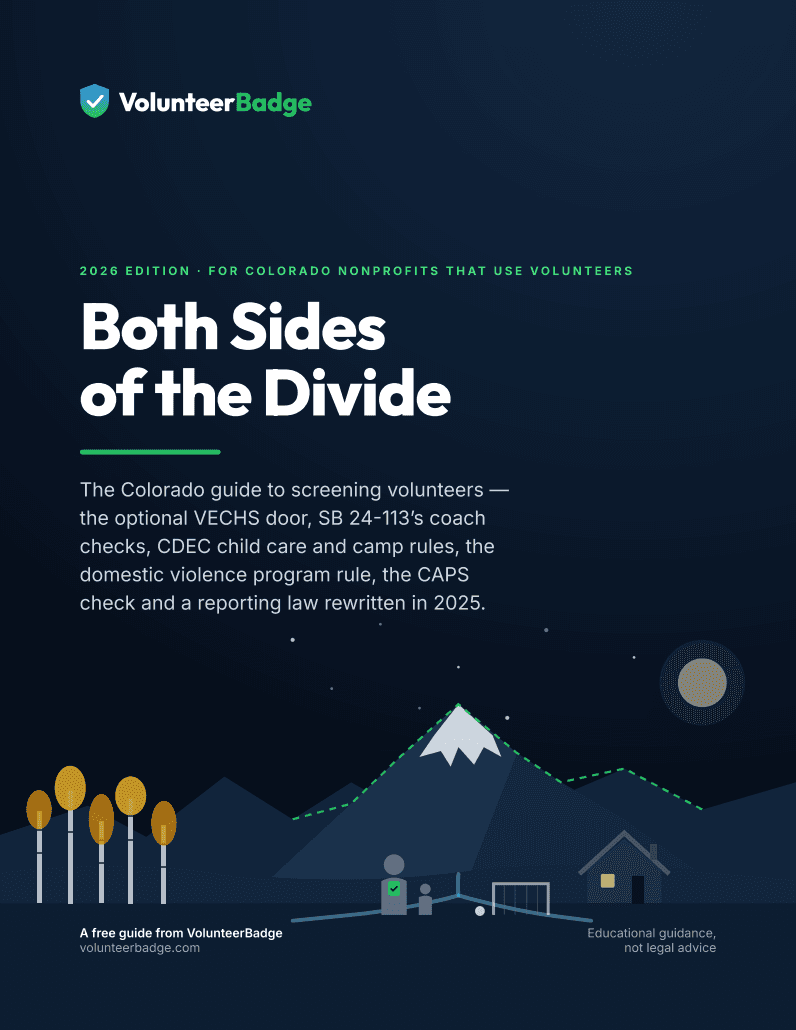
Cover of Both Sides of the Divide

Free whitepaper PDF

Both Sides of the Divide: the Colorado guide to screening volunteers: the optional VECHS door, SB 24-113’s coach checks, CDEC child care and camp rules, the domestic violence program rule, the CAPS check and a reporting law rewritten in 2025

Colorado’s volunteer-screening law starts with a permission, not an order. Its VECHS statute lets organizations that care for children, older adults or people with disabilities ask the Colorado Bureau of Investigation for fingerprint checks — “may,” not “shall.” Checks become mandatory in a handful of settings: private youth sports coaches under SB 24-113, CDEC-licensed child care and camps, licensed neighborhood youth organizations and programs funded by the State’s Domestic Violence Program. Both Sides of the Divide sorts each Colorado setting onto the “may” or the “shall” side.

Get the free guide

Volunteer background checks

Cited

We found no Colorado statute requiring every nonprofit volunteer to be background checked. Checks are required in specific settings: licensed child care, including day camps (CDEC rules require CBI and FBI fingerprints and a TRAILS child abuse check for volunteers who care for or supervise children or have unsupervised access, or who count toward staff-child ratio for 14 days or 112 hours a year); private youth sports organizations, which since August 7, 2024 must run a consumer-reporting-agency background check on every paid or volunteer coach, manager or supervisor before they start (C.R.S. 26.5-4-403); licensed neighborhood youth organizations (C.R.S. 26.5-5-308); and programs funded by the state Domestic Violence Program (12 CCR 2512-2). C.R.S. 24-72-305.3 separately lets any organization that provides care to children, the elderly or people with disabilities request CBI and FBI fingerprint checks on volunteers through the VECHS program, but it does not require them. Colorado’s school fingerprint law (C.R.S. 22-32-109.8) covers employees, not volunteers, and its ban-the-box law, the Chance to Compete Act (C.R.S. 8-2-130), is written for employment applications.

  • Youth Sports Coach Background Checks (SB 24-113) (C.R.S. 26.5-4-401 to 26.5-4-403) — Since August 7, 2024, a private youth sports organization must obtain a background check from a consumer reporting agency on every paid or volunteer coach, manager or supervisor before they begin. The statute lists what the check must cover, including sex offenses and felonies, a Social Security number trace and a Colorado court records search. Organizations that rely on the results in hiring and employment decisions are immune from civil liability unless they know the information is false or act with reckless disregard, and from July 1, 2025 every coach must complete mandatory-reporter training each year (26.5-4-402(1)(a)).
  • Child Care Licensing Background Checks (C.R.S. 26.5-5-316; 8 CCR 1402-1 §§ 2.120, 2.121, 2.412(E)) — Licensed child care, including day and summer camps (which Colorado law defines as child care centers, C.R.S. 26.5-5-303), must obtain CBI and FBI fingerprint checks and a TRAILS child abuse check for volunteers who care for or supervise children or have unsupervised access, or who count toward staff-child ratio for 14 days (112 hours) or more a year (§ 2.121(D)(2)-(3)). TRAILS and FBI checks renew every five years. The volunteer triggers come from CDEC rule, not statute, and CDEC redrafted these rules in 2026 — confirm the current version with CDEC.
  • Domestic Violence Program Rules (12 CCR 2512-2 § 12.201.8) — Programs funded by the state Domestic Violence Program must have a written criminal background check policy and a completed criminal background check for every volunteer before the volunteer’s start date.
  • Private Access to Criminal History Records of Volunteers and Employees of Charitable Organizations (VECHS) (C.R.S. 24-72-305.3) — Lets a qualified entity (a public, private, for-profit, not-for-profit or voluntary organization that provides care or care placement services to children, the elderly or individuals with disabilities) ask the CBI for state and FBI fingerprint-based checks on its employees and volunteers. The statute says a qualified entity “may” request these checks; it does not require them.
  • School District Background Check Requirements (C.R.S. 22-32-109.8) — Requires a person selected by a school district for a position that does not need an educator license to submit fingerprints for a CBI and FBI criminal history check. It covers employment applicants; we found no statute in Title 22 requiring school volunteers to be checked.
  • Colorado Chance to Compete Act (Ban the Box) (C.R.S. 8-2-130) — Since September 1, 2021, bars employers other than state and local government from saying in a job ad or application that people with a criminal history may not apply, and from asking about criminal history on an initial application. It does not apply where law requires a criminal history check for the position. Its text covers employment positions and applicants; we found no provision extending it to unpaid volunteers.
  • Who it reaches: Child care volunteers, including at day camps, who care for or supervise children or have unsupervised access, or who count toward staff-child ratio for 14 days (112 hours) or more a year (8 CCR 1402-1 § 2.121(D)(2)-(3)); Paid and volunteer coaches, managers and supervisors of private youth sports organizations, before they start (C.R.S. 26.5-4-403); All volunteers of programs funded by the state Domestic Violence Program, before their start date (12 CCR 2512-2 § 12.201.8); Resident camp volunteers who count toward staff-child ratio, or who work 14 days (112 hours) or more a year (8 CCR 1402-1 § 2.412(E)); Volunteers who work directly with youth five or more days a month at a licensed neighborhood youth organization, before starting and every two years (C.R.S. 26.5-5-308(4)); Optional, not required: CBI and FBI fingerprint checks through VECHS for organizations that care for children, the elderly or people with disabilities (C.R.S. 24-72-305.3); Optional, not required: a CAPS adult protective services check on volunteers who give direct care to at-risk adults (C.R.S. 26-3.1-111(6)(a)(IV)).
  • Check types in use: Fingerprint-based CBI criminal history check; FBI fingerprint check (required through CDEC licensing for child care; optional through VECHS for other care organizations); Consumer-reporting-agency check with SSN trace and Colorado court records search (youth sports coaches, C.R.S. 26.5-4-403); Sex offender registry check; TRAILS child abuse and neglect check (child care); CAPS adult protective services check (required for adult-care employees; optional for volunteers).
  • Administered by: Colorado Bureau of Investigation (CBI), Biometric Identification and Records Unit, with fingerprints taken by CBI-approved vendors (IdentoGO and Colorado Fingerprinting); Colorado Department of Early Childhood for child care checks.
  • Typical processing: CBI’s name-based online check returns results immediately (a $13 manual search can take up to 3 business days, then results are mailed); CAPS checks return within 5 business days. CBI does not publish a fingerprint turnaround time..
Full Colorado screening requirements

Sources

Mandated reporting

Framework

It depends on the role. Colorado names occupations rather than requiring universal reporting, so whether a volunteer is a mandated reporter turns on whether the statutory list reaches what they actually do. We have not verified the volunteer-specific detail for this state — read the statute or ask your state agency before writing your policy. Confirm Colorado's current statute before writing your policy — these are amended often.

  • In every state, territory and the District of Columbia, ANY person is permitted to report suspected abuse even when not required to. A volunteer who is not a mandated reporter can still call, and should.
  • The safest operating posture, whatever the statute says, is to train every volunteer on what to report and to whom — a policy that only trains "mandated" staff leaves the person most likely to witness something untrained.
  • Reporting duties are personal. A volunteer who is a mandated reporter cannot discharge the duty by telling a supervisor and stopping there in most states.
  • Screening and reporting are different obligations. Clearing a background check does not satisfy a reporting duty, and no reporting policy substitutes for screening.
Compare all 50 states on mandated reporting

Sources

Volunteer liability & charitable immunity

Framework

The federal Volunteer Protection Act of 1997 sets a floor: it shields a volunteer of a nonprofit or governmental entity from liability for harm caused by ordinary negligence while acting within the scope of their responsibilities, subject to conditions and exclusions. It is a floor, not a ceiling — a state may extend more protection, and the Act does not shield the ORGANIZATION itself. Colorado's own charitable immunity provisions sit on top of this and need to be read directly.

  • The federal shield protects the volunteer, not the nonprofit. Organizational liability is a separate question and is what general liability insurance is for.
  • It does not reach willful or criminal misconduct, gross negligence, reckless misconduct, or a conscious flagrant indifference to the rights or safety of the person harmed.
  • Harm involving a motor vehicle, vessel, or aircraft is generally carved out where the state requires an operator license or insurance — which is why volunteer drivers are their own category.
  • State statutes vary more than most boards expect, including in the standard of care they apply and in whether specific volunteer categories get named protection.

Sources

Charitable solicitation registration

Cited

Colorado requires a charitable organization to register with the Secretary of State before soliciting contributions, and to file annually (C.R.S. § 6-16-104); the Secretary of State charges $10 for a new registration, an amendment or a renewal. An organization that raises no more than $25,000 a year in gross revenue (not counting government or 501(c)(3) grants), or that receives contributions from ten or fewer people, need not register unless it has contracted with a paid solicitor (§ 6-16-104(6)(c)).

  • Small Colorado charities under the § 6-16-104(6)(c) thresholds are exempt, but the exemption does not apply once you contract with a paid solicitor.
  • Soliciting residents of other states can trigger registration in those states regardless of where you are based — an online donate button reaches all fifty.
  • Exemptions exist in most registering states (small organizations, religious organizations, membership appeals) but they are specific and usually must be claimed rather than assumed.
  • Confirm current requirements with your state charity office before relying on this — thresholds and exemptions are amended frequently.

Sources

Federal obligations that apply everywhere

Cited

These apply regardless of which state you operate in, and they are the ones most commonly missed by small organizations that assume state registration is the whole picture.

  • Annual Form 990, 990-EZ, or 990-N. Three consecutive years of non-filing revokes exempt status automatically — this is the single most common way small nonprofits lose their status.
  • If you run background checks on volunteers, the Fair Credit Reporting Act applies to you as a user of consumer reports: a standalone written disclosure, separate written authorization, and the pre-adverse and adverse action sequence before acting on a result.
  • Public disclosure: your exemption application and recent 990s must be made available on request.
  • Employment obligations attach to paid staff regardless of exempt status — payroll tax, worker classification, and wage and hour law all apply.

Sources

Entity formation & annual state filings

Go to the regulator

Incorporation, registered agent, and periodic report requirements differ by state and we have not yet completed primary-source research for Colorado. Rather than summarize someone else's summary, we point you at the office that actually administers it — your Secretary of State (or equivalent) for corporate filings, and your state charity office for charitable registration.

Sources

Insurance expectations

Go to the regulator

Insurance requirements are set by policy and contract rather than by statute in most states, so there is no single legal answer to publish. What is worth knowing: general liability, directors and officers, and abuse/molestation coverage are distinct, and abuse coverage is frequently excluded by default and priced against your screening and supervision practices. Ask your broker what your policy actually requires of your volunteer screening — it is often stricter than state law.

Sources

General information, not legal advice. We are a consumer reporting agency, not a law firm. State law changes — Colorado's requirements may have been amended since we verified these sources on August 21, 2026. Confirm anything you intend to rely on with your state agency, your licensor, your insurer, or your own counsel. If you spot something we have wrong, tell us at support@screenforgelabs.com — we would rather fix it than leave it.

The screening part, handled

Of everything on this page, volunteer background checks are the one we actually do. $5 per volunteer from an FCRA-regulated consumer reporting agency, all 50 state sex-offender registries plus the national registry, with the disclosure, authorization and adverse-action workflow built in — because running checks makes you a user of consumer reports whether you planned for that or not.