How to Start a Nonprofit in North Dakota
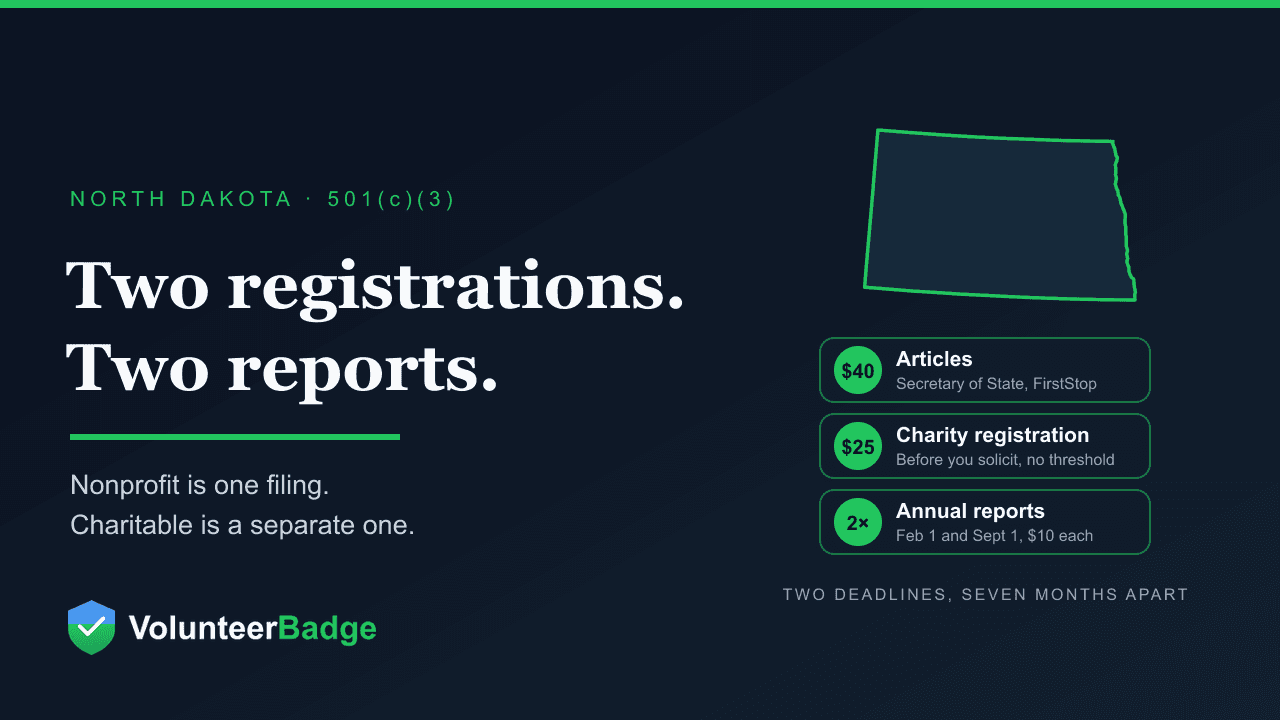
North Dakota asks most new charities to register twice and report twice, with the two deadlines seven months apart — and unlike most states, there is no dollar threshold below which you can skip the charitable registration. Here is what qualifies as a 501(c)(3), both tracks laid out side by side, and the calendar to put on the wall.
On this page
Most states let a very small charity skip fundraising registration until it crosses a dollar threshold. North Dakota does not. If you solicit charitable contributions here, you register as a charitable organization — and that is a second registration, on top of forming the nonprofit corporation, with its own fee, its own annual report and its own deadline seven months away from the first one.
That is the whole shape of doing this in North Dakota: two tracks running in parallel, each with its own paperwork. Confuse them, or assume the one you did covers the other, and the first sign of trouble is a letter telling you that you are no longer in good standing. This guide separates them clearly, explains what actually qualifies as a 501(c)(3), and ends with a calendar.
Before anything: is a new 501(c)(3) the right vehicle?
North Dakota has a strong tradition of community foundations and donor-advised funds, and in a state this size that matters more than it does elsewhere. If your idea is a scholarship, a memorial fund, a single building project or a program that would fit naturally inside an organization that already serves your county, a donor-advised fund or fiscal sponsorship gets the deduction flowing without creating a corporation that somebody has to maintain for the next thirty years.
Form your own when you need a lasting institution with its own board, staff and grant eligibility. That is a real and common answer — just make it a decision rather than a default.
What actually qualifies as a 501(c)(3)
Federal exemption under section 501(c)(3) turns on purpose, not on whether you distribute profit. An organization must be both organized and operated exclusively for exempt purposes. The statutory list is: charitable, religious, educational, scientific, literary, testing for public safety, fostering national or international amateur sports competition, and preventing cruelty to children or animals.
“Charitable” is broader than it sounds and carries most organizations. It includes relief of the poor, distressed or underprivileged; advancement of education or religion; lessening the burdens of government; combating community deterioration; and eliminating prejudice and discrimination.
Two constraints decide most borderline cases:
- No private inurement. Earnings may not benefit insiders. Paying a founder a reasonable salary for genuine work is fine. Renting the office from a board member at a generous rate, lending the organization’s money to a director, or steering contracts to a family business is not, and this is what actually gets exemptions pulled.
- Political activity. Intervening in a campaign for public office is prohibited outright — not limited, prohibited. Lobbying is permitted but must stay an insubstantial part of your activities.
The organizational half is handled in your articles. They must limit the corporation to exempt purposes and permanently dedicate its assets, including a dissolution clause directing remaining assets to another 501(c)(3) or a government unit. Articles that read like a mission statement and nothing more will come back from the IRS.
Track one — the nonprofit corporation
You register with the North Dakota Secretary of State through the FirstStop portal, filing articles as either a nonprofit corporation or a nonprofit LLC. The corporation is the usual choice and the one the IRS process assumes.
- Articles of Incorporation: $40.
- Registered agent with a North Dakota address, who stays current — this is the address the state uses when something is wrong.
- Nonprofit annual report: $10, due on or before February 1 every year, through FirstStop.
One wrinkle worth knowing on timing: the first annual report is due in the year following the effective date stated in your articles. The Secretary of State’s own example is articles filed on 1 December 2022 with an effective date of 1 January 2023 — the first annual report is not due until 1 February 2024. If you are incorporating late in a calendar year, setting a 1 January effective date buys you a full extra year before the first report.
The annual report asks for your registered agent, office address, a description of activities, the federal code section you are exempt under, and the names and addresses of officers and directors.
Track two — the charitable organization registration
This is the one that surprises people. If you solicit contributions for charitable purposes in North Dakota, you must register as a charitable organization — also with the Secretary of State, but as an entirely separate filing.
- Charitable Organization Registration Statement: $25.
- Charitable annual report: $10, due on or before September 1, extendable to December 1 on request and approval.
The charitable annual report is substantially heavier than the corporate one. It wants total receipts from all sources, general and management costs, the cost of program services, fundraising and public education, compensation paid by the organization and its affiliates, how much was disbursed within North Dakota, what was transferred out of state, and details of any professional fundraiser. It must also carry a financial statement — balance sheet, statement of income and expenses, and statement of functional expenses — covering the prior 12 months.
The IRS step
Get an EIN first. It is free from the IRS, takes minutes online, and you need it to open a bank account. Anyone charging you for one is selling you a free thing.
Then apply for recognition of exemption:
Form 1023-EZ — $275
Available if annual gross receipts are $50,000 or less and total assets $250,000 or less, and you clear the rest of the eligibility checklist. Short, online, and usually decided quickly. Most new North Dakota charities qualify.
Form 1023 — $600
The full application, with a narrative of activities, budgets, policies and compensation detail. Required above the EZ thresholds and for categories that cannot use the short form, including churches, schools and hospitals.
Apply within 27 months of the end of the month in which you formed, and recognition reaches back to your formation date, so gifts received while the application was pending are deductible. Past that window, exemption generally starts the day you applied.
The calendar to put on the wall
Three deadlines, three different months, two different agencies. None of them is difficult; all of them are easy to let slide in a year when the program is going well and nobody is thinking about filings.
Then your first volunteers arrive
At some point the thing you built starts attracting people who want to help, and you are suddenly responsible for deciding who gets to be alone with the kids at the after-school program, or in a car with an older adult on the way to an appointment.
Most small North Dakota nonprofits meet that moment with no budget for it. Traditional screening providers price for employers — per-check costs well above your entire state filing bill, often with a monthly minimum attached. So the check gets skipped, and the risk sits quietly with a board that has never discussed it.
VolunteerBadge was built for that gap: an FCRA-regulated background check for $5, no contract, no minimum, and the volunteer keeps a verified badge they carry to every organization they serve.
Create your organization — you can set it up and start inviting volunteers before your determination letter arrives.
Sources
- North Dakota Secretary of State — Nonprofit Corporation
- North Dakota Secretary of State — Charitable Organizations
- North Dakota Secretary of State — Maintaining Nonprofit Registration (PDF)
- IRS — Exemption Requirements, 501(c)(3) Organizations
- IRS — Form 1023 and 1023-EZ: Amount of User Fee
Fees and deadlines verified against the sources above in October 2026. State fees change; check the official page before you file. This is general information about public filing requirements, not legal or tax advice — for your specific situation, talk to a North Dakota attorney or CPA.
