How to Start a Nonprofit in Nebraska
Nebraska is one of the easiest states in the country to start a nonprofit in — it has no charitable-solicitation registry to join at all. It is also one of the few that still asks you to buy a newspaper advertisement. Here is what qualifies as a 501(c)(3), the order to do things in, the publication requirement that catches almost everyone, and what it costs.
On this page
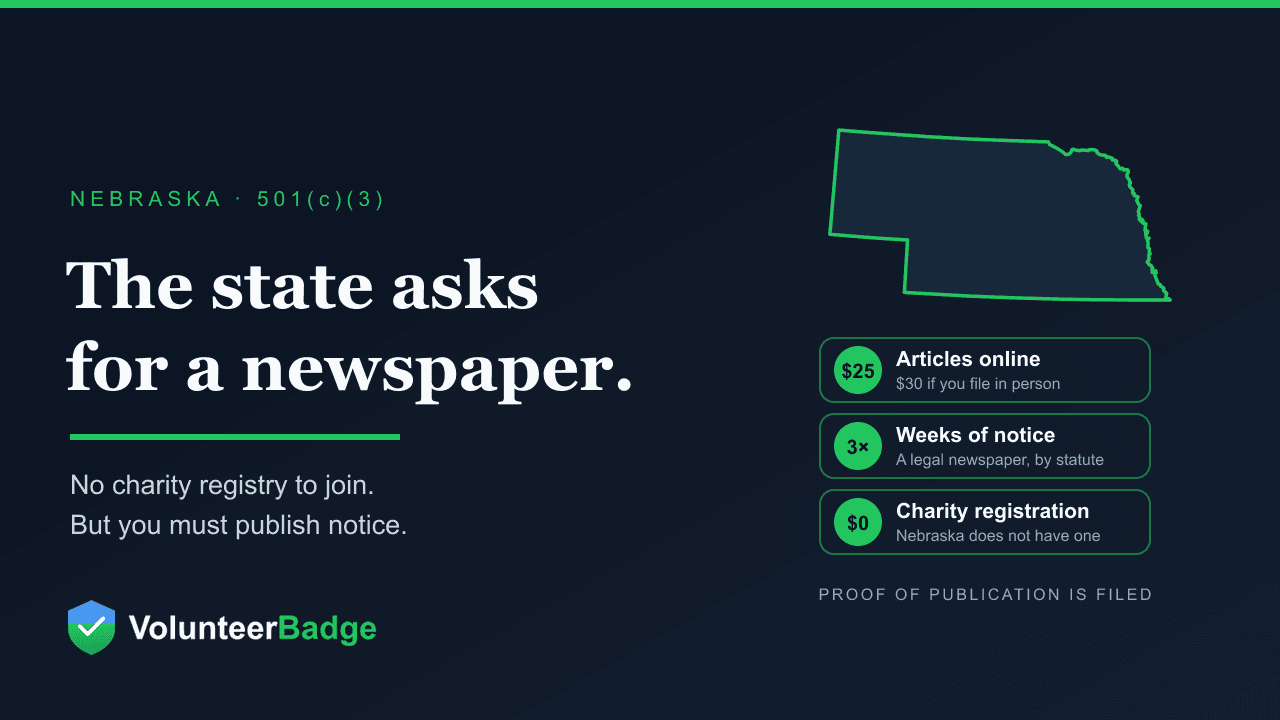
Nebraska is one of the simplest states in the country to start a nonprofit in. It has no charitable-solicitation registry — the requirement was repealed decades ago and never replaced, so there is no annual registration, no renewal fee, and no state form standing between you and your first fundraising letter. It is also one of the last states that still expects you to buy a newspaper advertisement, and that is the step people miss.
This guide is for the person who has been doing the work for a while — running the backpack program out of a church basement, coaching the team nobody would fund, driving neighbors to dialysis — and has reached the point where somebody has asked for a receipt they can deduct. It covers what actually qualifies as a 501(c)(3), the order to do things in, and what each step costs.
First, the question nobody asks you
Does this need to be its own nonprofit?
Starting one is a permanent administrative commitment. Every year after this, somebody has to file a federal return, keep a board that meets and takes minutes, and maintain a registered agent. If what you have is a project rather than an institution — a one-off capital campaign, a memorial fund, a program that would be stronger attached to an organization that already exists — then fiscal sponsorship is worth looking at first. An established 501(c)(3) accepts the donations, takes a percentage, and the deduction is real because the exemption is theirs. You get to do the work without inheriting the filing calendar.
Plenty of good work dies because the founder spent the first year on governance instead of the mission. If the answer is still yes, read on.
What actually qualifies as a 501(c)(3)
Section 501(c)(3) is narrower than “we are not trying to make money.” An organization qualifies when it is both organized and operated exclusively for one or more exempt purposes, which the statute lists as:
- Charitable — the broadest and the one most organizations rely on. It covers relief of the poor and distressed, advancement of education or religion, lessening neighborhood tensions, combating community deterioration, and defending human and civil rights.
- Religious
- Educational — instruction or training of the individual, or instruction of the public on subjects useful to the community.
- Scientific, literary, and testing for public safety
- Fostering national or international amateur sports competition
- Preventing cruelty to children or animals
Two tests follow from that, and both have to pass.
The organizational test
Your articles of incorporation have to limit the organization to exempt purposes and dedicate its assets permanently to those purposes. A dissolution clause sending remaining assets to another 501(c)(3) or to a government unit is not boilerplate — leave it out and the IRS will reject the application.
The operational test
What you actually do, year after year. No part of the earnings may benefit a private individual, political campaign intervention is prohibited outright, and lobbying must stay an insubstantial part of what you do. Programs that mainly benefit the founder, their family, or their business will fail this however well the paperwork reads.
The phrase to internalize is private inurement. A nonprofit may pay a fair salary for real work, including to its founder. What it may not do is let insiders extract value — below-market rent to a board member’s company, an interest-free loan to the director, a program that exists to funnel contracts. This is the issue that actually gets exemptions revoked.
Step 1 — Incorporate with the Secretary of State
Nebraska nonprofit corporations are formed under the Nebraska Nonprofit Corporation Act. You file Articles of Incorporation with the Secretary of State: $25 online, $30 in person.
Before you file, settle three things:
- Registered agent and registered office. A person or company with a physical Nebraska street address who can receive legal service during business hours. Your home address is allowed and becomes public record, which is worth thinking about before you use it.
- Membership or no members. Nebraska asks you to say whether the corporation will have members. Most new charities choose no members — the board governs. Choosing a membership structure means members get statutory voting rights, which is a real governance commitment, not a nicety.
- Your purpose clause. Write it for the IRS, not for the brochure. A narrow, exempt-purpose clause with the required dissolution language is what Step 3 will be graded against.
Step 2 — Publish notice in a newspaper
This is the Nebraska-specific step, it is statutory, and it is the one people discover late.
Under Neb. Rev. Stat. § 21-19,173, notice of incorporation must be published in “some legal newspaper of general circulation in the county where the corporation’s principal office or, if none in this state, its registered office is located,” for three successive weeks. Proof of publication is then filed with the Secretary of State.
The statute is forgiving about sequence: if the notice was not published at the time but is published later for the required period with proof filed, the corporation’s acts remain valid both before and after. That is a safety net, not a plan. File the proof.
Step 3 — Get an EIN, then apply to the IRS
An EIN is free, takes minutes on the IRS website, and you need it before the exemption application and before a bank will open an account. Never pay a third party for one.
Then the exemption application itself. There are two forms and the difference is substantial:
Form 1023-EZ — $275
For small organizations: annual gross receipts of $50,000 or less and total assets of $250,000 or less, plus other eligibility conditions on the IRS checklist. Three pages, filed online, and typically decided far faster.
Form 1023 — $600
The full application. Narrative description of activities, projected budgets, conflict-of-interest policy, compensation detail. Required if you exceed the EZ thresholds or fall into an excluded category, such as churches, schools and hospitals.
One date matters more than the rest: file within 27 months of the end of the month you incorporated in, and recognition is retroactive to your formation date — meaning gifts received while you were waiting are deductible. Miss that window and exemption generally runs only from the date you applied, which strands every donation in between.
Step 4 — Nebraska state taxes
Federal exemption is not state exemption, and it is not automatic. Once the IRS determination letter arrives, deal with the Nebraska Department of Revenue separately for sales-and-use tax treatment. Nebraska does not grant a blanket sales-tax exemption to everything with a 501(c)(3) letter — eligibility turns on the kind of organization you are. Check before you tell a vendor you are exempt; getting that wrong creates a liability, not a discount.
What the first year actually looks like
The part nobody puts in a startup guide
The paperwork above is the easy half. The hard half starts the first time somebody who is not you is alone with a child, an older adult, or a vulnerable person in your program.
Volunteer screening is where small organizations get caught between two bad options: skip it and carry a risk the board does not understand, or buy a program designed for an employer with an HR department and a budget to match. A single background check through a traditional provider often costs more than your entire state filing bill, and the pricing usually assumes a monthly minimum you will not hit.
That gap is the reason VolunteerBadge exists. A full FCRA-regulated background check is $5, with no contracts and no minimums, and the volunteer keeps a verified badge they can carry to the next organization they serve.
Create your organization — it takes a couple of minutes, and you can invite your first volunteers before your determination letter arrives.
Sources
- Nebraska Secretary of State — Forms and Fee Information
- Neb. Rev. Stat. § 21-19,173 — Notice of incorporation; publication
- Nebraska Secretary of State — Information on Charitable Solicitors
- IRS — Exemption Requirements, 501(c)(3) Organizations
- IRS — Form 1023 and 1023-EZ: Amount of User Fee
Fees and deadlines verified against the sources above in October 2026. State fees change; check the official page before you file. This is general information about public filing requirements, not legal or tax advice — for your specific situation, talk to a Nebraska attorney or CPA.
