How to Start a Nonprofit in Alaska
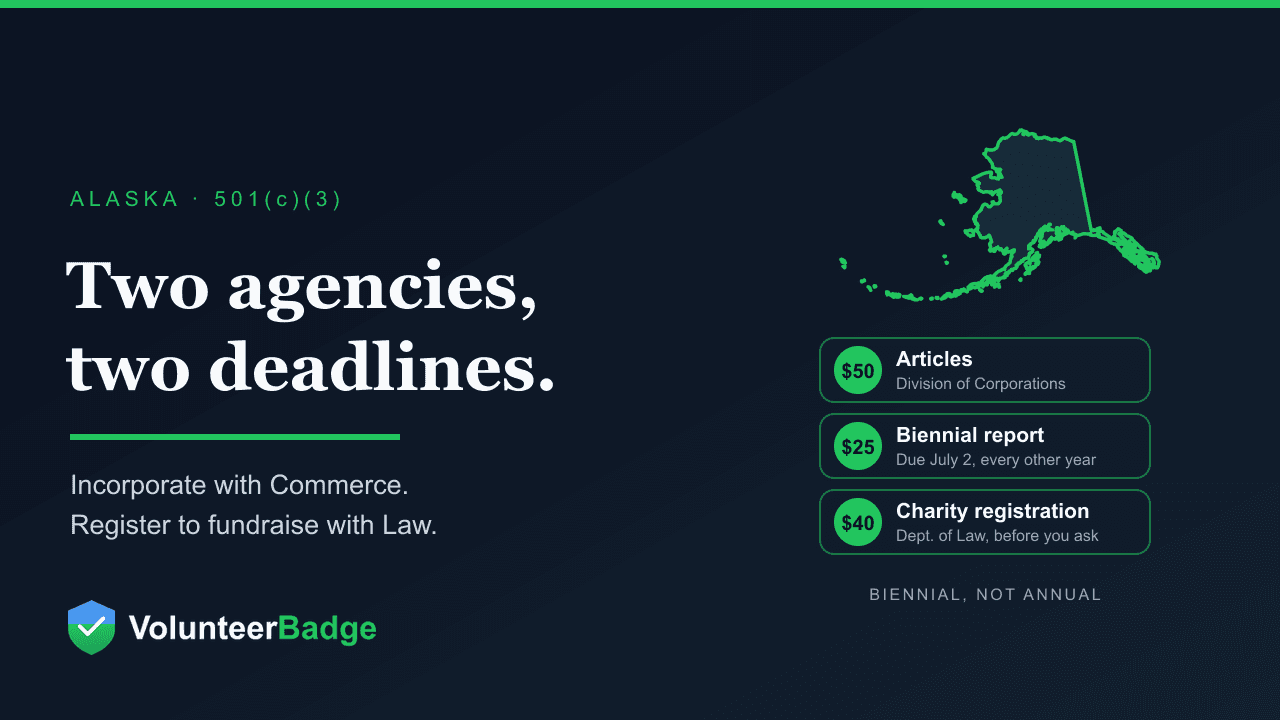
Alaska splits the job across two agencies that do not talk to each other: you incorporate with Commerce and you register to fundraise with the Department of Law — before you ask anyone for a dollar. Reports are biennial rather than annual, which sounds easier and is the exact reason organizations fall out of good standing. Here is the whole sequence.
On this page
Alaska divides this work between two agencies that have nothing to do with each other. You form the corporation with the Department of Commerce, Community and Economic Development. You register for the right to ask people for money with the Department of Law. Doing one does not do the other, and nobody will tell you that you have missed the second until you have already been soliciting without it.
The other Alaska peculiarity is that corporate reports are biennial, not annual. That sounds like a kindness and functions as a trap: a habit you perform once every two years is a habit nobody forms, and the board that filed in July of an even year is routinely the board that forgets in July of the next even year. This guide walks the whole sequence, explains what qualifies as a 501(c)(3), and ends with the calendar that keeps both agencies satisfied.
The Alaska-specific question to settle first
Before the paperwork: who are you, structurally, in relation to the people you serve?
Alaska has an institutional landscape that does not exist in the Lower 48 — ANCSA regional and village corporations, tribal governments, regional health and social service nonprofits, and borough governments covering areas larger than most states. A new standalone 501(c)(3) is sometimes the right answer. It is just as often the wrong one, because a tribal entity, a village corporation’s charitable arm, or an existing regional nonprofit already has the infrastructure, the standing with funders, and the community relationships that you would spend five years building.
If you are serving a tribal community, start by asking whether the work belongs under a tribal entity. If you are serving a region, ask the regional nonprofit whether they would house it. If the answer is genuinely no — you need your own board, your own grant eligibility, your own permanent institution — then form your own. Just do not treat incorporation as the default first move.
What actually qualifies as a 501(c)(3)
Federal exemption under 501(c)(3) depends on purpose and conduct. An organization must be both organized and operated exclusively for one or more exempt purposes, which the statute lists as charitable, religious, educational, scientific, literary, testing for public safety, fostering national or international amateur sports competition, and preventing cruelty to children or animals.
“Charitable” is read broadly and carries most organizations: relief of the poor, distressed or underprivileged; advancement of education or religion; lessening the burdens of government; combating community deterioration; eliminating prejudice and discrimination; defending human and civil rights.
Two things decide the hard cases:
No private inurement
Nothing of value may flow to insiders beyond reasonable compensation for genuine work. A working founder may be paid a fair salary. Renting from a board member on favourable terms, lending organization funds to a director, or routing contracts to a family business is what actually gets exemptions revoked.
Political limits
Intervening in a campaign for public office is prohibited outright, not merely limited. Lobbying is allowed but must remain an insubstantial part of your activities — a real constraint for organizations formed specifically to change a state policy.
The organizational half lives in your articles: they must limit the corporation to exempt purposes and permanently dedicate its assets, including a dissolution clause directing what is left to another 501(c)(3) or to a government unit. Articles that read like a mission statement and omit that language are the most common reason a first IRS application comes back.
Step 1 — Incorporate with Commerce: $50
File Articles of Incorporation for a domestic nonprofit corporation with the Division of Corporations, Business and Professional Licensing, inside the Department of Commerce, Community and Economic Development. The fee is $50.
Settle before filing:
- Registered agent with a physical Alaska street address. Not a PO box. In a state where a great many addresses are PO boxes, this is a genuine constraint worth solving before you start the form rather than halfway through it.
- At least three directors is the conventional structure for a charity, and it is what funders and the IRS expect to see — a one-person board invites exactly the inurement questions you want to avoid.
- Purpose and dissolution clauses written for the IRS, because amending later costs another filing and another wait.
Step 2 — Register with the Department of Law, before you solicit
This is the step that is easiest to miss, because nothing in the incorporation process mentions it.
Alaska law requires charitable organizations to register with the Department of Law prior to soliciting contributions of money or property in Alaska. The registration fee is $40, and the annual registration is due by September 1 each year.
Note the shape of this: the charity registration is annual and runs on a September calendar, while your corporate report is biennial and runs on a July calendar. Two agencies, two rhythms, neither of which reminds you about the other.
Step 3 — EIN, then the IRS
An EIN is free and immediate from the IRS. You need it before a bank will open an account and before you can apply for exemption. Nobody should be charging you for it.
Form 1023-EZ — $275
For organizations with $50,000 or less in expected annual gross receipts and $250,000 or less in assets, subject to the remaining eligibility checklist. Short, online, generally decided quickly.
Form 1023 — $600
The full application: narrative of activities, budgets, conflict-of-interest policy, compensation detail. Required above the thresholds and for churches, schools and hospitals whatever their size.
File within 27 months of the end of the month you incorporated and exemption is retroactive to formation, so gifts received while the application was pending are deductible. After that window, exemption generally starts from the application date — which is why the summer you spent fundraising before applying can turn into a problem for the donors who trusted you.
The two-calendar problem
One more Alaska-specific note: there is no statewide sales tax, but many boroughs and municipalities levy their own, and exemption is handled locally. If you buy in volume, ask your borough directly — there is no single state form that settles it.
What happens when your first volunteers show up
Alaska makes volunteer programs harder than most places. Distances are enormous, a lot of service happens in communities off the road system, and the person helping at the youth night in a village of four hundred is frequently somebody everybody already knows. That last part is precisely why screening conversations get skipped — it feels redundant to check somebody whose family you have known for twenty years.
It is also why the standard advice fails here. Traditional screening providers price for employers: one check can cost more than everything you paid both agencies to exist, and the plans assume monthly volume a village nonprofit will never have. So the check does not happen, and the risk sits with a board that has never explicitly discussed it.
VolunteerBadge was built for that gap. An FCRA-regulated background check is $5, with no contract and no minimum, run from anywhere with a connection, and the volunteer keeps a verified badge they carry to the next organization they serve — which matters a great deal in a state where the same handful of people volunteer for the school, the church and the fire department.
Create your organization — you can set it up and invite volunteers before your determination letter arrives.
Sources
- Alaska Division of Corporations — Corporation Forms & Fees
- Alaska Division of Corporations — Biennial Reports
- Alaska Department of Law — Charity & Paid Solicitor Registration
- Alaska Nonprofit & Community Association Handbook (PDF)
- IRS — Exemption Requirements, 501(c)(3) Organizations
- IRS — Form 1023 and 1023-EZ: Amount of User Fee
Fees and deadlines verified against the sources above in October 2026. State fees change; check the official page before you file. This is general information about public filing requirements, not legal or tax advice — for your specific situation, talk to an Alaska attorney or CPA.
