
PA Criminal Background Check for Volunteers: 2026 Guide
Learn the PA Criminal Background Check for Volunteers rules: which clearances apply, which fees are free, renewal every 60 months and how to stay compliant.
On this page
Is a clean national criminal background search enough to put a volunteer in front of children in Pennsylvania?
No. That report can show a name matched no indexed court record across 50 states and still leave your organization out of compliance, because a Pennsylvania role that involves the care, supervision, guidance or control of children requires certificates issued by Pennsylvania agencies. The law ties those certificates to eligibility, disclosure duties and a renewal cycle, and a commercial database search doesn't stand in for any of them.
The gap between what a generic search covers and what a coordinator must hold on file is where audits find problems. What follows is the sequence a volunteer coordinator can work through with one open role in hand.
Table of Contents
- Pennsylvania Volunteer Clearances at a Glance
- When Act 153 Requires Clearances for Volunteers
- Which Clearance Path Applies by Residency
- Clearance Steps and Compliant Workflow
- Renewal Timing and Costs Nonprofits Often Miss
- Screening Mistakes That Leave Volunteers Unverified
Pennsylvania Volunteer Clearances at a Glance
The PA criminal background check for volunteers isn't a single check. Pennsylvania issues a short menu, and each item on that menu has its own trigger, its own fee and its own renewal clock. Matching the menu to a specific role is the coordinator's job before the first shift, not after the first incident.
The Pennsylvania Department of Human Services 2024 annual child abuse report names the components a covered volunteer can be asked to produce: a Pennsylvania Child Abuse History Certification, a Pennsylvania State Police criminal-record check, an FBI criminal-history check, national sex-offender-registry verification and out-of-state clearances for applicants with recent residence elsewhere. That report also notes the Pennsylvania State Police currently states volunteer criminal-history checks are free, which removes the cost objection from the state side of the file.
| Clearance | Who needs it | Volunteer fee | Renewal |
|---|---|---|---|
| PA Child Abuse History Certification | Adult volunteers with responsibility for a child's welfare or direct contact with children | Waived for volunteers | Every 60 months |
| PA State Police criminal-history check | The same child-contact volunteers | Free for volunteers | Every 60 months |
| FBI fingerprint-based check | Volunteers whose residency history or DHS rules require it | Charged, at the rate DHS sets | Every 60 months |
| Signed statutory affirmation | Volunteers with 10 years of continuous Pennsylvania residence, used in place of the FBI check | No fee | Signed once and kept with the file |
| National sex-offender-registry verification | Roles the program designates, typically unsupervised contact | Not a state certificate, so no state volunteer rate applies | Set by the program's own policy |
| Out-of-state clearances | Applicants with recent residence in another state | Charged by that state | Follows that state's cycle |
The row coordinators skip most often is the third. A volunteer who relocated to Pennsylvania recently needs a fingerprint-based federal check, and a nationwide database search doesn't produce it. Each certificate comes from a separate system: the DHS child abuse registry, State Police criminal history, and federal fingerprint records routed through DHS.
Which rows apply to your volunteer
- Child contact plus 10 years in Pennsylvania: the Child Abuse History Certification, the State Police check and a signed affirmation.
- Child contact plus a move inside the last decade: the two state clearances and the fingerprint check.
- Child contact as a short-term visitor from another state: the documents your program requires, matched to the calendar-year rule for visiting volunteers.
- No child contact at all: no statutory Pennsylvania clearance, though your own policy can still require a criminal search.
Read the table with one specific role in front of you. If two rows apply and you can't tell which, the residency history on the application usually settles it.
When Act 153 Requires Clearances for Volunteers
Act 153 of 2014 turned volunteer screening from a private-sector habit into a legal gate. The statute requires an adult applying for an unpaid position that involves responsibility for a child's welfare or direct contact with children to complete the applicable child-protection clearances before beginning service. It took effect on December 31, 2014.
The test is the role, not the volunteer's title. Pennsylvania covers positions built around routine care, supervision, guidance or control of children, and that language reaches further than many might expect. It catches the coach, the Sunday school teacher, the chaperone who travels with a team and the volunteer who staffs the middle-school homework room twice a week.
The image below captures what the law is really allocating, which is accountability for the child in the room.
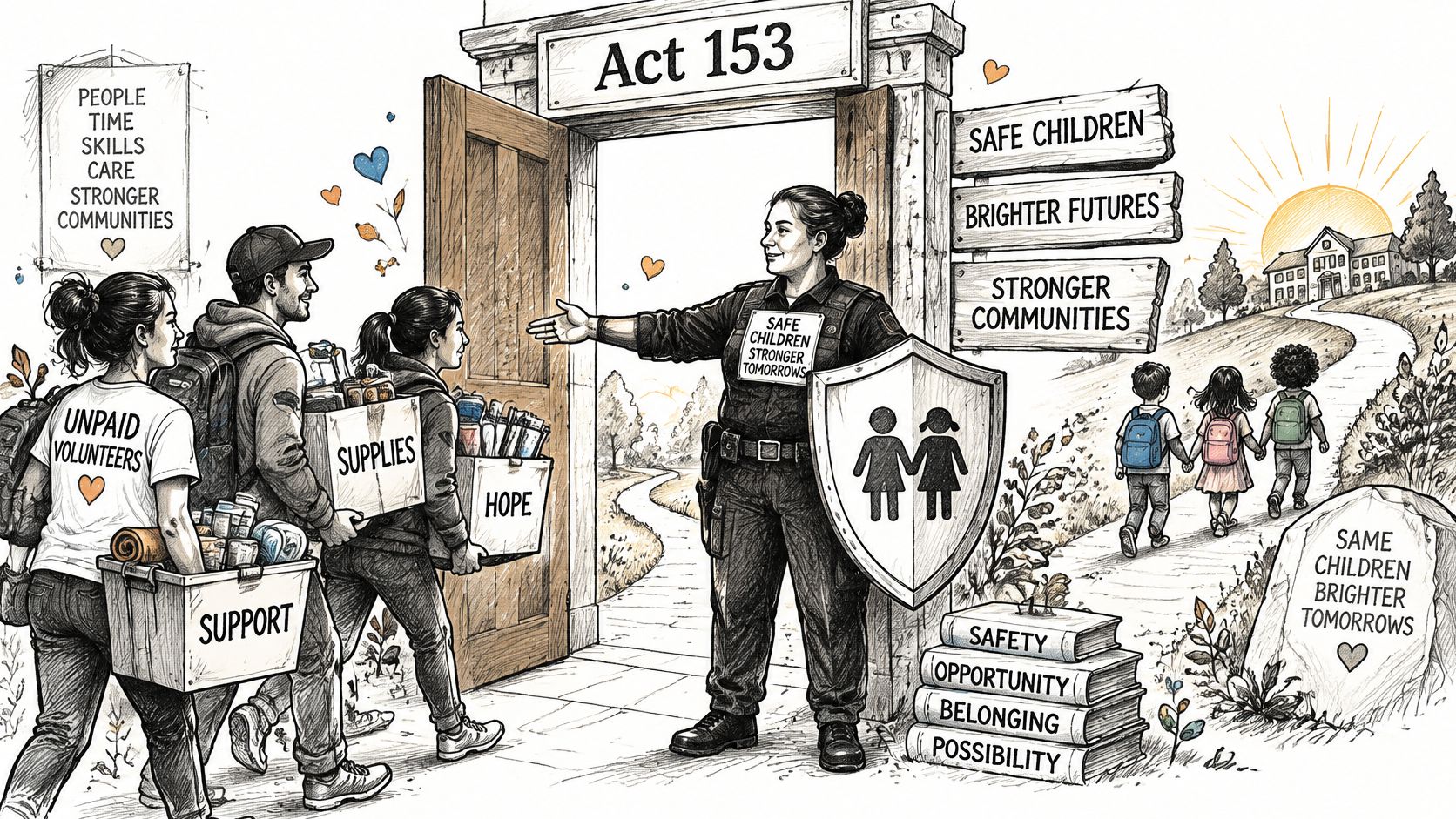
Practical rule: If you'd hesitate to leave the volunteer alone with a nine-year-old for twenty minutes, the role likely meets the child-contact test, and the clearances belong in the file before the first session.
Compare two roles inside one organization. A volunteer sorting canned goods in a food bank basement has no responsibility for a child's welfare and no direct contact with children, and Act 153 asks nothing of that person. A youth league coach who runs weekly practices, rides the team van to an away game and supervises a locker room sits squarely inside the law. The first role carries no statutory Pennsylvania clearance requirement, so any screening there is optional and governed by consumer-report rules rather than the Child Protective Services Law. The second cannot start until the certificates are on file.
For the practical shape of that screening conversation, this short walkthrough covers the ground most coordinators ask about first:
The statute also builds in a reduced path. For qualifying volunteers who have lived continuously in Pennsylvania for the previous 10 years, it permits a process built on Pennsylvania child-abuse-history and state criminal-history information rather than every component otherwise required. Where the results reveal a disqualifying offense under the Child Protective Services Law, the volunteer cannot be approved. Deliberately failing to disclose required information is a third-degree misdemeanor, and the discipline available includes denial of the volunteer position.
That gives a coordinator a clean test: classify the role as covered or not covered, and record the classification next to the position description. A role with routine child supervision needs the full Pennsylvania set before service. A role that never touches children needs none of it, and writing that down keeps your program from imposing requirements the law doesn't.
Which Clearance Path Applies by Residency
Residency, not job title, decides which version of the Pennsylvania set a volunteer owes. The question on the application isn't whether the volunteer has ever lived in another state. It's whether they've lived continuously in Pennsylvania for the previous 10 years.
For volunteers who will have contact with children in Pennsylvania, the Child Protective Services Law generally requires three compliance pathways, as the DHS child abuse clearances guidance explains: a Pennsylvania Child Abuse History Certification, a Pennsylvania State Police criminal-history record check, and either an FBI fingerprint-based criminal-history check or a signed statutory affirmation.
The FBI check is generally required when the volunteer has not continuously resided in Pennsylvania for the preceding 10 years, has not obtained the applicable DHS FBI clearance since establishing residency, or otherwise falls within the law's fingerprinting requirements. A volunteer with the full 10 years may instead sign the required disclosure or affirmation, and that document is not a substitute for the State Police or child abuse clearances. Neither is a national criminal search.
Matching the residency case to the paperwork
| Volunteer case | Clearances to collect | Timing |
|---|---|---|
| Pennsylvania resident for the previous 10 years, continuously | Child Abuse History Certification, State Police check, signed affirmation | Before approval and service |
| Pennsylvania resident with less than 10 years, or no FBI clearance since residency began | Child Abuse History Certification, State Police check, FBI fingerprint check | Before approval and service |
| Nonresident volunteering more than 30 days in a calendar year | Child abuse, State Police and applicable FBI documentation | Before approval and service |
| Nonresident volunteering 30 days or fewer in a calendar year | Home-state clearance standards, documentation provided to the organization | Documentation on file before service |
Say a church in Pittsburgh recruits a youth group volunteer who moved from Ohio four years ago and hasn't had a DHS FBI clearance since the move. The church needs three documents before the first meeting: the child abuse certification, the State Police check and the fingerprint-based FBI check. The volunteer can sign an affirmation, but signing it doesn't remove the fingerprint requirement in that case, and the file stays incomplete until the federal result arrives.
Fingerprinting is also the slowest step, so schedule the appointment the week the volunteer applies rather than the week before the retreat. Understanding how long a fingerprint background check takes helps you tell a volunteer what to expect and keeps the approval date from sliding.
The affirmation causes more confusion than any other document. It's a residency disclosure signed by the volunteer, not a clearance, and it doesn't replace the Child Abuse History Certification or the State Police record check. File it alongside the other documents or don't file it at all.
Before approving service, check the residency history against the address history on the application and keep the records. A national criminal search from a commercial vendor is useful information, but it does not independently satisfy these Pennsylvania-specific clearance obligations, and an auditor will ask for the certificates by name.
Clearance Steps and Compliant Workflow
Build the file in a fixed order and most of the confusion disappears. The workflow compresses into three moves: classify the role, collect the required documents, then record and renew them against a real date.
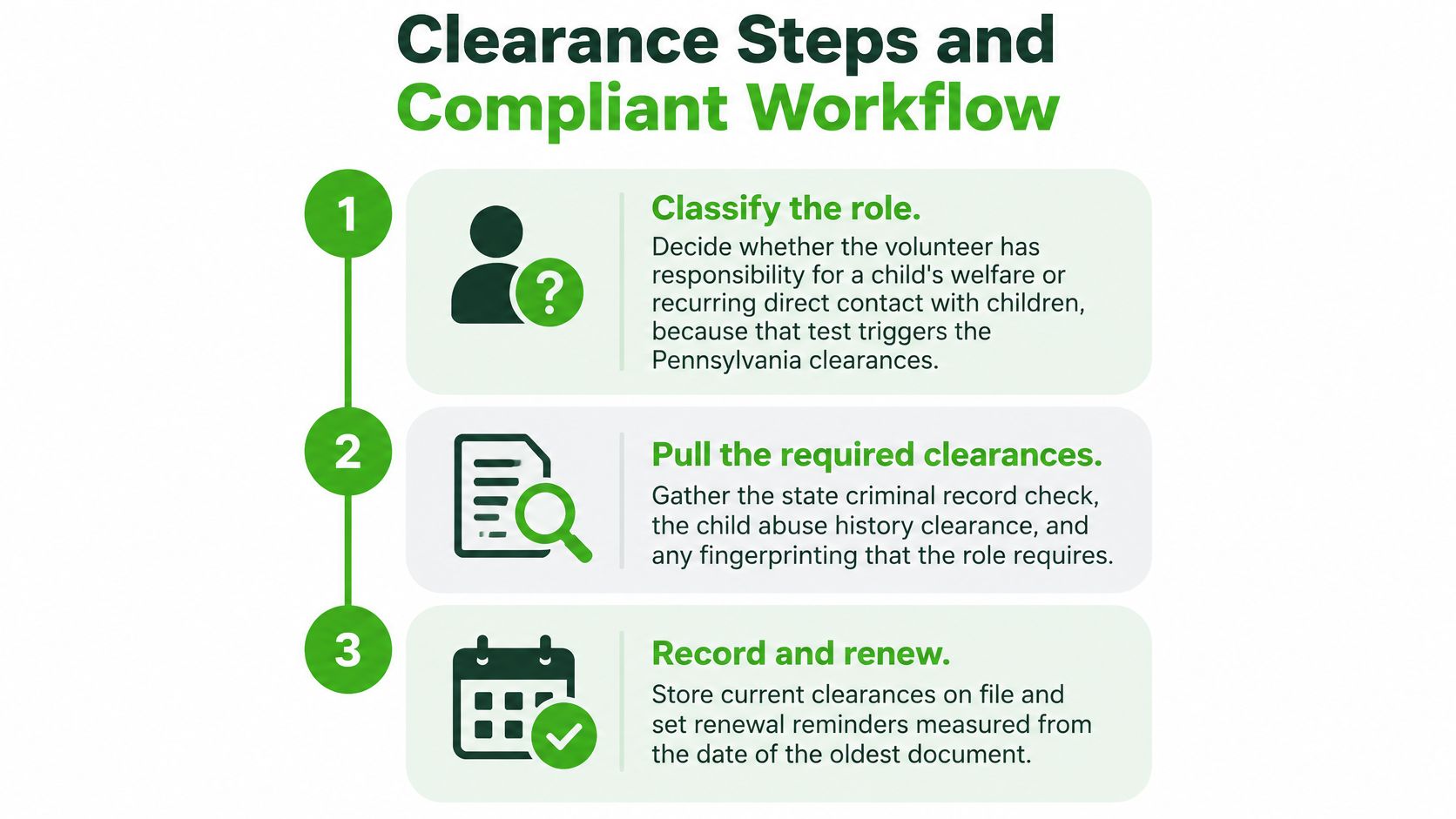
Classify the role in writing. One sentence in the position description should state whether the volunteer has responsibility for a child's welfare or recurring direct contact with children. Every later step depends on that answer. The usual slip is a title that sounds harmless, like "office helper," attached to a volunteer who ends up supervising the waiting room where children sit.
Pull the 10-year residence history from the application, not at the fingerprint appointment. A volunteer who lists an out-of-state address inside the past decade isn't a 10-year resident, whatever they believe, and the address check is where those gaps surface.
Order the Pennsylvania Child Abuse History Certification through the DHS portal and log the issue date the day it arrives. Download and store the actual certificate rather than the email notification, since that's the document an auditor wants to see.
Order the State Police criminal-history record check through the state's PATCH system and file the certification form, not a screenshot of the search result.
Pick the FBI route deliberately. A fingerprint check applies when residency triggers it, and the signed affirmation applies only to volunteers with a full decade of continuous Pennsylvania residence. Choosing the wrong one here is the single most expensive mistake in the sequence, because the federal result has to arrive before service starts.
Check the short-term visitor rule before scheduling anything if the volunteer lives in another state. The calendar-year threshold decides whether Pennsylvania documents are required at all, and a tournament weekend is a very different case from a full season.
Approve only when the file is complete. Hand the volunteer an approval date after the last document lands, unless a program-specific provisional rule applies and you can document why. Most provisional service exceptions belong to specific programs and shouldn't be stretched across a whole organization.
What a complete file holds
- Dated certificates for the child abuse clearance and the State Police check, saved as PDFs.
- The affirmation, if the volunteer used one, stored with the certificates rather than in a separate folder.
- Residence notes showing the years the volunteer lived outside Pennsylvania, if any.
- An approval date recorded by the person who signed off, plus the renewal date calculated from the oldest certificate.
Running the commercial side of a check takes three steps: build the application, we verify the volunteer's address history, then run the check. We also send re-screening alerts 30 and 7 days before a volunteer's check expires, so a lapsed renewal shows up as a task instead of an audit finding. What that workflow can't do is issue a Pennsylvania certificate, since those still come from the state portals. Pairing the two means the disclosure, authorization and FCRA compliance for nonprofits sit in one place while the state documents follow their own path.
Run one open volunteer role through those seven steps this week. Do it once and the pattern for every other role on the roster becomes obvious.
Renewal Timing and Costs Nonprofits Often Miss
Clearance dates, not calendar years, drive renewal. Pennsylvania lists the renewal interval for required employee and unpaid-volunteer clearances at least once every 60 months, as the DHS child abuse history clearance service states, and the DHS volunteer clearance FAQ adds that licensing or organizational rules can require checks more often than that. A school-affiliated program or a licensed child-care partner may hold volunteers to a tighter cycle than the statute does, so read the licensing rule before you promise a volunteer a five-year window.
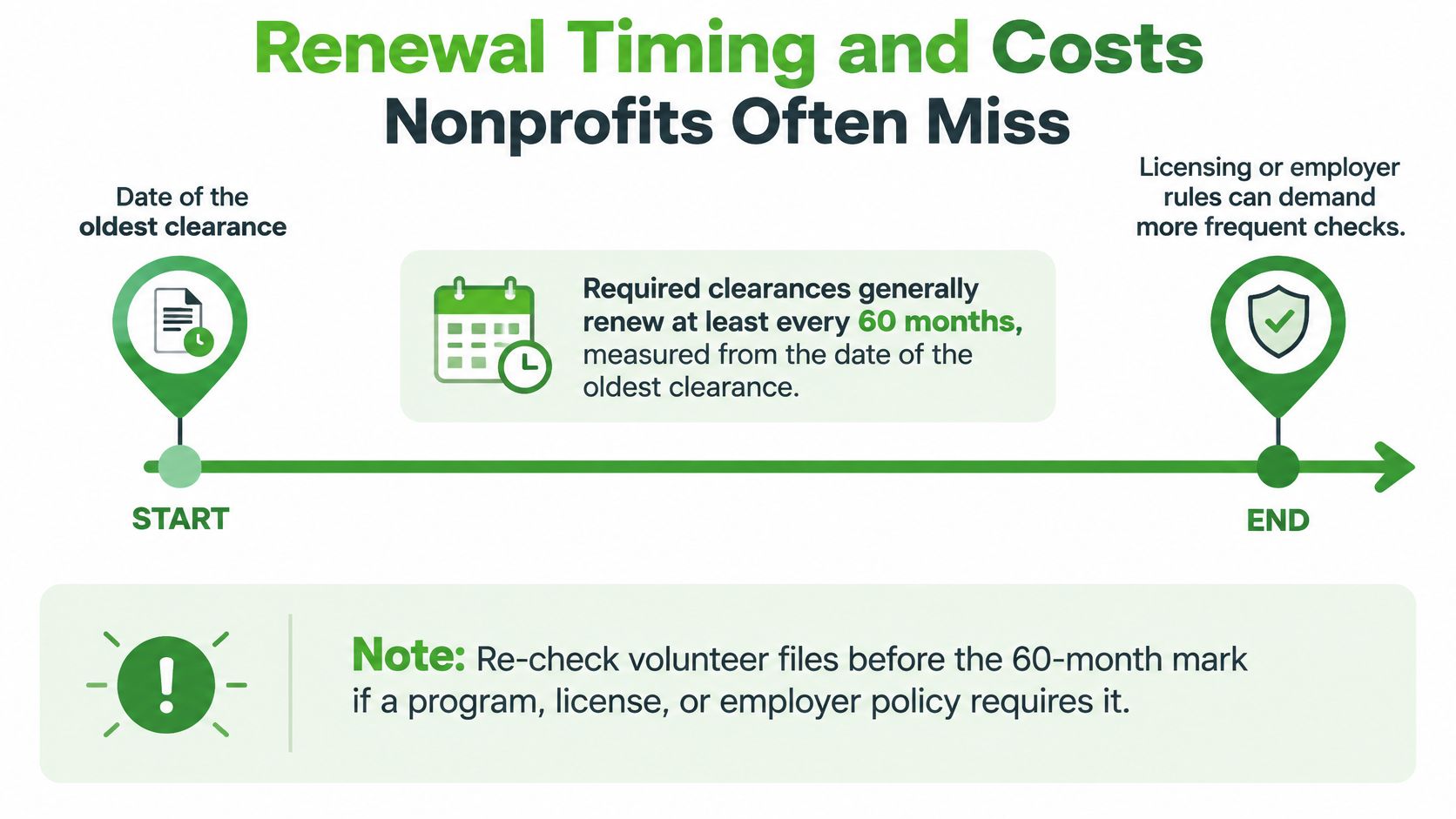
The anchor date is the oldest document in the file. A volunteer whose child abuse certification is issued in March 2024 and whose State Police check comes back in June 2024 renews on the March date, and the newer certificate doesn't push the deadline out. That's why a renewal calendar keyed to each certificate's issue date beats a single "expires" field in a spreadsheet.
Where the money actually goes
The fee structure creates a planning blind spot because the parts don't move together. Pennsylvania waives the Child Abuse History clearance fee for volunteers, who can request it at no cost once every 57 months, while the FBI volunteer fingerprint check carries its own fee, listed by the state at $22.95 before a stated October 1, 2026 increase to $25.95, according to the DHS FBI criminal history check page.
That split matters. A volunteer can hold a free, current child abuse clearance while the federal fingerprint requirement still depends on residency history and the role itself. Budget the paid component per volunteer per cycle, and treat the free component as a date-management problem instead of a cost problem.
Reuse is where the rules diverge. Pennsylvania education guidance treats certifications obtained within the previous 60 months as usable for volunteer service in any program, activity or service, while DHS cautions that an FBI clearance obtained through another department or entity may not be acceptable for its purposes. Accepting a coach's clearance packet from a school district without checking the source is how a file looks complete and isn't.
Set reminders well ahead of the 60-month mark, ideally at 90 days, so a volunteer whose certification lapses has time to reapply before a scheduled event. Track the issue date, the renewal deadline, the residency category, whether fingerprints were required and the role's actual child contact in one record. When a volunteer changes roles, the residency and fingerprint questions come back into play even if the certificates are still valid.
Screening Mistakes That Leave Volunteers Unverified
Say a youth soccer league runs national criminal searches on every coach, considers the roster cleared and moves on to the season. Months later, an audit or an insurer's questionnaire asks for the coaches' Pennsylvania child abuse certificates, and nobody can produce them. The searches were real. The compliance wasn't.
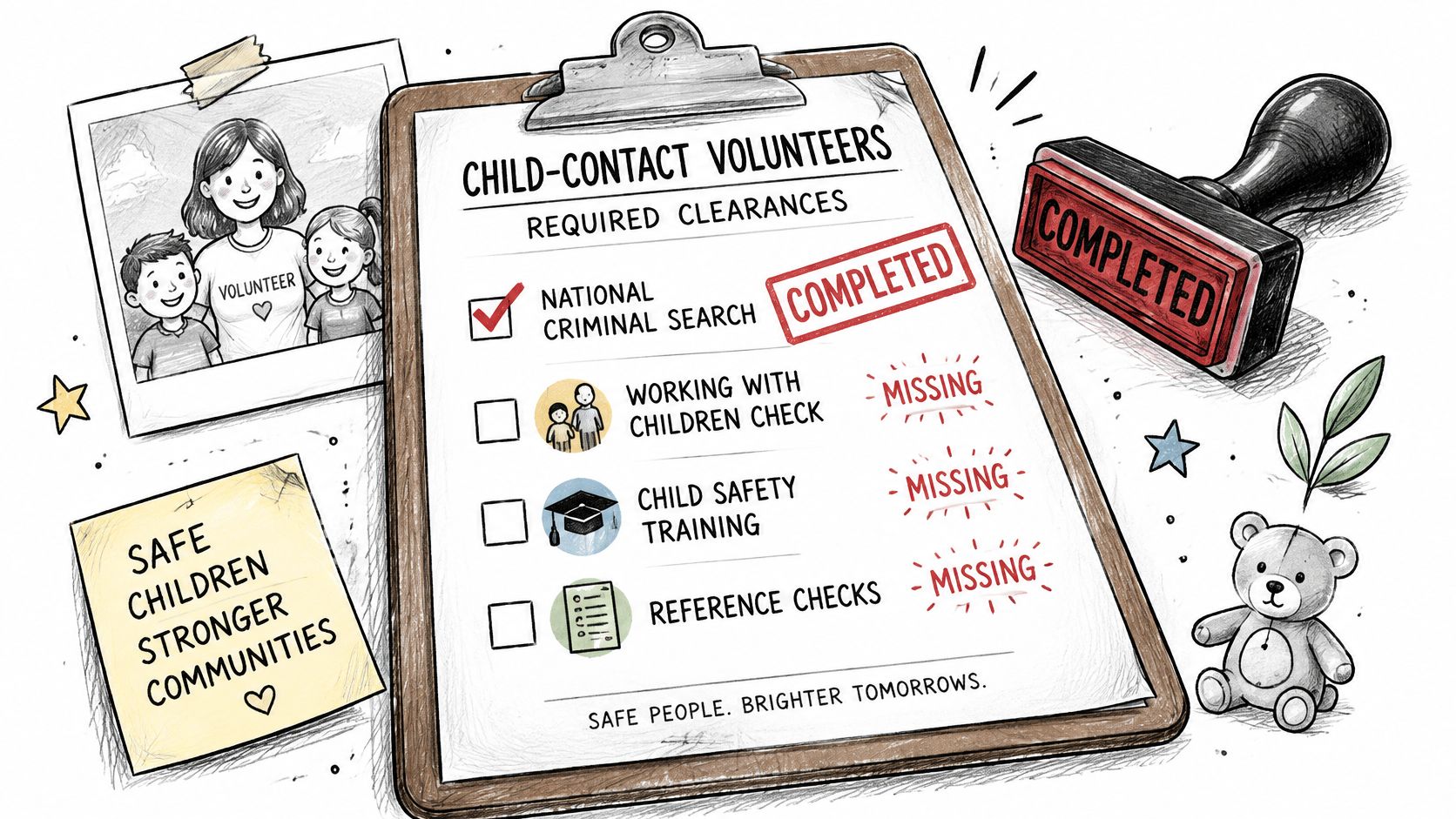
Mistake one is treating a national criminal search as a Pennsylvania clearance. The searches return court records from county, state and federal sources, and they're worth running. They still don't produce a DHS child abuse certification or a State Police record check. Order both and keep the PDFs.
Mistake two is accepting the signed affirmation alone. It's a residency disclosure, not a clearance, and it never replaces the state documents. Collect the affirmation and the certificates as one packet.
Mistake three is counting nonresident days loosely. The calendar-year threshold for visiting volunteers turns on how many days someone serves, and a volunteer who starts as a tournament-weekend helper can cross it during a long season. Log service days per volunteer per year.
Mistake four is waving through an incomplete disclosure or an offense you've decided not to examine. A disqualifying offense under the Child Protective Services Law blocks approval, and deliberate nondisclosure is a third-degree misdemeanor. Ask for full disclosure up front, then record who reviewed the answer and what they decided.
Mistake five is starting service on a pending application when the program doesn't qualify for a provisional exception. Confirm eligibility first, because a volunteer who has already been alone with children can't be un-trained.
An unverified volunteer on a child-contact roster exposes the organization in three directions at once: denial of the volunteer's position, audit or licensing findings, and the loss of programs that depended on that person. A written volunteer screening policy that names the documents, the reviewer and the approval gate turns all five mistakes into checkpoints somebody owns. Write it once, then audit your own roster against it each season instead of waiting for someone else to.
Pennsylvania's certificates have to come from state agencies, but the national search, the signed disclosure and the renewal calendar around them don't. VolunteerBadge runs an FCRA-compliant national criminal search for $5 per check with no contract and no monthly fee, and every volunteer application includes a free digital disclosure and authorization, so the commercial side of the file is finished before the state clearances land. Visit VolunteerBadge to create a free account and run your first Pennsylvania volunteer through it.
