
How to Compare Background Check Companies for Nonprofits
Compare background check companies on coverage, FCRA compliance, pricing, turnaround and API access, with a scorecard and benchmark steps for nonprofits.
On this page
Finding a criminal record isn't the same as finding a reason to reject someone. In an analysis of federal civil-service suitability cases involving identified criminal conduct, 76% of determinations were favorable, according to the EEOC's Second Chances report. That distinction should shape how nonprofits compare background check companies: you're buying reliable information for a decision, not an automated verdict about a volunteer.
A broad search can help locate records. A dependable provider must also establish whose records they are, whether they're current, and what they say.
Table of Contents
- Why Volunteer Screening Needs More Than a Cheap Report
- Six Criteria That Separate Background Check Providers
- Coverage Versus Verification Quality
- Pricing Models and the Costs Behind the Quote
- Turnaround and API Access for High-Volume Intake
- How to Benchmark Providers Side by Side
- Choose a Provider and Set a Re-Screening Schedule
Why Volunteer Screening Needs More Than a Cheap Report
The cheapest report isn't necessarily the least expensive screening process. If your coordinator has to untangle questionable matches, chase missing dispositions, or explain an unclear report to a volunteer, you've shifted work from the vendor to your own team.
Screening became mainstream long before many nonprofits developed formal review procedures: 80% of large employers conducted criminal background checks in 2004, up from 51% in 1996, according to EEOC meeting testimony on employment screening. Commercial reporting companies became intermediaries between organizations and government-held court records. Buying access, however, doesn't transfer responsibility for the final decision.
The practical distinction is between purchasing information and purchasing information your team can responsibly use.
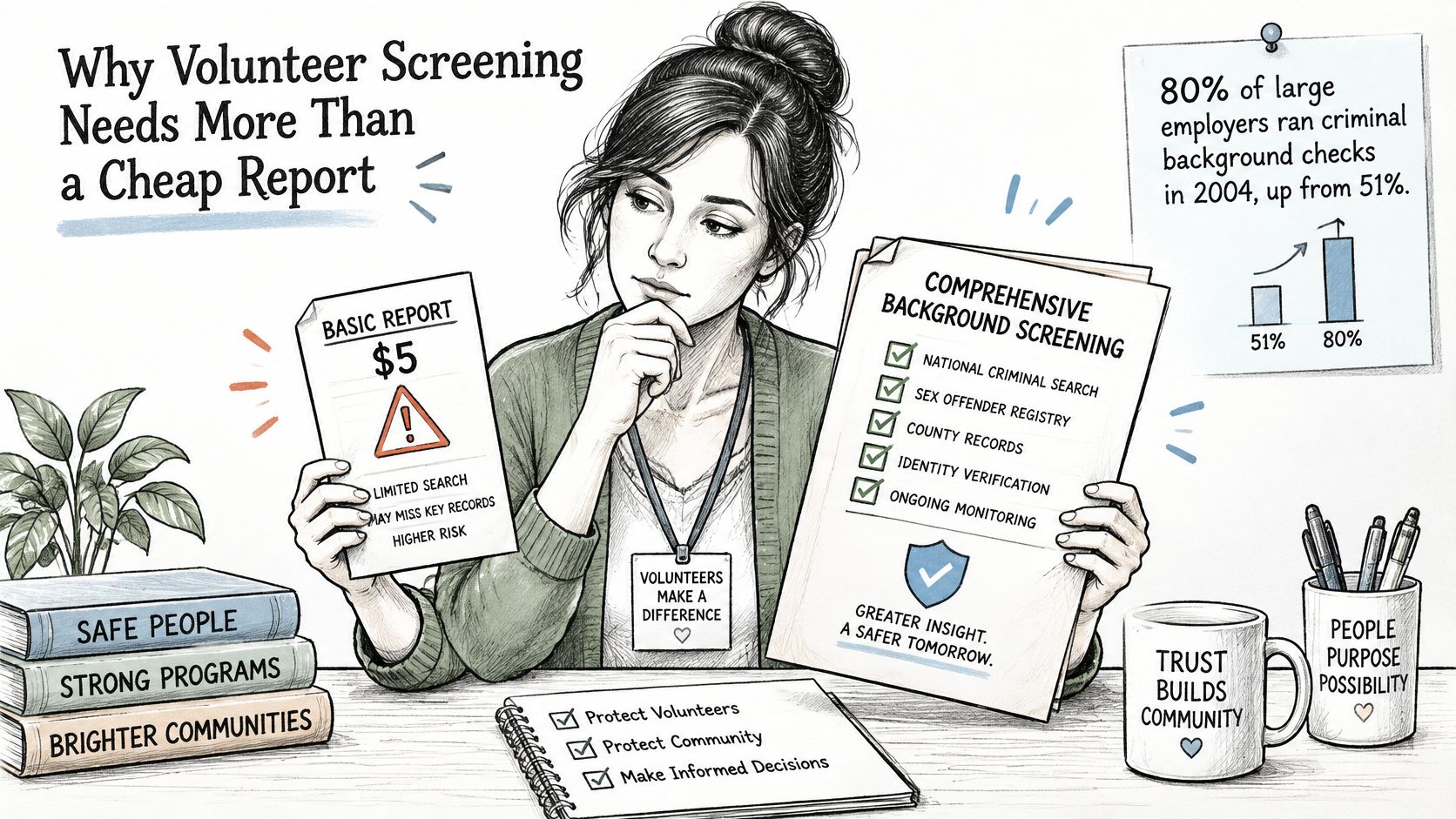
Buy a process, not just a search
A nonprofit without dedicated HR staff needs understandable reports, accessible dispute support, and clear ownership of unresolved cases. Otherwise, a low headline price can leave the volunteer coordinator doing investigative work they're not equipped to perform.
The Fair Credit Reporting Act, or FCRA, provides the framework for reports used for employment and other regulated purposes, including permissible purpose, disclosure, authorization, accuracy, and dispute procedures. For volunteer screening, have counsel confirm the requirements applicable to your organization and roles rather than assuming unpaid service falls outside screening law.
Procurement rule: Ask what the provider does before questionable information reaches your decision-maker, not just how many records it can search.
Compare coverage, compliance workflow, pricing, turnaround, integration, and source quality together. A bigger database may produce more potential matches. A decision-ready check explains which matches belong to the applicant and supports a documented, fair review.
Six Criteria That Separate Background Check Providers
Six criteria for comparing background check providers
| Criterion | What to Verify | Red Flag | What Good Looks Like |
|---|---|---|---|
| Coverage | Named jurisdictions, record types, and county-level retrieval | Nationwide database claim without source details | Named county, state, and federal sources, with county verification for relevant locations |
| FCRA compliance | Permissible-purpose, disclosure, authorization, and dispute workflows | Disclosure presented after ordering or treated as optional | Digital disclosure and authorization before ordering, with pre-adverse and final adverse notice support |
| Pricing | Total cost per completed check, including add-ons and platform fees | Required components omitted from the headline price | Clear per-check pricing with additional charges stated upfront |
| Turnaround | Defined start, completion, and exception points | Instant results without a definition of completion | Published service expectations and explanations for delayed searches |
| API and webhooks | REST documentation, API credentials, and status callbacks | File uploads without automated status updates | Documented API, relevant webhook events, and explicit access terms |
| Data sources | Source names, refresh practices, and identity-matching methods | Database size offered as the main evidence of accuracy | Documented sourcing, refresh practices, and applicant-matching procedures |
Use this framework to separate essential controls from convenience features. The criteria below should remain distinct even when a vendor sells them as a single package.
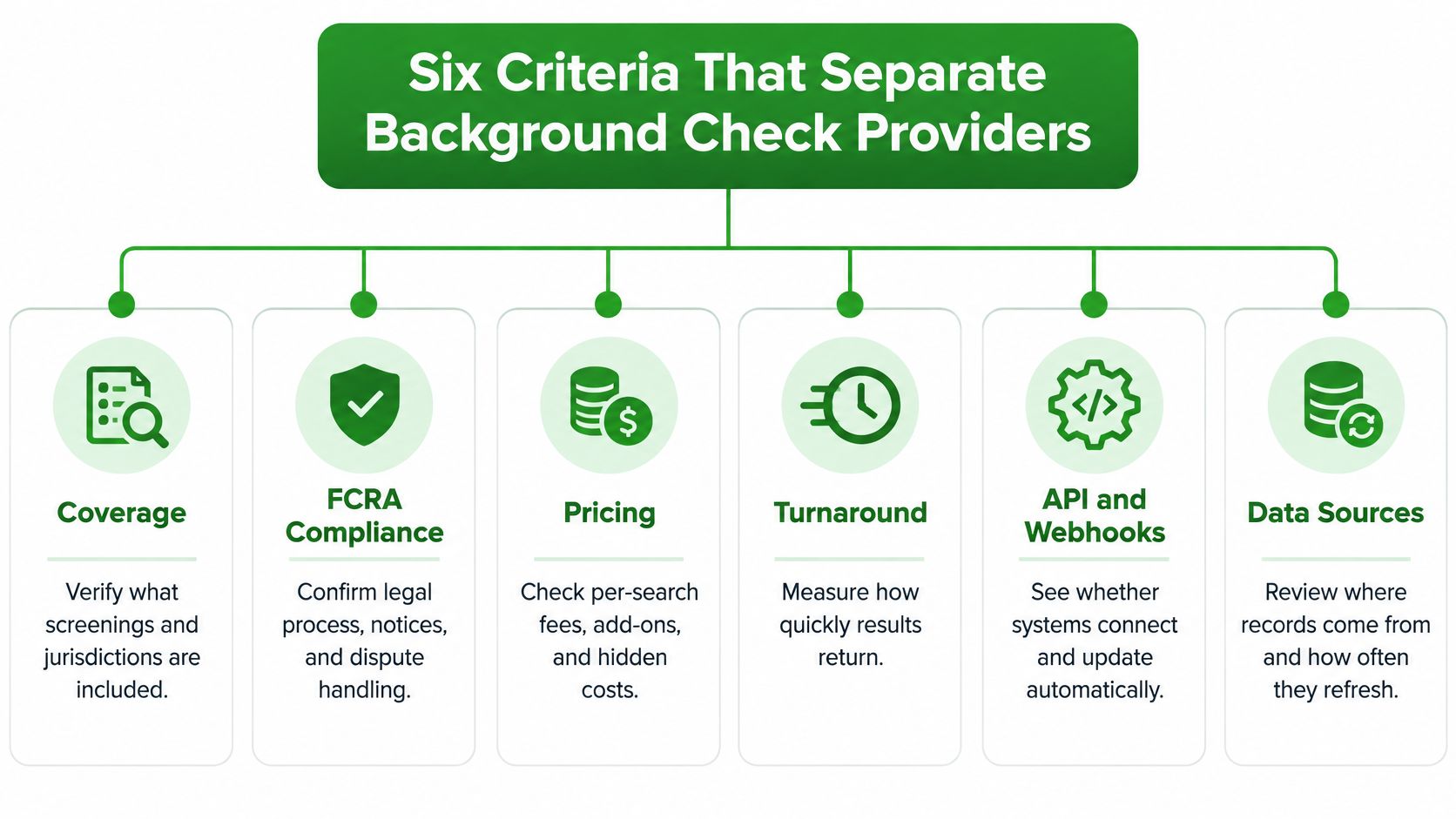
Set a consistent scoring scale
For your internal scorecard, use a scale from one to five. These are procurement ratings, not industry standards:
- One means unsupported: The vendor can't explain the process or provide evidence.
- Two means incomplete: Some capabilities exist, but important steps require workarounds.
- Three means documented: The service meets your written minimum requirements.
- Four means demonstrated: Documentation and a working demonstration support the claim.
- Five means validated: Your pilot confirms the capability, including exception handling.
Record the evidence beside every rating. A sales representative saying county verification is available isn't equivalent to a sample showing when verification happens and what it costs.
For a youth program, I would give coverage, matching quality, and compliance workflow more influence than price. For a small church with occasional intake, predictable billing and easy authorization may deserve greater weight, provided the vendor still meets the safeguarding minimums.
Distinguish requirements from preferences
Free disclosure forms and API access without a separate contract are useful buying preferences, not proof of legal compliance. Likewise, per-component pricing isn't automatically bad. It becomes a problem when mandatory components appear only after you've committed.
Ask vendors to demonstrate an ordinary application and an exception case. Can a volunteer correct information? Can your coordinator identify the next action without calling sales? Does the system preserve the decision history?
Use the following video as a discussion prompt, then require vendors to demonstrate their own workflows.
A polished interface earns no extra credit if your team still has to reconstruct what happened.
Coverage Versus Verification Quality
A national search isn't automatically the most complete or accurate check. It describes a search scope, not a guarantee that every jurisdiction contributes current records or that every returned record belongs to your volunteer.
The FTC's guidance for employment background screening companies requires reasonable procedures for maximum possible accuracy and identifies problems including name-only matching, duplicate offenses, mismatched dates of birth, and sealed or expunged records. Those are reporting-quality problems, not gaps you solve by adding another database.
Search types, what they cover and where they fall short
| Search Type | What It Covers | Known Limit | Use It When |
|---|---|---|---|
| National database search | Aggregated records from participating jurisdictions | Potential mismatches, duplicates, outdated records, and coverage gaps | Locating leads for source-level verification |
| County courthouse search | Records held by the relevant county court | Limited to that jurisdiction and the records searched | Residence history or another lead identifies a relevant county |
| State repository search | Records submitted to a state's central repository | Completeness relies on participating agencies and reporting practices | Relevant residence spans several counties within a state |
| Sex offender registry search | Registered offenders in the registries searched | Doesn't identify every person who has committed sexual misconduct | Evaluating roles involving children or vulnerable adults |
| Child abuse registry search | Accessible state child-protection findings | Access and reportable information are governed by state rules | Screening child-serving roles where access is permitted |
| Federal and watchlist search | Selected federal records, sanctions lists, and wanted-person lists | Sanctions and wanted-person lists aren't substitutes for criminal court searches | A role requires federal-record or sanctions review |
Keep unlike searches separate
Ask the provider to distinguish federal criminal court searches from watchlist searches. OFAC sanctions and the FBI Most Wanted list serve different purposes from a search of criminal case records. A package label that combines them can make limited coverage sound broader than it is.
The same discipline applies to registries. A sex offender registry search doesn't replace a child abuse registry review, and neither replaces role-specific references or supervision.
For each component, ask what happens when the search returns a possible match. Does the provider resolve identity, retrieve the underlying record, and check the case outcome? Or does it send your coordinator a flag and leave the investigation to them?
More search results aren't necessarily more useful information. An unresolved match is work to complete, not a finding to act on.
Require a traceable verification chain
Use address history to identify relevant jurisdictions, while treating it as a search aid rather than proof that every residence has been captured. Have the provider explain how aliases, incomplete addresses, and conflicting identifiers change the search plan.
For a county hit, require source-level confirmation before relying on adverse information. The reviewer should be able to distinguish the charge from the disposition and see which identifiers support the match.
A clear background check report format helps your team inspect that chain. Ask for a redacted sample that shows a resolved match and an unresolved case, not only a clean report.
Pricing Models and the Costs Behind the Quote
Total cost per completed check equals all screening charges for the period divided by completed checks. Add base report charges, required components, platform fees, and applicable extras before dividing. Don't divide a single report's price by monthly volume, and don't compare packages that contain different searches.
A headline rate is useful only after you've defined the same screening specification for every vendor. Ask each provider to price that specification, including the verification work needed to make the report usable.
Pricing models and the cost you need to check
| Pricing Model | How It Is Billed | Hidden Cost to Check | Best Fit |
|---|---|---|---|
| Flat per-report fee | Charge for each report ordered | Add-ons, rush fees, and re-order charges | Low, infrequent volume |
| Monthly platform plus per-check | Recurring platform fee plus report charges | Charges during idle months | Steady year-round intake |
| Flat per-check, no monthly fee | Per-check price without a platform charge | Whether address history, registries, and disclosure tools are included | Uneven intake and small teams |
| Bundled package | Prepaid allocation for a defined period | Expiring unused checks and overage charges | Predictable volunteer cohorts |
| Per-component billing | Separate charges for individual searches | Combined cost of the complete screening specification | Targeted supplemental searches |
Compare your intake pattern, not someone else's
Consider a youth program that screens a large cohort before a season and a church that adds volunteers sporadically. The youth program may use a prepaid allocation efficiently. The church may pay for capacity it never uses.
A monthly platform plan can make sense when staff use its workflow features throughout the year. It can be poor value when the account sits idle between recruitment drives. Lower marginal cost doesn't guarantee lower total cost.
Use your actual intake calendar to request quotes. Include a quiet period and a recruitment surge, then ask what happens if you exceed the expected volume or need to repeat an incomplete order.
Put the inclusion list in writing
Before accepting a flat rate, confirm whether it includes address-history retrieval, the required registries, authorization tools, and source verification. Ask separately about courthouse access charges, cancellations, duplicate applications, and reports that cannot be completed.
Your transparent pricing model checklist should also distinguish provider charges from internal work. A coordinator repeatedly chasing exceptions adds operational cost even when the invoice looks modest.
Budget test: Compare the cost of a completed, usable screening process, not the cost of pressing the order button.
Turnaround and API Access for High-Volume Intake
Standard criminal searches commonly take 24–48 hours, while employment, education, reference, and international checks generally take longer, according to SHRM's guide to choosing a background screening provider. Treat that as a procurement benchmark, not a promise that every jurisdiction or application will finish within the same window.
Separate report production from organizational approval. A completed search may still require your reviewer to evaluate relevant information, contact the volunteer, or complete the applicable notice process.
The visual below summarizes the distinction between routine searches and broader verification work.
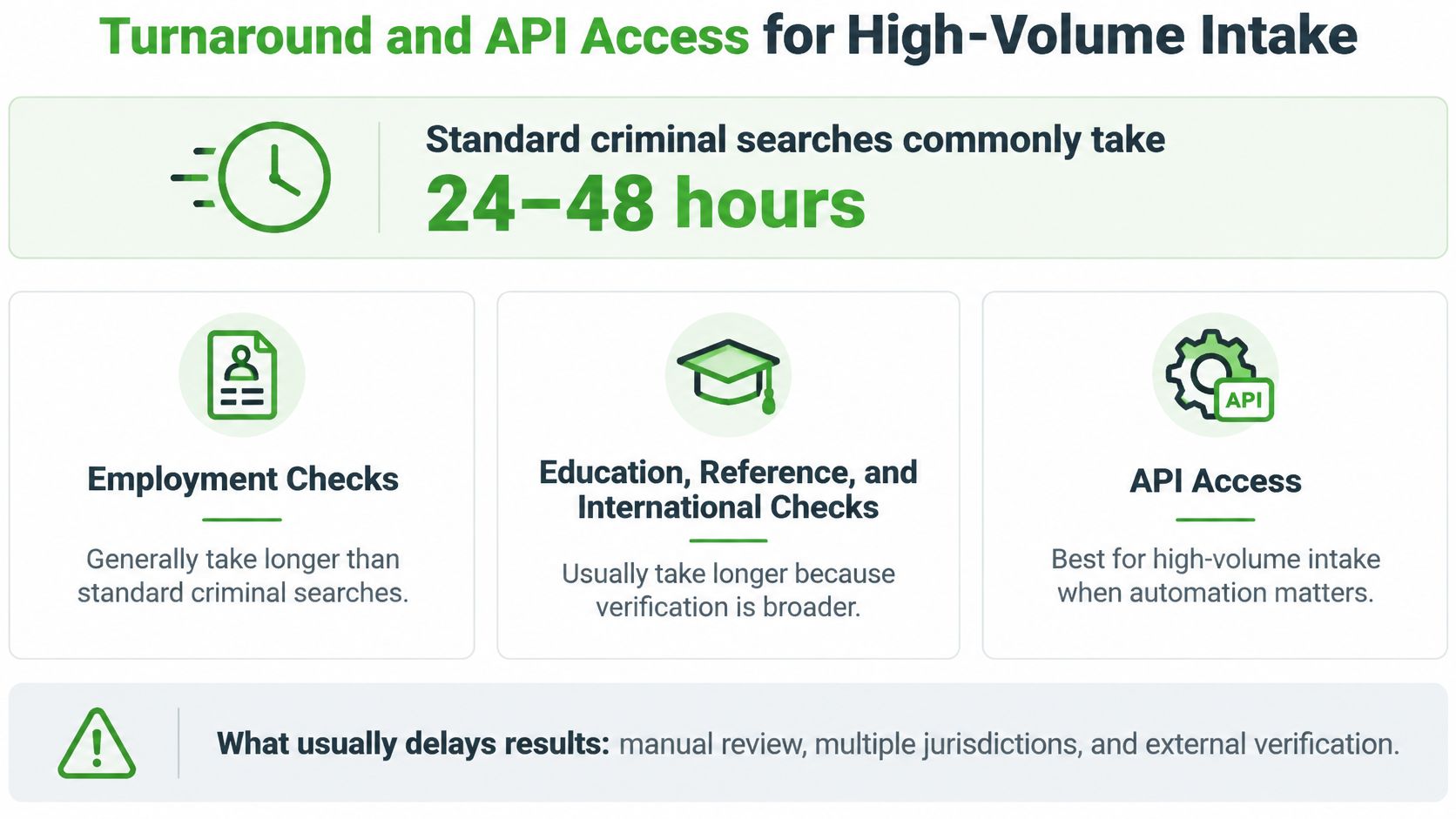
Ask what pending actually means
A useful dashboard distinguishes waiting for authorization, identity review, source retrieval, report review, and organizational adjudication. A single pending label doesn't tell your coordinator whether to contact the volunteer or leave the case alone.
Ask for the escalation path when a courthouse search stalls. Also ask how the vendor handles incomplete online records, updates its legal procedures, and documents compliance reviews. Speed shouldn't come from skipping necessary verification.
Automate handoffs without automating judgment
A REST API lets your intake system submit authorized orders without re-keying applicant information. Webhooks let the provider notify your system when a status changes, rather than requiring staff to refresh a portal.
Require a demonstration using your actual workflow:
- Access terms: Is API access included, and are technical support or implementation charges separate?
- Event coverage: Which events identify completion, exceptions, disputes, and notice-related stages?
- Order consistency: Do web, mobile, and API orders use the same package definitions and account credits?
- Failure handling: How are retries, duplicate orders, and missed callbacks handled?
Use a background check API integration guide to map the handoffs before involving your developer. Keep sensitive report content out of general volunteer-management notes, and restrict access to designated reviewers.
An integration should update an applicant to ready for review, not automatically declare them suitable. A fast report that nobody notices still leaves a volunteer waiting.
How to Benchmark Providers Side by Side
Run a controlled pilot before signing a long-term agreement. Use consenting participants, a documented permissible purpose, appropriate access controls, and an approved retention plan. Don't order reports on unsuspecting people to test a vendor.
For employment decisions, the EEOC's enforcement guidance on arrest and conviction records distinguishes arrest from proof of conduct and emphasizes the nature of the offense, time elapsed, and job relevance. Build a review process that can evaluate context rather than treating every record as an automatic exclusion.
Run the same test for every shortlisted vendor
Request a redacted sample report. Check source names, jurisdictions, retrieval dates, identifiers, and dispositions. This exposes vague reporting before you spend money on a pilot.
Build a consented test group. Include common names and different residence histories without pressuring participants to disclose sensitive information publicly. These cases help test matching and jurisdiction selection.
Use the same authorized search specification. Log potential matches, verified findings, unresolved results, and corrections. Different packages won't provide a fair accuracy comparison.
Apply the fixed scorecard. Rate each criterion using the documented scale and attach evidence. Keep an unknown capability marked unverified rather than awarding an optimistic score.
Assign dispute and decision ownership. Ask who investigates accuracy disputes, who communicates with the applicant, and who controls notice-related steps. Written responsibility prevents cases from bouncing between the vendor and your coordinator.
Inspect maintenance practices. Request source-refresh procedures and re-screening terms. A clear explanation is more useful than a general claim that records are constantly updated.
Calculate completed-check cost. Include required additions and unresolved orders, while recording staff handling time separately. This prevents an inexpensive initial search from winning on an incomplete invoice.
Review the paperwork before ordering. Inspect disclosure, authorization, certification, and applicable notice materials with counsel. A product demonstration doesn't establish that your organization's implementation is appropriate.
Use the process visual as a meeting aid, with your evidence log beside it.
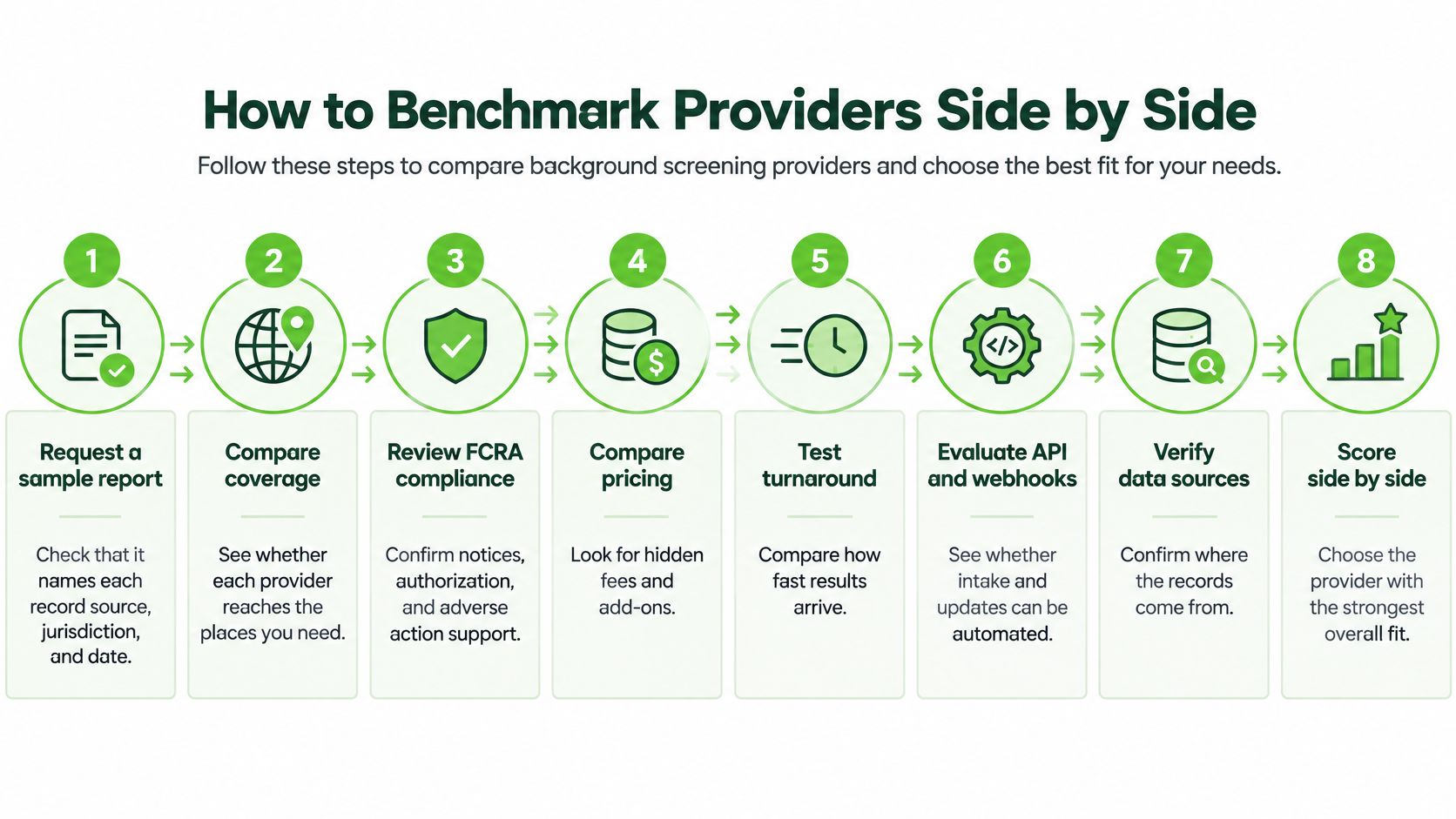
Establish a minimum before comparing totals
I would exclude a provider from child-serving screening if its coverage or compliance workflow falls below documented minimum requirements, regardless of its overall score. That's a procurement recommendation, not a legal threshold.
Don't allow strong API features or low prices to compensate for unsupported matching practices. If a vendor can't demonstrate how it resolves an inaccurate result, pause the purchase until it can.
Choose a Provider and Set a Re-Screening Schedule
In a national survey of 517 nonprofit human-services organizations, only 32% reported periodically re-screening volunteers, according to the Nonprofit Risk Management Center's account of volunteer screening practices. A broader initial search cannot replace renewal tracking, incident reporting, and review when a volunteer's responsibilities change.
Choose a provider around the duties volunteers perform. A church nursery volunteer and a church event greeter should not automatically receive identical screening packages. National database breadth matters, but source-level verification determines whether a potential match is ready for a volunteer-placement decision.
Provider profile by organization situation
| Organization Situation | Top Priorities | Provider Profile to Choose |
|---|---|---|
| Youth programs and youth sports | Relevant registries, county verification, and renewals | Provider with documented registry coverage, source-level verification, and clear re-screening terms |
| Church with a small volunteer base | Predictable cost, accessible authorization, and simple administration | Flat per-check provider without a monthly fee, with included disclosure tools |
| Large program with high turnover | Automated ordering, status updates, and exception management | Provider with documented API and webhooks; compare recurring pricing against per-check costs |
| Schools and after-school programs | Applicable state coverage and auditable procedures | Provider able to document compliance controls and required state-specific searches |
| One-off event volunteers | Proportionate screening and controlled cost | Per-check provider paired with role restrictions and a defined rule for returning volunteers |
Write the renewal policy before signing
Set re-screening intervals by role, applicable law, insurer requirements, and program risk. An annual subscription is a purchasing arrangement, not a reason to apply the same interval to every volunteer.
Make responsibility explicit. Your policy should identify who receives renewal alerts, who pays for repeat checks, and who reviews screening requirements when duties change. Moving from supervised event work to unsupervised access should trigger a review of whether the original screening remains appropriate. A returning event volunteer also needs a clear rule: when does the previous check remain acceptable, and when is another required?
Scheduled checks need an incident-reporting process alongside them. Identify who receives safeguarding concerns and who decides the next step. A future renewal date should never postpone evaluation of a new concern.
Keep screening inside a broader operating system
References, orientation, supervision, access restrictions, and reporting channels remain necessary after a satisfactory report. Assign a named owner to each control. Otherwise, a completed report can become the only recorded safeguard while day-to-day responsibilities remain unclear.
For health-service nonprofits, assess access to patient information and systems separately for each position. Apply that role-by-role review to volunteers, direct-service staff, and remote administrative positions such as Medical Virtual Assistants, rather than applying a volunteer screening package to every role.
I would finish procurement with a consented pilot, a written list of included searches, and an approved renewal policy. Give the coordinator responsibility for renewal alerts and unresolved cases before routine ordering begins. Choose a provider whose verification and follow-up workflow your team can operate responsibly.
VolunteerBadge offers nonprofit volunteer screening with digital disclosure and authorization, report-review guidance, and API and webhook options. Visit VolunteerBadge to compare its workflow against your role requirements and request coverage and pricing details for a controlled pilot.
