
Background Check API Pricing for Nonprofits
Compare background check API pricing models, court fees, and total cost so nonprofits can budget volunteer screening without surprise charges.
On this page
The cheapest API credit on a pricing page is rarely the cheapest way to clear a volunteer. That advice sounds counterintuitive, but anyone who has reconciled a screening invoice knows why it matters. You've got to judge background check API pricing by the cost of one finished, compliant decision you can use, not by the starting rate for one search component. Everything else (court fees, extra counties, notices, your staff's time) shows up later if you don't price it now.
Table of Contents
- Why Background Check API Pricing Misleads Buyers
- How Background Check API Pricing Models Work
- Comparing Per-Check Subscription and Tiered Pricing
- Cost Drivers Behind County and National Searches
- Nonprofit Use Cases for Background Check API Pricing
- Calculate Total Cost Before You Integrate
- How to Choose a Background Check API
Why Background Check API Pricing Misleads Buyers
Stop shopping for the lowest listed credit. That's the popular advice, and it's the wrong starting point for a nonprofit. A headline rate usually prices one slice of work, then your team discovers the rest on the first invoice or, worse, in unpaid hours spent chasing an incomplete report.
The core problem is simple. Background check API pricing is usually shown as a single per-check number, while you need the true cost per usable decision. That headline can exclude identity and address verification, county-court searches, federal searches, sex-offender registries, manual record retrieval, disputes, integrations, and adverse-action workflows, and public pricing discussions span roughly $5 to $140 depending on the search components included.
That spread isn't evidence that one vendor is gouging and another is a bargain. It's evidence that they're not selling the same work. A name-based database pull isn't the same product as a package that also checks county, state, and federal sources, sends the required notices, and gives your coordinator a result she can act on without opening three other systems.
The question that exposes the real price
Ask this instead: what's included in the API response, and which events trigger another charge?
- Extra addresses: Does a volunteer with several prior addresses trigger more county searches, and are those billed separately?
- Unverifiable records: Do you pay when a county record can't be verified or a search returns nothing usable?
- Compliance work: Who sends disclosure, authorization, and adverse-action notices, you or the vendor?
- Operations: Are webhooks, sandbox access, seats, and minimums included, or are they separate line items?
If a vendor can't answer those in writing, you don't have a price. You have a starting point.
A low API rate that forces your coordinator to reconcile partial records by hand isn't cheap. It's a labor cost with a software label.
That's why a transparent pricing model for volunteer screening matters more than a low entry tier. For the rest of your comparison, use one metric: all-in cost per completed, compliant volunteer decision. Count the searches required for the role, the fees those searches trigger, the notices, the dispute path, and the staff time to close the file. If a quote doesn't cover that full path, you're comparing a partial bill against a complete one.
How Background Check API Pricing Models Work
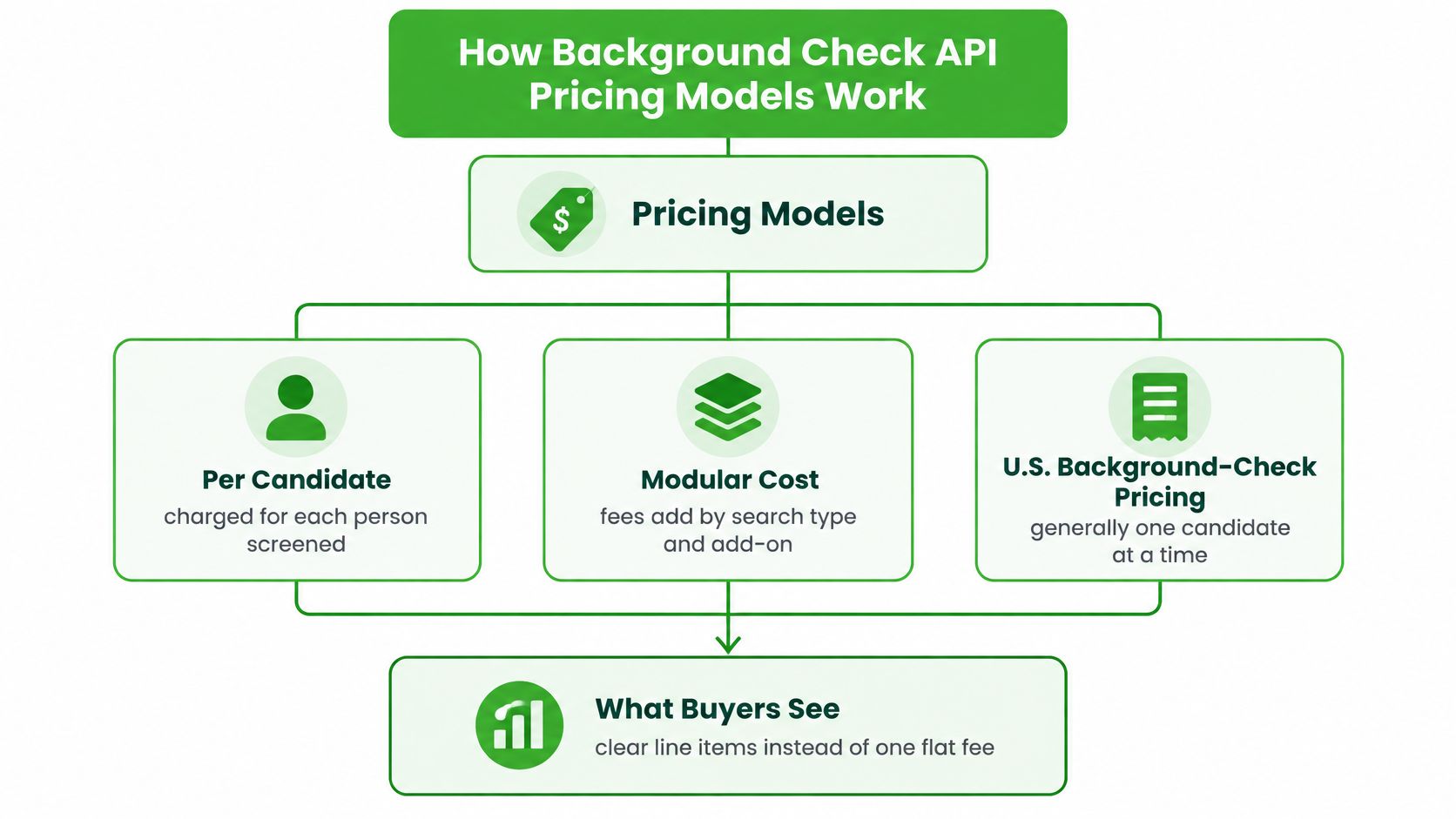
Vendors rarely bill you for the API. They bill you for the searches the API orders. Once you see that distinction, price pages get much easier to read.
U.S. pricing is generally per candidate and modular, rather than one standardized API fee. A published pricing comparison puts basic criminal screening near $14 per check, identity traces at $2 to $5, basic criminal packages at $15 to $40, standard packages at $40 to $90, and complete packages at $90 to $200 per candidate. The same comparison notes entry prices advertised near $29.99, broader packages commonly running $50 to $150, and enterprise platforms quoting custom rates instead of publishing prices, as shown in the employee background check services pricing comparison.
What a basic package usually contains
A typical basic package combines an identity or Social Security number trace with a national criminal database search and one county search. Higher tiers add federal criminal records, employment or education verification, motor-vehicle records, drug testing, or international searches. Each addition changes the transaction cost, even though the API call looks identical in your code.
That is the practical lesson for engineering and finance. The endpoint can come at no separate charge and still produce very different bills, because the retrieval work behind it varies. One volunteer needs a single county confirmation. Another needs several jurisdictions searched before your coordinator can make a decision.
How to read any vendor price page
Separate three layers before comparing anything.
- Access layer: platform fees, seat charges, minimums, or setup costs for using the API at all.
- Search layer: which traces, database searches, and county searches sit inside the quoted package.
- Decision layer: whether applicant communications, compliance documents, and result delivery are included in that same price.
Enterprise custom quotes aren't automatically worse. They're just harder to budget until the vendor names what's inside. Published per-candidate rates earn their transparency only when you can map each volunteer profile to a final bill without guessing which add-ons will fire. The API connection is plumbing. Price the work flowing through it.
Comparing Per-Check Subscription and Tiered Pricing
Four billing shapes dominate vendor proposals, and they behave very differently when your volunteer volume is uneven. The right choice depends less on the advertised credit and more on what triggers a charge.
The most decision-relevant distinction is whether billing is per completed report, per underlying search, or a blended subscription-plus-usage model, and a 2026 cost analysis identifies database-access fees, courthouse researcher costs, compliance infrastructure, technology, and verification depth as primary drivers while estimating that compliance management, applicant experience, ATS integration, adverse-action processing, and continuous monitoring can add roughly 15 to 40 percent beyond a quoted base screening fee.
Background Check API Pricing Models Compared
| Pricing model | What triggers the charge | What the headline often excludes | When it fits a nonprofit |
|---|---|---|---|
| Per completed report | A finished report for one volunteer | Court pass-throughs, extra verifications, dispute handling | You want a predictable unit price per decision |
| Per underlying search | Each trace, county, federal, or registry search | Multi-address county work, manual retrieval | You need tight control over search depth by role |
| Published tiers | The package level you select | Add-ons outside that tier, jurisdiction fees | Your roles fall into a few stable screening levels |
| Subscription plus usage | A recurring platform fee plus each check | Seats, minimums, unused committed volume | Your volume is steady enough to use what you pay for |
Where irregular volume changes the math
Per-search billing looks precise. It can also punish exactly the volunteers who need the most careful review, because each additional jurisdiction becomes another charge. Per-report billing is easier for a board or finance lead to forecast, provided the vendor defines what counts as a completed report and whether failed searches are billable.
Subscription-plus-usage is the model to interrogate hardest if you screen in bursts. A church, league, or school program may run many checks before a season starts and almost none for months afterward. During quiet months, a minimum or seat fee keeps billing while no volunteers move through the system.
The differentiator: Monthly commitments and per-seat fees raise your effective cost per volunteer when utilization is low, even if the per-check credit looks cheap.
Tiered packages sit between those extremes. They work when your roles map cleanly to the tiers. They waste money when coordinators buy a deeper tier for everyone because nobody wants to decide, case by case, which searches a role requires.
Don't compare feature lists first. Build three sample volunteer profiles, run each profile through every model, and add the compliance and integration layer noted above. The model with the lowest fully loaded cost for your actual mix wins. A model that's cheap for a steady employer can be expensive for a nonprofit whose screening calendar is lumpy by design.
Cost Drivers Behind County and National Searches
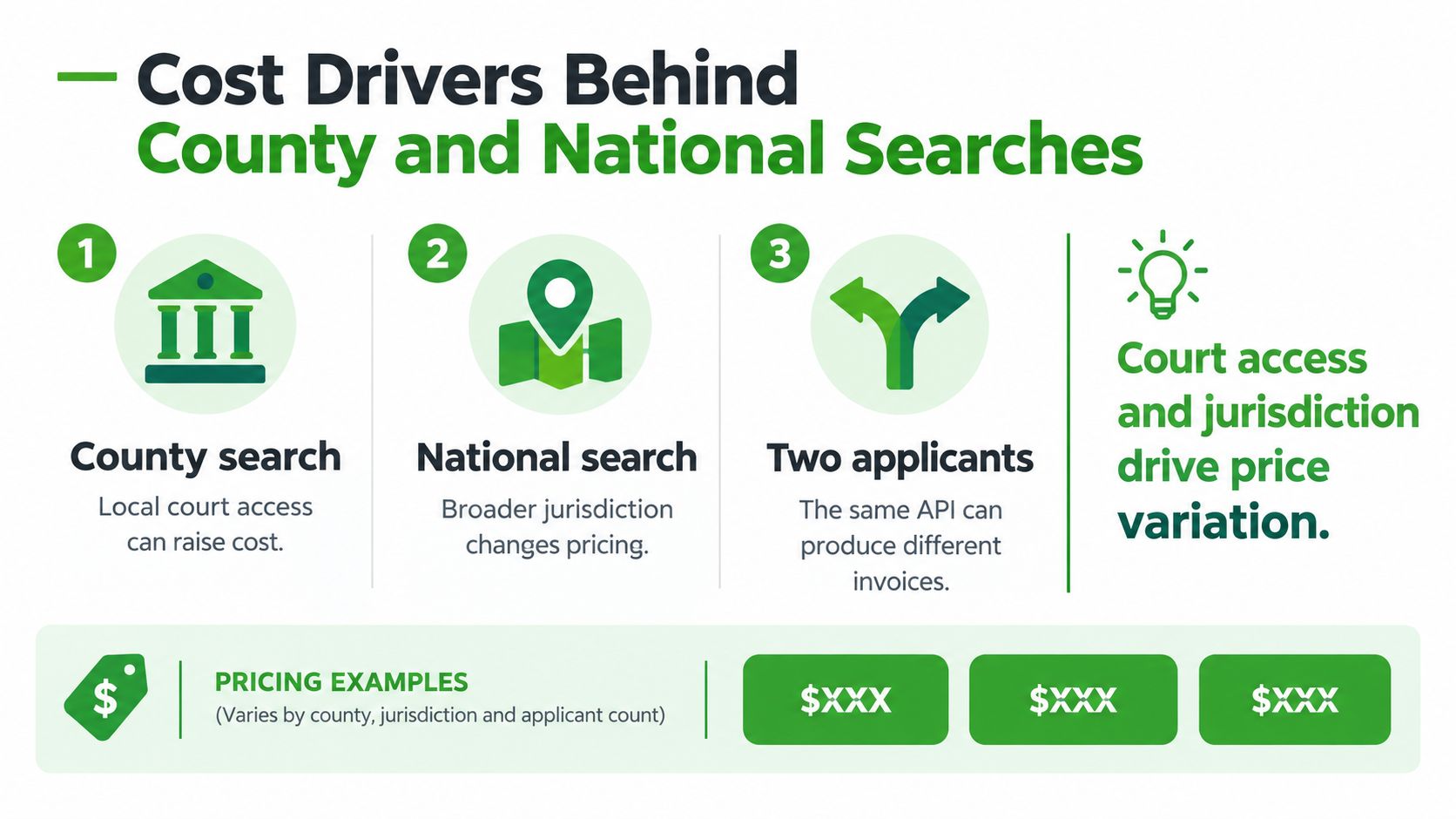
Two volunteers can enter the same API on the same day and produce different invoices. That isn't a billing error. It's the structure of U.S. criminal records.
There's no single universal database that settles every question. Searches may require access to county courts, state repositories, federal districts, and other registries. Automation speeds up ordering and status updates, but it doesn't erase the access fees or the human retrieval work some jurisdictions still require.
Jurisdiction is a price variable
Published fee schedules report county criminal searches averaging about $8.61 nationally, with Florida, Iowa, and Maryland averaging roughly $6.25. Those averages hide the extremes that break budgets.
- Low-access-cost jurisdictions: Some county court access charges start at $0.20, according to the published fee schedule data cited above.
- High-access-cost jurisdictions: Certain New York counties approach $100, and Massachusetts statewide CORI searches can cost about $90 because of repository fees, based on that same published fee data.
- Add-on verifications: Employment verification ranges from approximately $17.95 to $119.95 per search, while international criminal searches can reach $120, under the fee ranges cited above.
Read those bullets as a warning about averages. A vendor can quote you a national average and still bill far more for the volunteer whose address history lands in an expensive county. If your program recruits across state lines, your average volunteer may not exist.
Why a national search doesn't end the work
A national database search is useful for finding leads across jurisdictions. It doesn't automatically replace county-level confirmation when a record needs verification before you can rely on it. That's where a modest starter rate becomes a larger invoice, especially when address history points to several counties.
If you want to understand that layer before you sign, review how a county criminal records search works in volunteer screening and ask vendors to price it explicitly. The question isn't whether county work costs money. It does. The question is whether it's included in your quoted rate, capped, passed through at cost, or marked up as another search.
Price the completed, compliant check, including required searches, court fees, disclosure workflows, and exception handling. The technical access charge is the smallest part of that calculation, and it's the part vendors most like to advertise.
Nonprofit Use Cases for Background Check API Pricing
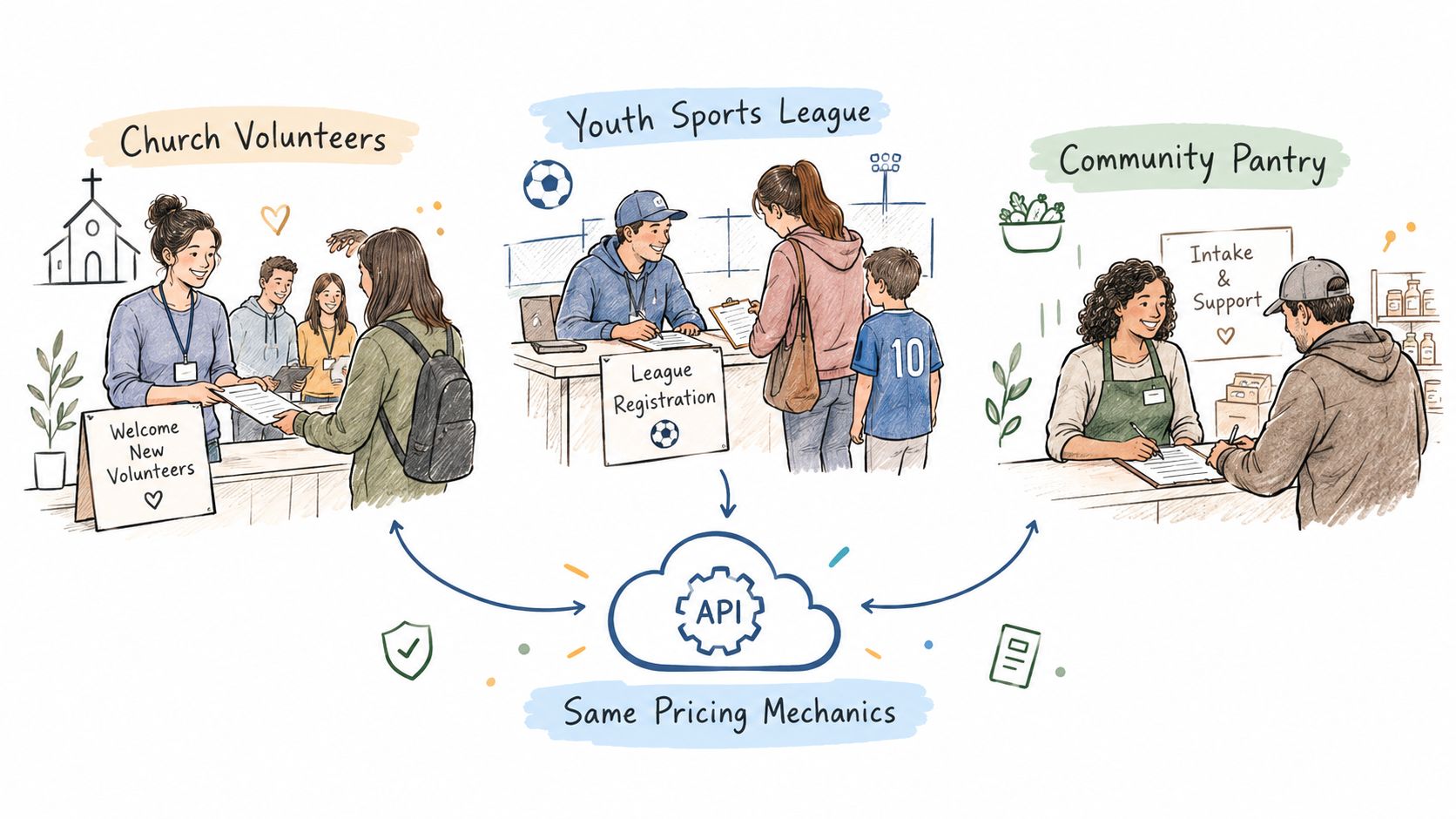
Abstract fee schedules don't tell you which model fits your program. Your calendar and your roles do. Look at three common situations and the buying mistake each one invites.
The illustration below maps the kinds of programs that run into the same pricing traps for different reasons.
A church adding volunteers steadily
A church brings on a handful of new volunteers each month for children's ministry, welcome teams, and drivers. Volume is modest and fairly steady, but the roles aren't equivalent. A greeter supervised in a public space doesn't need the same depth as an adult alone with children.
The trap is buying one deep package for everyone because it's administratively tidy. The better move is role-based depth with a per-check price your finance team can forecast. You pay for the searches each role justifies, and you don't carry a subscription designed for a much larger program.
A youth sports league with a seasonal spike
A league screens coaches and assistants in a rush before the season, then almost stops. Coaches have direct, recurring contact with minors, so cutting corners on county and registry coverage to hit a low headline rate is a poor trade. A minimum-based contract hurts here. You're busy for a short window and idle the rest of the year, so pay-as-you-go pricing usually fits better than a commitment that assumes steady monthly use.
The video below gives useful context on how screening fits into a volunteer onboarding flow before you lock in a pricing model.
A school or library program screening by contact level
A school or library may screen only roles with unsupervised contact (tutors, reading buddies, after-school mentors) while treating one-time event helpers differently under its own policy. The pricing question follows the policy question. Which components does the role need, and is anyone treating a national database result as a substitute for county confirmation because the package made that look sufficient?
Across all three cases, a transparent flat per-check price is easier to budget than a low base rate supplemented by separate charges for address history, criminal searches, and registry checks. You can explain it to a board in one sentence. You can also forecast a cohort before registration opens, instead of explaining an invoice after the season starts.
Calculate Total Cost Before You Integrate
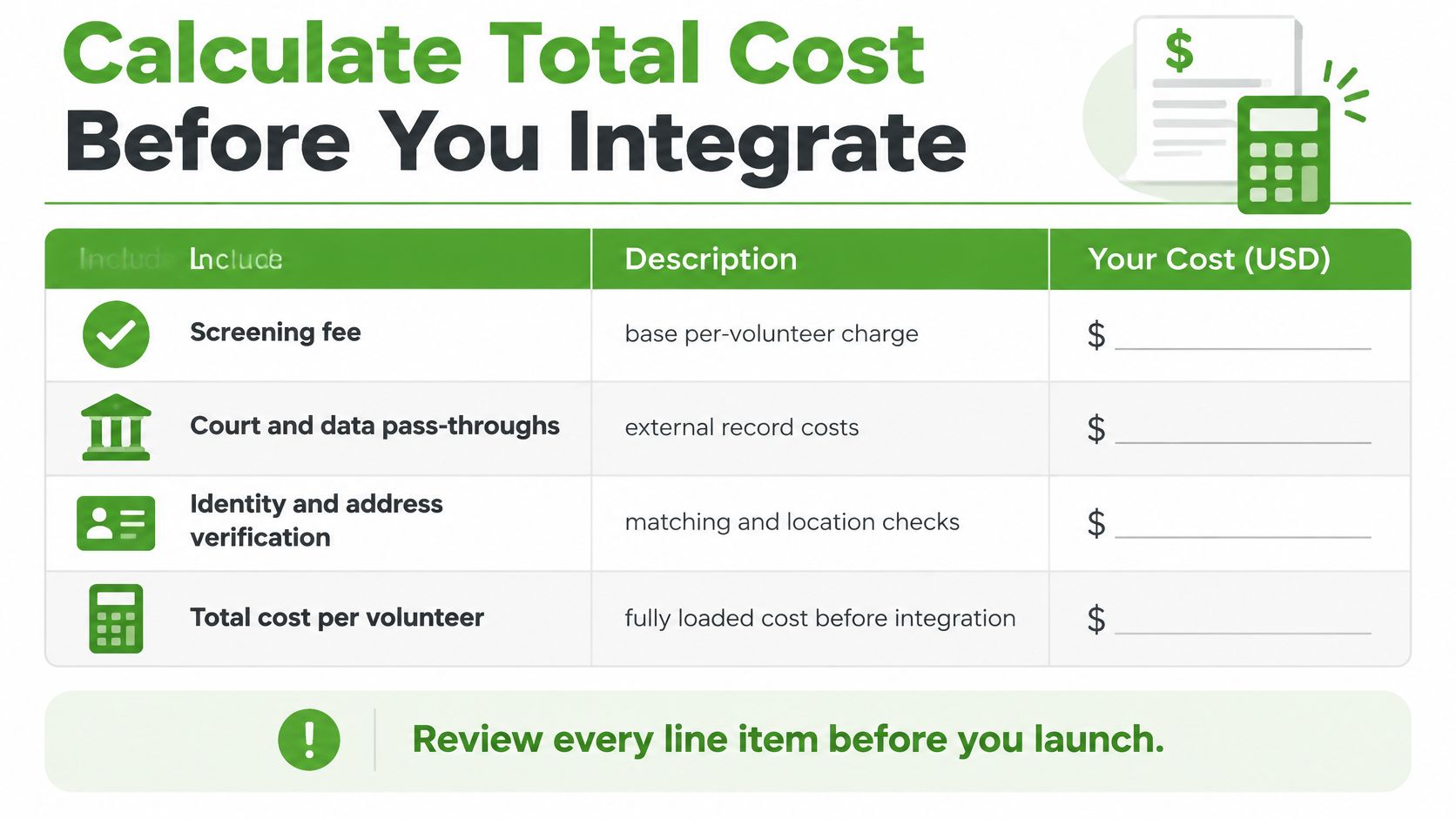
Don't write integration code against a quote you haven't stress-tested. Build the worksheet first, send it to every vendor, and require answers in the same format. That single step eliminates most pricing surprises.
Build your fully loaded unit cost
Add these lines for one volunteer, then multiply by a real upcoming cohort.
- Screening fee: The base per-volunteer charge for the package you'll order.
- Court and data pass-throughs: Jurisdiction access and researcher charges, stated separately from the vendor's own fee.
- Identity and address verification: Matching, location history, and any charge for extra counties those results trigger.
- Implementation: Setup, seats, sandbox access, webhooks, and minimums, spread across expected volume.
- Notification and dispute work: Applicant communications, report delivery, and reinvestigation support.
Then ask the uncomfortable billing questions. Is a failed or unverifiable search still billable? Are batch rows charged individually? What happens when a volunteer never completes authorization? A vendor that won't define billable events is asking you to discover them on an invoice.
Add the compliance layer you can't delegate away
The FTC states that organizations using consumer reports for personnel decisions must comply with the Fair Credit Reporting Act, including appropriate disclosure, authorization, certification, and adverse-action procedures. An API that only returns record data may still leave you to build consent capture, standalone disclosures, report delivery, pre-adverse notices, a meaningful review period, final adverse-action notices, audit logs, and dispute handling. California and Vermont are also cited as examples requiring additional review before charging applicants or volunteers.
That work has a cost whether you pay a vendor or assign it to staff. Families comparing fees for hiring a nanny face a similar lesson in a different setting, because a quoted placement or screening figure only makes sense once you know which checks, paperwork, and follow-up it covers.
Before you commit, review the technical side in this guide to background check API integration for volunteer programs and make vendors confirm which compliance documents and delivery records the integration produces. Automation doesn't transfer legal responsibility away from your nonprofit. Price the workflow you're legally required to run, not just the data you're buying.
How to Choose a Background Check API
Choose by situation, not by the longest feature list. Your volume pattern, role risk, and tolerance for building compliance workflows should drive the decision.
When a flat published price fits
Pick a flat, published per-check price when your volume is uneven and you need county, state, and federal coverage plus registry checks inside one decision. VolunteerBadge is one option built for that nonprofit pattern as a licensed consumer reporting agency. It charges $4.95 per check with no monthly fee, and includes a national criminal search across county, state, and federal courts, all 50-state sex offender registries, the FBI Most Wanted list, OFAC sanctions, and global watchlists.
Its workflow items matter to the pricing comparison. Digital disclosure and authorization are free, an address-history pull runs before a credit is spent, results arrive in plain English in 24 to 48 hours, and FCRA notices plus REST API, webhooks, and an NLP interface are included at no extra cost. If county records exist but can't be verified under FCRA guidelines, the fee is refunded. That's a defined billable event, which is exactly what your worksheet should demand from any vendor.
When a custom quote makes sense
Consider a negotiated enterprise package when your volume is consistently high, you need international searches, or your roles require extra verifications that a standard volunteer package doesn't cover. In that case, a custom quote can be rational, provided the vendor prices pass-throughs, compliance workflows, and minimums in writing. Don't accept a lower credit price in exchange for vague add-on language.
Run one real upcoming volunteer cohort through your worksheet, then run that same cohort against a single all-in per-check figure before you sign any minimum.
That exercise ends the debate quickly. If the all-in figure is lower and the required searches and notices are included, you don't need a more complex contract. If a custom vendor wins on the same cohort with the same components, you've got evidence for the board instead of a sales claim. Either way, you've bought a usable decision at a known price, which is the only definition of affordable that survives contact with an invoice.
Price your next volunteer cohort at one known, all-in cost before you commit to an API contract or monthly minimum. VolunteerBadge gives nonprofits FCRA-ready volunteer screening with its REST API and webhooks included, so you can compare a single per-check figure against the fully loaded quotes on your worksheet. Visit the site, run your numbers against your next real cohort, and start with the pricing you can explain to your board.
