
Criminal Background Check API: A Nonprofit Guide
Learn how a criminal background check API helps nonprofits screen volunteers and staff efficiently, accurately, and affordably in 2026.
On this page
The fastest way for a nonprofit to create background check liability isn't skipping a search. It's automating a bad one. A volunteer coordinator clicks approve, an API returns a result in seconds, the system marks the person eligible, and nobody can later prove who gave consent, which sources were searched, or whether the record belonged to that volunteer.
That's the trap I keep watching churches, youth leagues, and small charities walk into. They buy a criminal background check API for speed, then discover speed was never the hard part. Identity matching, incomplete court data, dispute handling, and proof of consent are the hard parts. If your API doesn't expose those controls clearly, it isn't reducing risk. It's industrializing it.
Table of Contents
- What a Criminal Background Check API Actually Does
- How the API Resolves Identity Before It Searches Records
- The Five Source Categories Every Volunteer Program Needs
- FCRA Compliance as a First-Class API Feature
- REST APIs, Webhooks, and NLP Interfaces Compared
- How to Evaluate a Criminal Background Check API for Your Nonprofit
- Common Mistakes and a Final Decision Checklist
What a Criminal Background Check API Actually Does
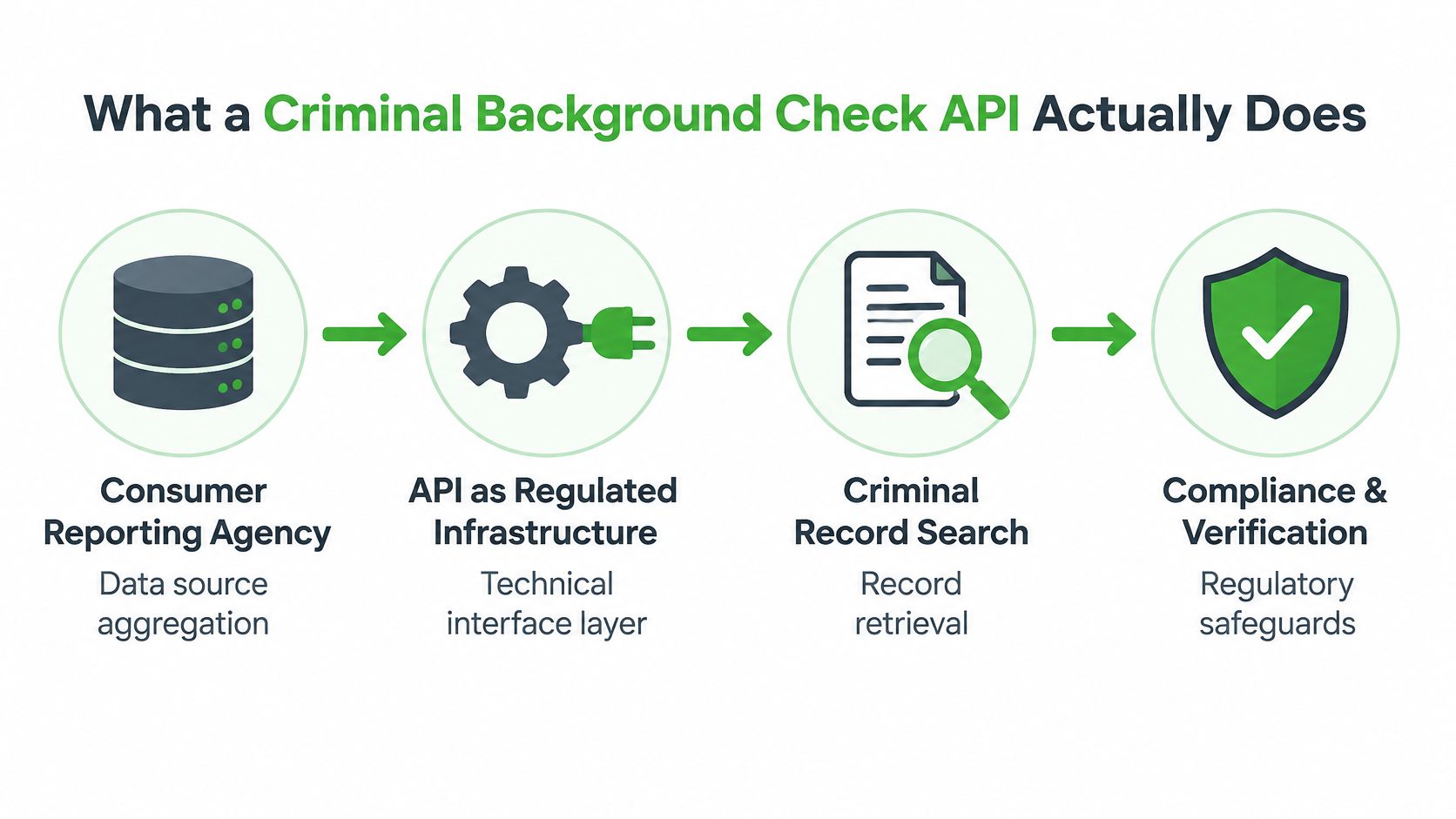
A criminal background check API isn't a magic pipe into a single national database. It's the technical interface between your volunteer system and a consumer reporting agency, or CRA, that compiles public record information for eligibility decisions. Your software sends identifiers, the CRA runs searches, assembles a report, and returns structured results your system can store, display, and act on.
That distinction matters because the underlying activity is regulated, not just technical. The modern industry traces back to the Fair Credit Reporting Act enacted by Congress in 1970, which treats reports containing criminal records as consumer reports when they're used for eligibility decisions, including volunteer roles. Consumer reports can include public records such as arrests, judgments, and bankruptcies, and the law assigns duties to agencies that compile reports, furnishers that supply data, and users that decide based on them.
A Volunteer Check From Start to Finish
Walk through a normal flow. A parent applies to coach. Your form collects legal name, date of birth, address history, and authorization, then your system calls the API. The provider resolves identity, determines which jurisdictions to search, queries criminal sources, verifies possible matches, and returns a report status.
Your job doesn't end when JSON comes back. Someone, either your system or a trained coordinator, has to interpret the report, pause on uncertain matches, and follow the required steps if the information may affect eligibility. A clean integration makes those handoffs visible. A sloppy one hides them behind a green checkmark.
Practical rule: If a vendor can only describe endpoints and latency, and can't describe consent storage, dispute pauses, and audit trails, don't integrate it.
Where Your Responsibility Sits
Automation doesn't transfer your duties to the vendor. Your organization still needs a permissible purpose, proper disclosure and authorization where applicable, controlled access to results, and adverse action procedures if a report contributes to a negative decision. The FTC reports that during the decade covered by its 2020 accuracy report, it brought more than 30 FCRA enforcement actions involving reporting agencies, users, and furnishers. That history is a warning for both sides of the API contract.
Ask four blunt questions before you write code. Who sends each notice? Who stores proof of consent? Who reviews uncertain matches? Who can prove, months later, exactly what happened? If the answers are vague, the API isn't ready for your volunteer pipeline, no matter how elegant the documentation looks.
How the API Resolves Identity Before It Searches Records
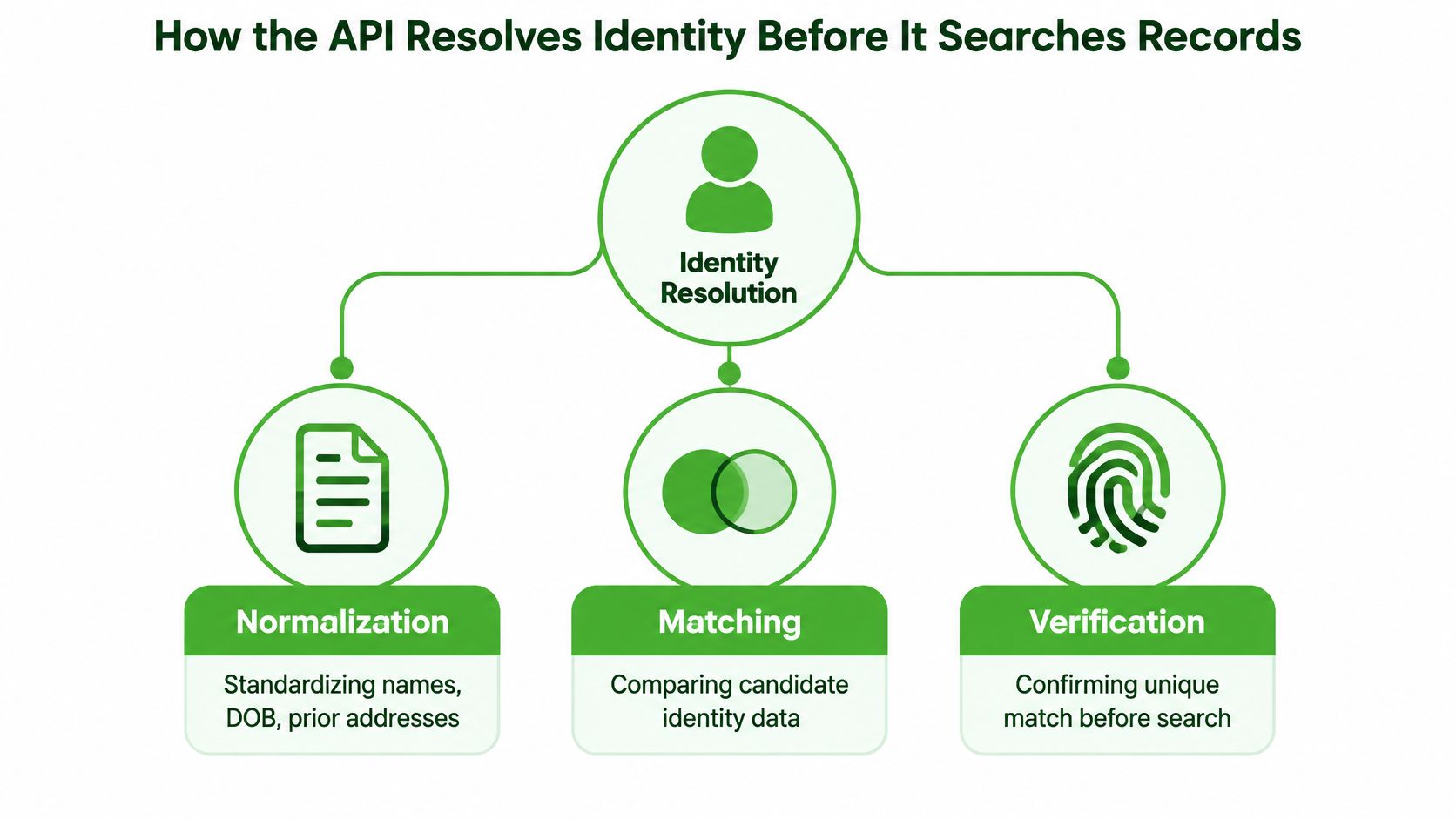
Most bad screening outcomes start before any courthouse is searched. The API matched the wrong person, missed a prior name, or queried the wrong counties because the address history was incomplete. A credible provider separates identity resolution from record retrieval. One answers who this person is. The other answers which records reliably belong to that person.
NIST defines identity proofing as resolving a claimed identity to one unique identity, validating that submitted evidence is genuine, and confirming that the identity corresponds to an actual, living person. Your API should approximate that standard in workflow terms: collect the minimum personally identifiable information needed for resolution, protect it for confidentiality and integrity, and preserve source attribution for every identifier it used.
Normalization and Matching in Practice
The pipeline runs in stages. First, the API normalizes what the volunteer submitted: name variations, date formats, and addresses, assembled into a set of identifiers and prior jurisdictions. Then it compares that identity against candidate records and returns the provenance behind each match. Which identifier ties this record to your applicant? Which source supplied it? A common name plus a matching birth year proves nothing, and your coordinator deserves the reasoning behind every match.
Consider an applicant who lists three addresses with a two-year gap between them. A useful API flags that gap before you spend money on the full check and surfaces additional jurisdictions that may need searching. That matters because a county criminal records search only covers counties where the person lived, worked, or used another name. Skip that step and you get false confidence dressed up as efficiency.
Separate Statuses Prevent Bad Automation
Demand distinct fields for identity status and criminal record status. Identity resolution moves through states: unresolved, insufficient evidence, verified match, no reliable match. Record status is a different question entirely.
When vendors collapse both into clear or flagged, your workflow eventually converts uncertainty into an eligibility decision. False positives hurt innocent volunteers; false negatives slip risky applicants through. Ask the harder question too: when identity can't be resolved, does the order pause with its own status, or does the vendor bill you for a report that converted doubt into a result?
Lock the data down while you're at it. Require field level encryption, tokenized applicant IDs, role-scoped access to raw identifiers, retention and deletion rules, and tamper-evident event logs. A part-time coordinator shouldn't see more sensitive data than the role requires, and your API logs shouldn't become an unprotected second copy of every application.
The Five Source Categories Every Volunteer Program Needs
Vendors love the word national because it sounds complete. It isn't. Criminal records are created and stored across local courts, state repositories, federal courts, registries, and watchlists, each with different update practices and gaps. A serious criminal background check API layers sources, verifies hits at the appropriate level, and tells you what's still unresolved.
The structural problem is not theoretical. A 2024 Consumer Financial Protection Bureau review reported that in a 2018 survey, 48 states and the District of Columbia had reported final case dispositions for an average of only 64% of arrests appearing in state databases during the preceding five years, according to the CFPB background screening market snapshot. Roughly the remaining share lacked a reported final disposition in that data. An arrest with no disposition isn't proof of conviction, dismissal, or current status. Treat it as a lead requiring verification, not a verdict.
Source Coverage Comparison for Volunteer Screening
| Source Category | What It Covers | Known Limitation | Volunteer Use Case |
|---|---|---|---|
| County courthouse records | Local charges, filings, and dispositions where cases were heard | You must know the right counties, and retrieval speed varies | Verifying a database hit before a youth facing role decision |
| State repositories | Statewide criminal history submitted by local agencies | Arrests may lack final dispositions or arrive incomplete | Broad check across a state where a volunteer lived |
| Federal courts | Federal offenses prosecuted in federal court | Federal cases are separate from county and state systems | Roles involving finances, transport, or vulnerable people |
| Sex offender registries | Registration information across states | Registry data isn't a substitute for underlying court verification | Any unsupervised work with children or vulnerable adults |
| Global watchlists | Sanctions and wanted person lists, including OFAC and FBI lists | Name based lists can produce candidate matches needing review | Final safety screen for drivers, treasurers, and mentors |
What Each Layer Actually Buys You
County records are often closest to the source, which makes them valuable for confirming charge details and final outcomes. State searches can widen the net, but the missing disposition problem means your provider must follow up rather than dump raw arrest data into a report. Federal courts sit apart from both. If your vendor's national search never touches federal sources, ask why the marketing implies otherwise.
Sex offender registry checks and watchlists serve a different purpose. They can surface a person who moved, registered elsewhere, or appears on a sanctions or wanted list. They don't replace court research, and a registry match still needs identity confirmation. Layering works because each source covers a failure mode the others miss.
Demand provenance in every response. The API should return source searched, jurisdiction coverage, source timestamp, verification status, and an explicit incomplete state where evidence couldn't be confirmed. Binary output is convenient for demos. It's lousy for defensible decisions. A result should prove what was searched and verified, not merely assert that nothing was found.
FCRA Compliance as a First-Class API Feature
Here's the claim vendors underplay. An API doesn't remove your FCRA obligations. In many nonprofits, it makes violations easier to repeat at scale. A manual mistake affects one file. An automated workflow can send the wrong notice, skip the waiting period, or auto reject every flagged volunteer for an entire season before anyone notices.
Screening an unpaid volunteer can still implicate the FCRA when a third party CRA supplies information used for an eligibility decision. The guidance on FCRA compliance for nonprofits is useful here because volunteer status doesn't magically turn a consumer report into an unregulated database lookup. Your league, church, or charity still needs a lawful, documented process.
Track Compliance as State, Not Paperwork
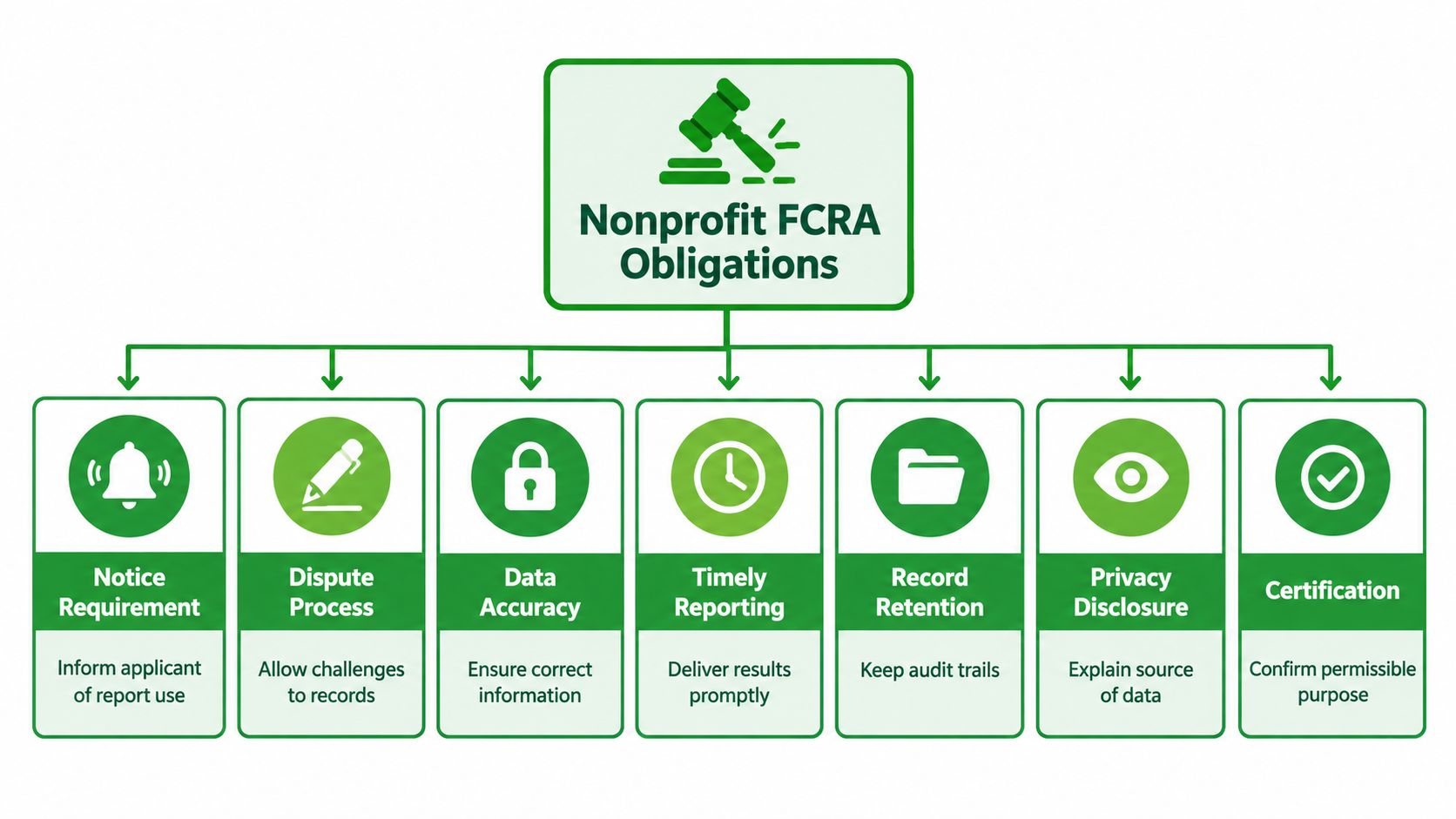
Build your integration around seven queryable states, not a folder of PDFs somebody hopes were sent.
- Permissible purpose recorded: Your system stores why this check is allowed for this role.
- Disclosure delivered: The volunteer receives a standalone disclosure before the check runs.
- Authorization received: Written authorization is captured and tied to the applicant record.
- Report and rights summary delivered: The person gets the required materials before adverse action.
- Waiting period running: Automation pauses instead of finalizing the decision immediately.
- Dispute window open: The applicant gets a meaningful chance to challenge inaccurate or mismatched information.
- Final adverse action sent: If the decision stands, the final notice is issued and logged.
Each transition should carry a timestamp, actor, and document reference. That's not bureaucracy. That's your evidence if a volunteer says they never consented or never had a chance to correct a record that belonged to somebody else.
Where Automation Goes Wrong
Take a youth sports league that buys a cheap API and configures it to reject any applicant with a hit. No human reviews identity confidence. No workflow pauses for dispute. No one checks whether the record is sealed, duplicated, or missing a disposition. The FTC warns reporting agencies must use reasonable procedures to assure maximum possible accuracy, and its guidance for employment background screening companies also stresses notice or strict procedures to keep public record information complete and up to date for employment purposes. Your process should be built with the same seriousness.
Good controls also cover storage and access. As you define retention, permissions, and deletion, data handling rules for SMBs from Nutmeg Technologies offers a practical reference point for handling sensitive information responsibly. Pair that discipline with the nonprofit specific reference at GCheck on ATS and screening integration for nonprofits, which underscores the unanswered operational question in many integrations. Which party sends each notice, stores consent, pauses disputes, and preserves the trail?
A vendor that treats compliance states as optional metadata is asking your volunteer coordinator to become the compliance system.
REST APIs, Webhooks, and NLP Interfaces Compared
Nonprofits don't all need the same integration depth. A national charity with developers can wire screening into its own platform. A church with one coordinator and a spreadsheet needs something she can operate without filing a ticket. Judge REST APIs, webhooks, and NLP interfaces by staffing reality, not technical fashion.
A REST API gives your system direct control. Your application submits a check, receives an identifier, and either polls for status or retrieves the completed report. That's the right pattern when screening is embedded in a custom application, your team owns the user experience, and you need status fields to drive internal workflow. The cost is engineering responsibility. You own authentication, retries, error handling, secure storage, and what happens when a result stays pending.
Webhooks Fit the Waiting Period Reality
Most thorough checks aren't instant, especially when county verification is required. Webhooks solve that operational gap by pushing an event when a check completes, needs information, or changes compliance state. Your volunteer platform can then notify a coordinator, enable the next step, or keep the application paused. That beats staff refreshing a dashboard during registration week.
The failure mode is security and reliability. A webhook needs a protected public endpoint, signature or token verification, duplicate event handling, and a fallback polling process if a delivery fails. If your team can't maintain that endpoint, don't pretend you're integrated. Use the provider's hosted workflow until you can. The overview of API integrations and what they mean is a sensible starting point for separating a native connection from a manual export wearing integration clothes.
NLP Is Useful, and It Needs Boundaries
An NLP interface lets a coordinator describe the check in plain English to an AI assistant, which then calls the API with structured fields. For a small food bank with no developer, that is practical. She can start a check, ask for status, or retrieve next steps conversationally instead of learning endpoint syntax.
Don't let convenience hide accountability. The assistant becomes another party touching sensitive workflow data, so you need the same identity checks, consent records, role limits, and audit events as any other channel. The API key should not float around in prompts or shared chats. My recommendation is simple. Start with the hosted or NLP workflow if you lack developers, add webhooks when another system must react automatically, and build direct REST only when volume and internal ownership justify it. The strongest providers let you move across those modes without changing your compliance history.
How to Evaluate a Criminal Background Check API for Your Nonprofit
Don't evaluate a screening API the way you'd evaluate a weather API. Uptime and elegant response fields matter, but they won't save you when a county record can't be verified, a volunteer disputes a match, or a board member asks why somebody was rejected. Evaluate failure handling first. That's where vendors reveal whether they understand regulated screening or just resell data access.
Start with a concrete pricing reference so the tradeoffs stay honest. VolunteerBadge offers screening at $4.95 per check with no monthly fees, address history included, and REST, webhooks, and NLP access under one arrangement, with a refund when county records cannot be verified. Use that kind of transparent structure as a benchmark, then force every other vendor to explain its platform fees, add ons, and unverifiable record policy line by line.
The product sketch below is a useful reminder of what you're really buying, which is court evidence handled carefully, not a decorative dashboard.

A Scorecard That Exposes Weak Providers
Ask for a live walkthrough of an uncertain match, not a clean demo applicant. Can the API show which identifiers matched, which jurisdictions were searched, and when each source was checked? Does it distinguish arrest, charge, and conviction? Can it hold a decision in an incomplete state instead of forcing clear or reject? If the salesperson keeps returning to speed, you have your answer.
Interrogate the refund policy next. If county records exist but can't be verified to the standard needed for a report, do you pay anyway? A vendor willing to refund or delay rather than publish shaky data is signaling something important about its incentives. A vendor that charges for every query, verified or not, profits from ambiguity. Your nonprofit absorbs the dispute risk.
Audit depth is the third test. You need consent records, notice delivery, report access, status changes, and decision actions tied to the applicant. During seasonal intake, even your volunteer interview process should be measurable and reviewable, and response-time tracking for interviews from Form Timer shows the broader value of timing and documenting candidate facing steps rather than relying on memory. Apply that same discipline to screening events.
Watch the following video before your vendor calls and note which questions your current process cannot answer.
Price Is Only Cheap If the Decision Holds Up
A bargain check that returns a false clean result isn't a bargain. Neither is a premium platform fee if your league only screens during two registration bursts a year. Match the contract to your operating pattern, insist on transparent per check pricing, and confirm whether the integration is native, certified, custom built, or really a manual export. Demand the failure states in writing. The cheapest API is rarely the best deal when the cost of one indefensible decision lands on your board.
Common Mistakes and a Final Decision Checklist
I see the same five mistakes repeatedly. Programs treat a national database response as proof that no record exists. They skip address history, so they search the wrong places. They auto reject on any flag, ignore sealed or expunged record handling, and fail to store proof of consent where anyone can retrieve it later. None of those are technology failures first. They're governance failures the technology happily accelerates.
Take this checklist into every vendor demo and don't accept verbal shrugs.
- Layered source coverage confirmed: County, state, federal, registry, and watchlist sources are named, with limitations explained.
- Refund logic confirmed: You know what happens when a county record cannot be verified.
- FCRA notices confirmed: Disclosure, authorization, pre adverse action, dispute pause, and final notice are tracked as states.
- Integration depth confirmed: You know whether you're buying native integration, webhooks, REST, NLP, or manual export.
- Pricing confirmed: Per check cost, add ons, and platform fees are explicit before seasonal volume hits.
The safest screening system may occasionally delay or refund a check instead of returning a deceptively clean result. A vendor willing to do that is worth trusting.
Flush out any provider who calls that caution friction. For a volunteer program, that pause is often the feature that prevents the lawsuit.
If your nonprofit needs screening that treats compliance, source provenance, and refund logic as core features rather than fine print, VolunteerBadge offers FCRA compliant volunteer checks with address history, automated notices, and API, webhook, and NLP options under transparent per check pricing. Visit the site, run your vendor checklist against it, and start your next volunteer season with a process your board can defend.
