
FBI Most Wanted List: A Nonprofit Screening Guide
Learn what the FBI Most Wanted list is, how fugitives are added, and how nonprofits can use it in FCRA-compliant volunteer background screening.
On this page
You're staring at a volunteer application on a Tuesday afternoon, and the name on the form looks ordinary enough. The person wants to help with weekend youth programs, the references are fine, and the request is urgent because the event starts soon. The hard part is knowing whether a quick check against the FBI Most Wanted list belongs anywhere in that decision, or whether it's just a dramatic headline that doesn't help a nonprofit make safer calls.
For a compliance-minded volunteer manager, this list matters because it's one of the few federal watch tools built to draw public attention to fugitives who are considered especially dangerous. It's not a replacement for a proper screening program, and it's definitely not a shortcut around consent, documentation, or fair-process rules. But it does belong in the conversation, because a nonprofit that runs youth programs, food distribution, shelter intake, or faith-based outreach needs a defensible way to reduce risk without pretending any single list can do the whole job.
The practical question is simple. If you already screen volunteers, where does the FBI list fit, what can it tell you, and what can't it tell you at all?
Table of Contents
- Why the FBI Most Wanted List Matters to Nonprofits
- What the FBI Most Wanted List Actually Is
- How Fugitives Are Added, Updated, and Removed
- What the List Can and Cannot Tell a Screener
- Legal and Practical Limits of Using the List for Volunteers
- A Practical Volunteer Screening Workflow
- How VolunteerBadge Builds the FBI Check Into Screening
- Putting It All Together for Safer Volunteer Programs
Why the FBI Most Wanted List Matters to Nonprofits
A small nonprofit often feels the pressure first. A volunteer coordinator at a community center gets a rush of last-minute applicants before a holiday drive, and the problem isn't just volume, it's confidence. You need to know whether a federal fugitive alert should be part of the intake process, because the people you supervise may have direct access to children, older adults, cash, or sensitive spaces.
That's why the FBI Most Wanted list belongs in a screening conversation, even for organizations that are not law enforcement agencies. It's a federal public-safety tool designed to widen the net on dangerous fugitives, and nonprofits operate in environments where trust is a working asset, not a luxury. A volunteer roster is not the place to discover, after the fact, that a person should have triggered a deeper review.
The real issue is workflow, not curiosity
Most articles treat the list as a crime-story artifact. Nonprofit operators need a different lens, because the operational question is whether the list can help you make a safer, more defensible decision without turning screening into guesswork. The answer is yes, but only as one input in a broader process that includes written authorization, identity checks, and a clean process for responding to hits.
Practical rule: if a screening source can't be explained to a board member, documented in a policy, and defended in writing, it's not ready for volunteer vetting.
That's where legal terms like permissible purpose, written disclosure, and adverse action enter the picture. Those aren't abstract HR concepts, they're the guardrails that keep a nonprofit from treating a watchlist as a rumor mill. A good screening process respects the FBI's public-safety goal without assuming the list itself settles suitability.
What the FBI Most Wanted List Actually Is
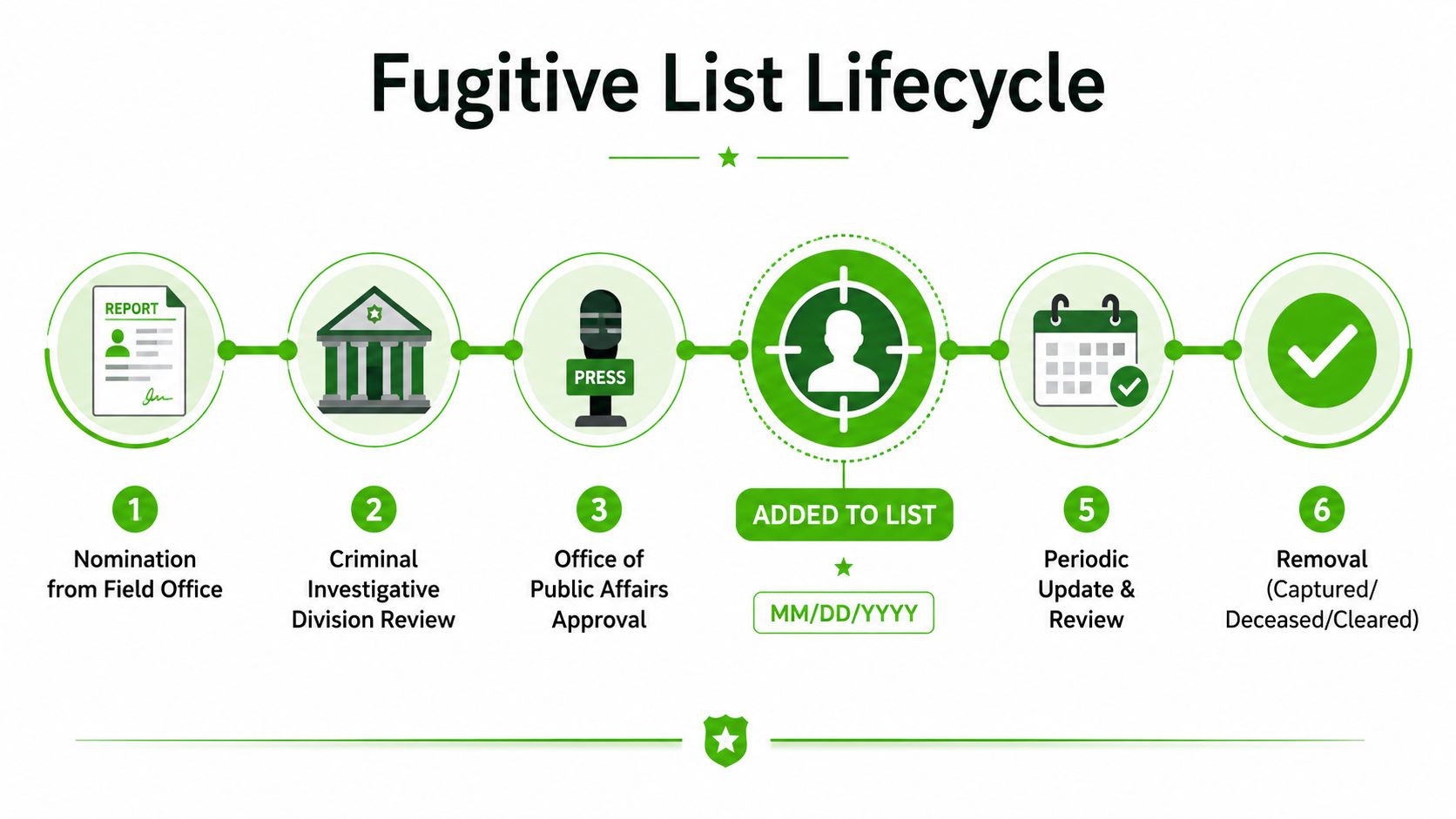
The headline program is the FBI's Ten Most Wanted Fugitives, and the name can make it sound like a ranking table. The FBI says the list is not ranked, so “most wanted” signals priority and public visibility, not a scorecard for who is “worst.” A person is added only when FBI officials believe the fugitive is especially dangerous and public exposure is likely to help locate them, with nominations moving up from the 56 field offices to FBI Headquarters. FBI history page on the Ten Most Wanted program
A church volunteer coordinator might hear two names in the news and wonder why only one appears on the list. That usually reflects an operational judgment about publicity value, likely tip generation, and whether public notice could support an arrest. For nonprofits, the practical lesson is simple, a name missing from this list is not the same as a clean bill of health, and a name on the list means the FBI wants help finding the person, not that a volunteer screener should stop at the headline.
Workflow, not curiosity: how to use the list
The list sits inside a wider wanted ecosystem that includes violent and non-violent fugitives, terrorism suspects, kidnapped and missing persons, and cases where the FBI wants more information. The Department of Justice also organizes separate wanted categories for cybercrimes, white-collar crime, counterintelligence, human trafficking, and domestic terrorism, so there is no single static “most wanted” universe to check and be done with. That matters for nonprofit managers because a clean result on one source only means there was no match on that source.
The list is built to generate leads. The FBI's history materials describe it as a publicity-and-tip-generation tool, which places it closer to a public-facing search aid than to a verdict engine. For a nonprofit, that keeps expectations grounded. A watchlist search is useful only when it sits inside a process that also includes identity checks, written consent, and a documented response path for any match.
How Fugitives Are Added, Updated, and Removed
A person does not appear on the FBI Most Wanted list because of a headline or a public rumor. FBI field offices nominate fugitives first, headquarters reviews those nominations, and the Criminal Investigative Division and Office of Public Affairs decide whether the case meets the standard for public exposure. The FBI's history materials also show that names can come off the list when a case no longer fits that standard, which is a useful reminder for screeners who need to treat the list as a live operational tool, not a permanent label.
That living quality matters in practice. By the FBI's count as of March 17, 2025, 535 fugitives had appeared on the list and 497 had been apprehended or located, which works out to roughly 93% found FBI 65th anniversary story, with 163 apprehensions attributed directly to citizen cooperation. The FBI also marked the list's 75+ year run by noting its start on March 14, 1950. FBI Ten Most Wanted Fugitives FAQ
Why dates on the list can feel surprising
The timing can look inconsistent because the list follows operational need, not permanence. The FBI's anniversary material points to two extremes, the longest time on the list was 32 years for Victor Manuel Gerena, while the shortest was just 2 hours for Billie Austin Bryant. FBI 65th anniversary story
For a volunteer screener, that range has a practical lesson. A name can stay active for years, or it can disappear quickly if the person is captured or no longer fits the criteria. A search result should be treated as time-sensitive, and the date of the search should be recorded so the review can be traced later.
Recent additions also show the system is still active, not just historical theater. The FBI's wanted pages have included newer entries such as Fausto Isidro Meza Flores in February 2025 and Gregory Henderson Jr. in August 2026, which shows that the ecosystem keeps changing and that organizations relying on old assumptions are likely to miss the point. The FBI also offers at least $100,000 for information on Ten Most Wanted fugitives, which reflects how seriously it treats public tips. FBI wanted collection page
A positive match means law enforcement is actively seeking that person. It does not tell you where they are, what risk they pose today, or whether your volunteer applicant is legally the same person without careful identity review.
What the List Can and Cannot Tell a Screener
Two applicants can produce the same result and still present very different screening questions. One volunteer candidate may come back clean on the FBI Most Wanted list, but still have county court records, an unresolved state matter, or a sanctions issue that matters to your program. Another may also show no FBI match, yet the only problem is a name collision that needs identity review before anyone draws a conclusion.
That is the practical limit of this source. It helps a screener spot a narrow, high-risk category, then move the file to a human review step. It does not tell you whether the person has a history in local systems, whether they have used aliases, or whether the applicant in front of you is the same person described in the public record.
Where this source fits in a layered review
A volunteer screening workflow works better when each source has a defined job. County criminal records can surface local charges, state repositories can widen the search, the national sex offender registry addresses a different risk category, and sanctions or watchlist checks cover separate legal and security concerns. The FBI list sits in that stack as a high-signal watchlist, and it should be read alongside the other sources, not in isolation.
A simple way to see the difference is to compare two applicant files side by side. One file shows no FBI match and also no issues in county, state, or sanctions screening. The other file also shows no FBI match, but it still contains unresolved local history or identity inconsistencies. The FBI result is the same in both cases, yet the overall screening outcome is not.
For teams building that layered approach, the global watchlist screening guide explains how watchlist checks fit into a broader review without treating any one source as the whole answer.
A clean search can still be incomplete
That gap matters because the FBI's public list is built for visibility and law-enforcement use, not for complete volunteer vetting. It reflects current priorities and public lead generation, so a person can be unsuitable for service without ever appearing there. For a nonprofit manager, the operational lesson is straightforward. Use the FBI result as one input, then verify identity, check the other records your policy requires, and document what each source did and did not show.
Legal and Practical Limits of Using the List for Volunteers
If a nonprofit uses a consumer reporting agency to run a volunteer against watchlist data, the Fair Credit Reporting Act can come into play, because the result is being used for a decision about access, trust, or service eligibility. That means you need a permissible purpose, a proper written disclosure and authorization, careful record handling, and the right notices if you take adverse action. The process can get even more nuanced when a volunteer role is treated differently from an employee role, so the policy has to match the actual decision-making model.
People get into trouble by assuming a public list is legally simple. It isn't. A search result that looks obvious to a human can still create compliance risk if the organization didn't disclose the screening, didn't document consent, or didn't give the person a chance to respond before rejecting them.
Why false matches happen
Name collisions are common, aliases are common, and identity data is often incomplete. Even when the right name appears, the list can't tell you on its own whether the volunteer applicant is the same person without additional identifiers and review. That's why a watchlist hit should trigger a careful verification process, not a reflexive removal.
The FBI's public-facing approach also creates a practical limit. It's designed to get help from the public and generate leads, which means it's not built to be a standalone screening engine for nonprofits. A youth ministry, shelter, or mentoring program that treats it as the only check is still exposed to ordinary criminal history, sanctions, and identity-matching problems.
For organizations also thinking about sanctions and restricted-party workflows, this OFAC background check overview shows why a sanctions search sits in a different lane from an FBI fugitive search.
Compliance rule: don't reject on a watchlist hit until you've confirmed identity, checked your policy, and followed the notice process your screening vendor or counsel requires.
The smartest takeaway is not “avoid the list.” It's “use the list carefully.” For volunteers, the legal and operational burden comes from using the result to make a decision, not from the existence of the public record itself.
A Practical Volunteer Screening Workflow
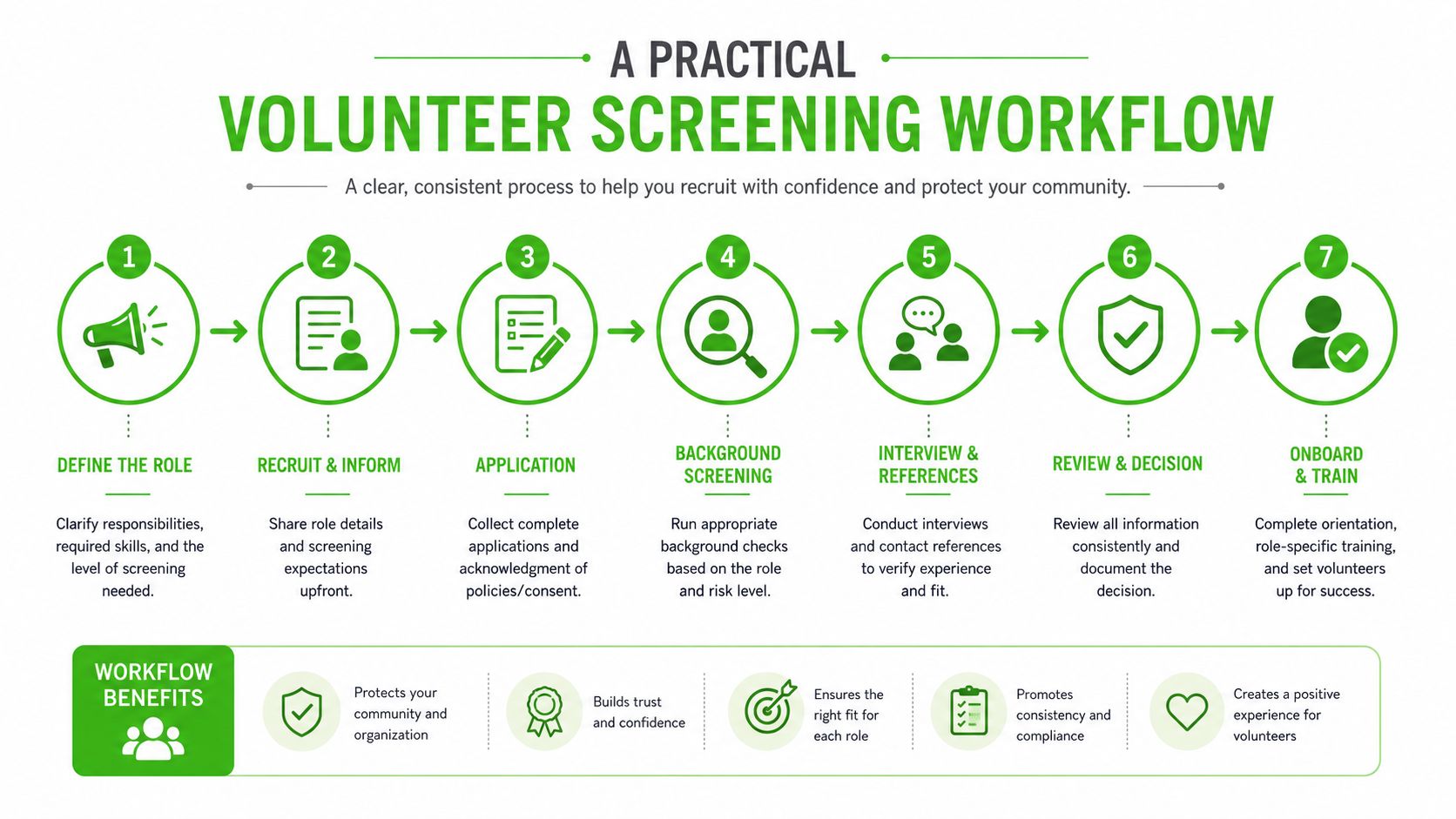
A defensible volunteer program starts with a written policy, not with a search box. Decide which roles get screened, which checks apply to which roles, and how your team will handle results that need review. If volunteers work with children, money, transportation, or confidential records, your policy should say that plainly so every applicant is screened under the same standard.
The order matters
Collect a clear disclosure and authorization.
Put the screening consent in the application flow so people know what you're checking before they apply.Capture identity details and address history.
More address history helps reduce false negatives and helps vendors match records more accurately.Run the layered checks.
Use county, state, federal, sex offender, sanctions, and FBI watchlist searches together, not one at a time.Review results in plain English.
Don't let a coordinator guess what a record means. They should know when to escalate.Document the decision.
Keep the rationale simple and policy-based.Send pre-adverse and adverse action notices when needed.
If the result affects eligibility, the person gets the proper notices before a final decision.Recheck on a schedule that matches the role.
Volunteers aren't one-and-done if the work is ongoing.
That structure keeps the FBI Most Wanted check in the right place, alongside other sources that tell you different things about risk. It also keeps your team from overreacting to a single hit or underreacting to a broader pattern.
The practical benefit is consistency. If two volunteers apply for the same youth role, they should go through the same disclosure, the same review path, and the same notice process if a result creates concern. If you're building or revising that playbook, a how-long background checks take guide can help you set expectations about timing without promising what the vendor can't guarantee.
A good vendor does most of the legal scaffolding for you, but your team still owns the policy, the role definition, and the final judgment. That's the part board members and auditors care about, because it shows you screened people in a consistent, explainable way rather than improvising under pressure.
How VolunteerBadge Builds the FBI Check Into Screening
A volunteer applies for a youth mentor role, and the screening queue has to answer a hard question quickly, who is this person, and what should the organization do if a record appears? VolunteerBadge bundles the FBI Most Wanted search into its volunteer background check alongside county, state, and federal court searches, all 50-state sex offender registries, OFAC sanctions, and global watchlists. It operates as a licensed consumer reporting agency, so the compliance pieces are already built into the workflow from the start.
That matters for operators because the process is not being assembled by a busy program manager one vendor at a time. The disclosure and authorization are digital, address history is automated, and the system flags gaps before the check is run, which cuts down on the back-and-forth that slows volunteer onboarding. A nonprofit still makes the policy decisions, but the screening steps arrive in a form that is easier to document and repeat.
What a bundled flow changes for operators
The report arrives in 24 to 48 hours in plain English, and the workflow includes step-by-step FCRA guidance plus auto-generated pre-adverse and final adverse action notices when needed. If county records exist but cannot be verified under FCRA guidelines, the fee is refunded, which reduces some of the billing uncertainty that smaller nonprofits worry about.
VolunteerBadge also exposes an NLP interface, REST API, and webhooks, so teams can run checks in-app, on mobile, or through AI tools without changing the compliance backbone. That matters for organizations that want screening embedded in the volunteer intake flow and not handled as a separate admin task. Organizations comparing approaches often find that one path assembles tools piece by piece, while the other packages the entire screening logic into a single report.
Putting It All Together for Safer Volunteer Programs
The FBI Most Wanted list is a high-signal, low-volume input, not a standalone verdict. For nonprofits, the right model is layered screening, clear authorization, careful review, and a notice process that you can defend if anyone asks why a person was approved or declined. If you want a practical next step this week, audit your volunteer application for a proper disclosure and authorization, then compare your current workflow with a practical guide for safe spaces so your policy matches the environment you're trying to protect.
The goal isn't to catch a fugitive hiding in your volunteer roster. The goal is to build a process sound enough that you'd be comfortable defending every decision you made.
VolunteerBadge helps nonprofits run FCRA-compliant volunteer checks that include the FBI Most Wanted list, criminal court records, sex offender registries, OFAC sanctions, and global watchlists in one workflow. If you want to see how that fits into a real volunteer onboarding process, visit VolunteerBadge and review the screening options with your team.
