How to Start a Homeschool Co-op: The Complete Guide

Most guides to starting a co-op are written by people selling curriculum. This one covers what actually happens: which of the two models you are building, why you probably need less legal structure than you have been told, the insurance nobody warns you about, the fee stack, service hours and buyouts — and the real reason co-ops close, which is not a safety incident.
On this page
Most articles about starting a homeschool co-op are written by people selling curriculum. This one is written by a background-check company, which is its own kind of bias — so here is the useful part up front: the thing most likely to end your co-op is not a safety incident. It is that one exhausted mother is doing everything, and in March she stops.
We will get to screening, because it is what we do and because it matters. But a guide that leads with our own product would be useless to you, and you would be able to tell. So this is the order the work actually happens in: what you are building, how it is structured, what it costs, who teaches, and only then who gets checked.
First decide which of the two things you are building
Almost every disagreement a young co-op has traces back to skipping this question. There are two very different models wearing the same word.
A true cooperative is one where every enrolled family contributes labor. Parents teach, assist, run the nursery, set up and clean up. Nobody drops off. Fees are low because the labor is the payment, and the group's whole economics depend on that labor arriving.
A drop-off or hybrid program is one where families pay, leave, and return at pickup. Teachers may be paid. It is closer to a small school than a cooperative, and it costs meaningfully more per family because someone has to be paid to do what parents would otherwise do.
That single answer sets your insurance, your fee level, your service-hour policy, your staffing model and — in some states — whether you have wandered into territory the state regulates differently. Groups that never chose end up with families who assumed drop-off paying cooperative prices, and parents who expected to teach discovering they are the only ones who did.
Pick one. Write it in a sentence. Put that sentence at the top of every enrollment page you ever publish.
Structure: you probably need less than you have been told
There is an entire cottage industry telling new homeschool groups they must incorporate and obtain 501(c)(3) status immediately. For a group of eight families sharing a church basement and collecting $40 a semester, that advice is usually wrong, and following it burns money and months you do not have.
Here is the actual landscape, in rough order of commitment.
Unincorporated association
Many small co-ops operate this way for years. You are a group of people doing something together. There is no filing, no fee and no annual report. The trade-off is real: an unincorporated association generally offers no liability shield, so the people running it can be personally exposed. For a small group meeting in donated space with insurance in place, plenty of leaders accept that. For a group signing a lease or holding meaningful money, it stops being reasonable.
Nonprofit corporation
Incorporating at the state level is what actually provides the liability shield people think 501(c)(3) provides. These are two different things, routinely conflated. Incorporation is a state filing, usually inexpensive, and it is what stands between your board members and personal liability. If you incorporate, your state will almost certainly require you to adopt bylaws as part of it — which is the honest reason most co-ops finally write bylaws.
Federal tax exemption
This is the part where the specifics genuinely save you money, so here they are.
An organization whose gross receipts are normally under $5,000 a year is not required to file Form 1023 at all, and — this surprises people — contributions to it are still tax-deductible even without an IRS determination letter. A great many homeschool co-ops live under that ceiling permanently and never need to file anything with the IRS. Note that gross receipts means everything coming in, before you subtract a single expense. If you cross the threshold, the requirement is to file within 90 days of the end of the year in which you exceeded it.
If you do need or want recognition, Form 1023-EZ is the short path: broadly for organizations projecting $50,000 or less in annual gross receipts with assets under $250,000, with a user fee of $275. Everyone must work through the eligibility worksheet first. The full Form 1023 carries a $600 fee and a great deal more work.
Two cautions. Fees and thresholds change, so verify current figures against the IRS before you file rather than against this article. And a determination letter brings ongoing annual filing obligations — exemption is not a thing you get once and forget. If your co-op handles real money, an hour with an accountant who knows homeschool organizations specifically is worth more than any article, this one included.
Insurance is the requirement nobody warns you about
Insurance is rarely required by law. It is almost always required by the church, community center or library that is about to hand you a key, and they will usually want to be named as an additional insured on your policy. Discovering this two weeks before your start date is a common and entirely avoidable crisis.
There are three coverages that come up for homeschool groups:
- General liability — injuries and property damage at your meeting place.
- Accident medical — medical costs when a child is hurt, without anyone having to be at fault.
- Abuse and molestation — often abbreviated SAM, and frequently excluded from a general liability policy rather than included in it. This is the one to ask about by name.
Costs vary far more than any published figure suggests. Small co-ops commonly land in the low hundreds annually; quotes running into the low thousands are not unusual for larger groups or riskier activities. Get more than one quote, and ask specifically whether abuse coverage is included or excluded — the answer changes the price and it changes what you are actually protected against.
One thing genuinely worth flagging: a co-op meeting in a member's home may affect that family's homeowners insurance. The family hosting should ask their own carrier rather than assume.
Money: the fee stack, and why you collect it early
Co-op fees are not one number, which is why borrowed spreadsheets fall apart by week three. In practice they stack:
- A registration or membership fee per family, usually annual, charged at enrollment.
- Semester fees per family, typically billed twice.
- A building or facility fee where the co-op leases space.
- Per-class supply fees per student, which vary wildly — a literature discussion costs almost nothing, a lab science or ceramics class does not.
Build the budget before you set any of these. Work out what the year costs — facility, insurance, background checks, curriculum, classroom and nursery supplies, the inevitable teacher appreciation — then set fees to cover it. Setting fees by copying the co-op down the road is how groups discover in February that they cannot pay March's rent.
And collect early. A family that withdraws in October having paid nothing does not just cost you their fees; in a small group it can be the difference between covering the lease and not. Charging the registration fee at enrollment rather than on the first day filters the families who were never really coming, which is a kindness to everyone including them.
Both jobs have a workbook: the annual budget and the tuition and fee tracker, free and without an account.
Service hours: decide the model, then decide the escape hatch
In a true cooperative, service hours are the currency. Two models dominate. Some co-ops set a ratio — a family contributes some number of hours for every hour of class their children attend. Others set days per child per semester, often capped so that a family with five children is not conscripted into the entire term.
Whichever you choose, three details matter far more than the model:
Hours belong to the family, not the person. Either parent can serve them, and a grandparent often does. Track them per family or the numbers will never reconcile.
Decide your buyout rate before you need it. Most co-ops let a family pay instead of serving, at a set rate per unserved hour. This is not a moral failure; it is how a co-op accommodates a single parent working Fridays without either losing them or resenting them. Set the rate in advance, publish it, and apply it without negotiation — the damage is done by making it a case-by-case favor.
Publish the policy before enrollment, not after. A family discovering their obligation in week three has a legitimate grievance, and it is the most common source of first-year bad feeling.
Recruit teachers first, then build the schedule
The instinct is to design a beautiful timetable and then fill it. This is backwards, and it costs new co-ops an entire planning cycle. Build the schedule you can actually staff.
Two rules save a great deal of grief. Match roles to what people are genuinely good at rather than to whoever raised their hand first — willingness and capability are different things, and pretending otherwise is unkind to the volunteer and to the children in the room. And name a substitute for every class before the term opens. Someone will get the flu in week two; the question is only whether you decided in advance what happens then.
When you do lay out the day, the failure that actually breaks a co-op morning is not an ugly grid. It is one parent rostered to teach in one room while listed as a helper in another during the same period, discovered at 9:05am. Rooms booked twice and classes over capacity are the other two. If you build the schedule in a spreadsheet, build in the check — our schedule builder flags all three.
Safety, honestly
We sell background checks, so treat what follows with appropriate suspicion and go read our own article on what screening actually catches, which takes apart several statistics our industry repeats.
The short version: a background check is a filter, not a safeguarding program. It catches people with a record. It does not catch people without one, which is most people who go on to cause harm. Any vendor — us included — who tells you screening is the foundation of child protection is overselling.
What actually protects children in a co-op is structural and free: two adults in every room, sightlines into classrooms, a written policy on one-to-one contact and transport, a named person to raise a concern with, and a culture where raising one is not treated as an accusation. Screening sits underneath that. It is worth doing — a co-op parent has more sustained, less supervised access to other people's children than a classroom teacher in a school with hall duty and cameras — but it is the floor, not the building.
If you want the full treatment, we wrote a separate guide to screening and child safety for co-ops. Keeping the register current is what the screening tracker is for.
Why co-ops actually die
Almost never from a dramatic event. Here is the real list, in the order it shows up.
One person is doing everything. When planning, teaching, communication and logistics all sit with the same parent, burnout is not a risk, it is a schedule. The co-ops that survive have a leadership team — two to four people sharing the load, even informally. That single structural choice changes the arithmetic more than any tool.
The scope was never realistic. Groups that try to be a full school replacement in year one usually collapse inside it. A co-op supplements homeschooling. Start smaller than feels satisfying and grow into demand.
Nobody shared the work, only the benefits. This is the same failure as the first, seen from the other side, and it is what service-hour policies exist to prevent. Which is why a policy you do not enforce is worse than no policy: it teaches the families who do serve that serving is optional and they were the fools.
The money ran out mid-year. Usually traceable to fees collected late, or a budget that never included insurance and background checks.
It could not adapt. The families who founded it had six-year-olds. Four years later they have ten-year-olds, and a group that never revisits its purpose slowly stops fitting anybody.
A six-month sequence
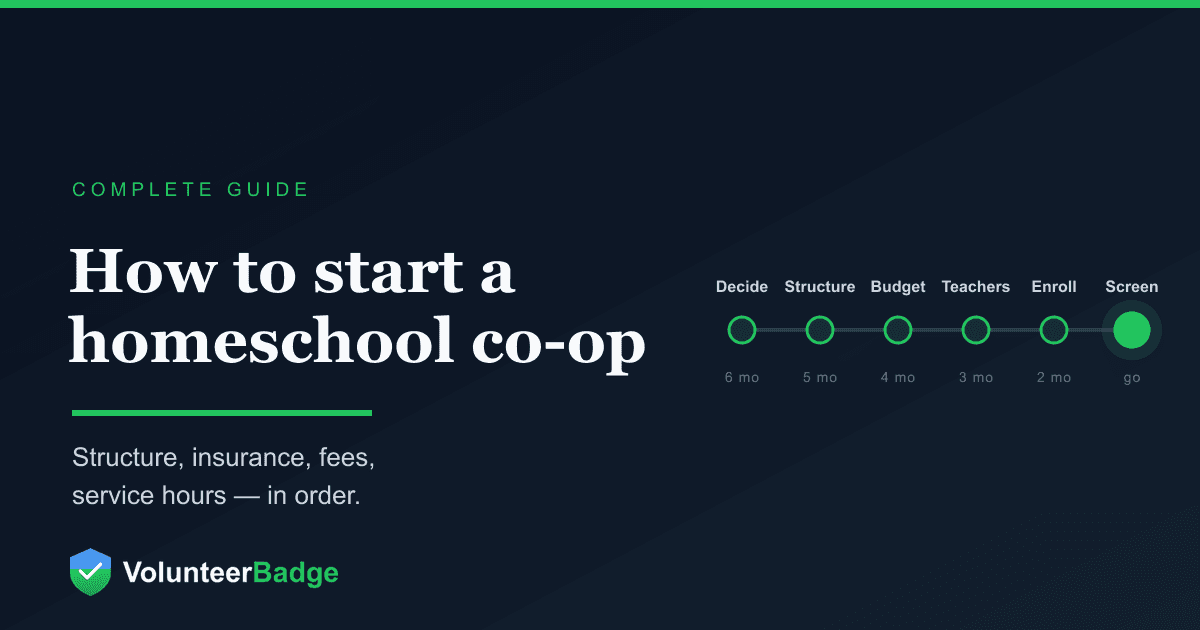
The ordering matters more than the calendar. Compressed, it runs: decide what you are and roughly how many families; sort structure, insurance and a place to meet; build the budget and set fees against it; recruit teachers and then schedule; open enrollment and collect; screen every adult and publish the handbook. Then run the day, and write down what broke the same afternoon.
We have laid that out step by step, with the relevant workbook attached to each stage, on the homeschool co-op toolkit — eight free Excel workbooks covering roster, tuition, service hours, scheduling, teaching assignments, budget, screening and field trips. No account, no email gate.
One last thing
Every co-op leader we have talked to describes the same first year: harder than expected, and worth it anyway. The families who stay are not the ones who found the best curriculum. They are the ones who felt like the group belonged to them too — which, in the end, is what the service hours are really for.
This article is general information, not legal, tax or insurance advice. Structure, filing and insurance requirements depend on your state, your size and what your co-op actually does. Verify current IRS figures before filing, and take the incorporation and exemption questions to an accountant familiar with homeschool organizations.
