What Background Checks Actually Catch: The Evidence on Volunteer Screening
We sell background checks - and most of the statistics our industry repeats are fabricated, uncited, or mean something else entirely. We traced every one to its primary source. The "80% recidivism" figure came from a 1986 magazine article. The "90% have no criminal record" claim has no citation at all. Here is what the evidence actually supports.
On this page
We sell background checks. That is exactly why this article is worth reading: almost every statistic our own industry repeats about child abuse in youth programs is either fabricated, uncited, or means something very different from what it is used to prove. We went and checked all of them against primary sources. Several did not survive.
If you run a camp, a youth sports league, a church program or a scouting troop, you have almost certainly been sold screening with a number like "90% of child molesters have no criminal record" or "sex offenders reoffend at 80%." Both are false. We will show you exactly where they came from.
You have also probably been told that background checks are the foundation of child protection. The evidence does not support that either — but it does support something narrower and more useful, and knowing the difference will change how you spend your money.
The four numbers you should stop repeating
These circulate constantly in youth-protection training, vendor marketing and news coverage. We traced each one to its origin.
1. "Sex offenders reoffend at 80%"
This number appears in a U.S. Supreme Court opinion, McKune v. Lile (2002), which called sexual recidivism "frightening and high." The Court cited a Justice Department practitioner's guide. That guide cited a single 1986 article in Psychology Today — a magazine — in which a counselor asserted the figure in passing. The article was not about recidivism. There was no study, no sample, no data. Ellman & Ellman documented the entire chain in Constitutional Commentary in 2015.
The measured rates are not close. Hanson & Bussière's meta-analysis of 61 studies found sexual recidivism of 13.4% across 23,393 offenders. The Bureau of Justice Statistics tracked 20,195 people released after rape or sexual assault across 30 states for nine years: 7.7% were rearrested for a sex offence.
2. "More than 90% of child sexual abusers have no criminal record"
This is the most-repeated claim in church and youth-safety training. We found its source: a 2020 PDF titled Criminal Background Checks — Not a Silver Bullet!, published by Abuse Prevention Systems and written by two attorneys who sell abuse-prevention training. The claim appears twice, introduced as "this fact." The document contains no footnote, no citation, no study reference and no bibliography.
A parallel version — "only an estimated 3-4% of sex offenders have criminal backgrounds" — appears in a Praesidium trade document, also uncited, and is incoherent as written, since a registered sex offender has a criminal record by definition.
The honest version of this idea is real and well-documented, and we get to it below. But it is not 90%, and it has never been attributed to research.
3. "1 in 10 students is sexually abused by a school employee"
The 9.6% figure comes from a 2004 U.S. Department of Education literature review by Charol Shakeshaft. The number is real and traceable — but it does not mean what it is used to mean.
It counts, as equivalent events, everything on a 14-item list: "made sexual comments, jokes, gestures, or looks," "said you were gay or a lesbian," "spread sexual rumors about you," "flashed or mooned you" — alongside "forced you to do something sexual." Non-contact behaviour (8.7%) exceeded contact behaviour (6.7%). It surveyed students in grades 8–11 only, with a margin of error of ±4 points, and projected the result across all of K–12. And its source was a four-page article in a university alumni magazine.
The Department of Education disclaimed it in the report's own preface: Deputy Secretary Eugene W. Hickok wrote that the author used "sexual misconduct" rather than "sexual abuse," and that "the distinction is significant in legal and other terms." In 2014 the GAO stated flatly that "the prevalence of sexual abuse by school personnel remains unknown."
A much better study now exists. Jeglic and colleagues surveyed 6,632 recent high-school graduates — a completed K–12 career — and published in Sexual Abuse in 2023. They found 11.7% reported some form of educator sexual misconduct, closely replicating Shakeshaft. But the composition is the point:
Roughly 94% of the "1 in 10" is unwanted sexual comments. Contact misconduct is on the order of 1%. Both numbers matter, but they are not the same finding, and conflating them inflates the abuse figure roughly tenfold.
4. "42% of volunteers with records had crimes in another state"
Cited to argue that only a nationwide check will do. But "had crimes in another state" is not the same as "had crimes only in another state." The Justice Department's own review of 400 records from that pilot found that 71% of volunteers with criminal histories would have been identified at the state level. The correct figure for what a state-only check misses is roughly 29%, not 42%.
The same trap runs through the youth sports research
You will see headlines that a quarter or more of young athletes experience "sexual violence" in sport. Here is what sits underneath the best-known figure. Parent & Vaillancourt-Morel surveyed 1,055 Quebec athletes aged 14–17 and reported sexual violence at 28.2%. Their own decomposition, in the same sentence: 27.1% sexual harassment, 2.0% non-contact abuse, 2.1% contact abuse.
The cleanest demonstration available comes from the same lead author. In a school-administered, genuinely representative sample of 6,450 Quebec adolescents, the figure for sexual abuse involving a coach was 0.5%.
28.2% and 0.5% are not a disagreement about reality. They are the difference between a self-selected sample with a broad definition and a representative sample with a narrow one.
The NSPCC's UK study of 6,124 young adults found 29% reported sexual harassment in childhood sport and 3% reported sexual harm. Of that 3%, 88% was perpetrated by teammates and peers, and the report states plainly: "There were no reports of active adult involvement in these behaviours."
So what does screening actually catch?
Here the evidence turns, and it is stronger than the sceptics allow.
The best data point in this entire literature comes from the Boy Scouts of America's own "ineligible volunteer" files, analysed by the Los Angeles Times. Between 1985 — when national background checks first became widely available — and 1991, the BSA admitted more than 230 men with previous arrests or convictions for sex crimes against children. Those men were accused of molesting nearly 400 boys while in Scouting. They represented one in six of everyone expelled for alleged abuse in that window.
The BSA was not screening. It had actively opposed doing so — arguing checks cost too much and would deter volunteers, and successfully lobbying to kill state legislation mandating FBI fingerprint screening. In 1993 congressional testimony, a BSA administrator objected that "many worthy volunteers would simply not wish to subject themselves to being fingerprinted." The organisation did not require criminal background checks for all volunteers until 2008.
A second, independent demonstration: in 2004 the Seattle Times ran 4,236 Amateur Athletic Union coaches and volunteers in Washington and Idaho against criminal records. It found 38 felons — convictions including murder, incest and indecent liberties with a child. Every one of them had signed an AAU card certifying: "I certify that I have never been convicted of any sex offense nor felony."
That is the cleanest available measure of what screening adds over self-disclosure, which is what most organisations still rely on. Self-disclosure caught none of them.
And a court has stated the counterfactual outright. In Doe v. U.S. Youth Soccer Association (2017), a California appellate court considered a volunteer coach with a prior battery conviction who went on to abuse a 12-year-old player. No check was ever run — the application asked him to self-disclose, he said no, and nobody verified. The court held the organisations "had a duty to conduct criminal background checks of all adults who would have contact with children," and that had one been run, "his prior conviction for domestic violence would have been discovered and it would have been highly unlikely that he would have been hired." The case settled for $8.2 million.
And here is the ceiling
Now the limit, which is just as well documented.
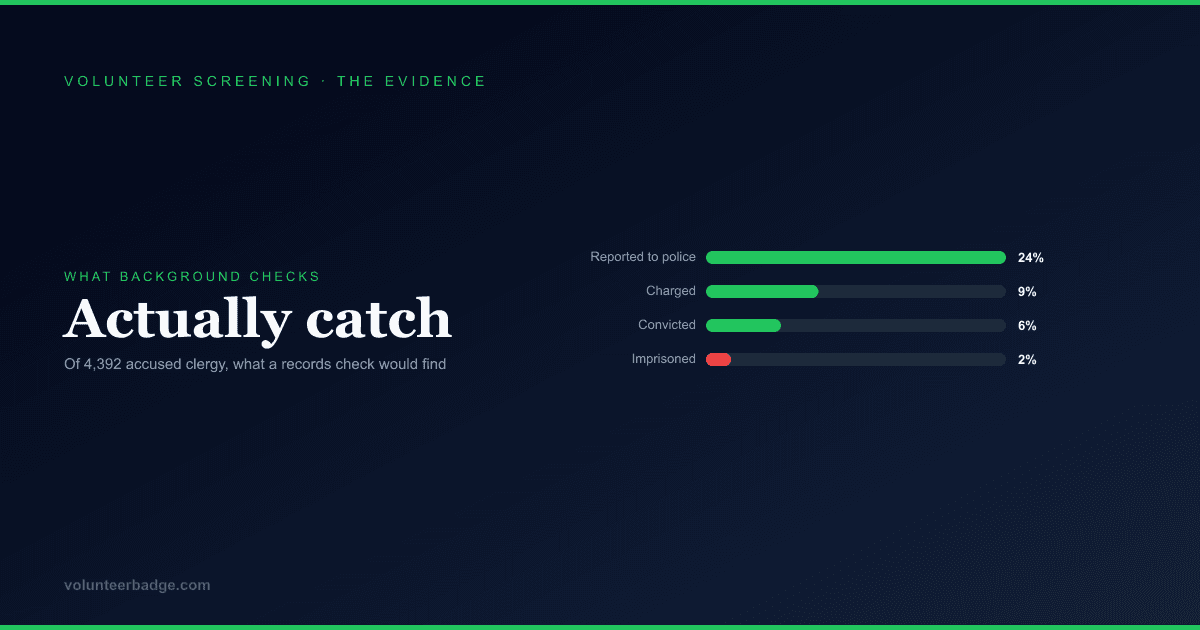
The John Jay College study of abuse in the Catholic Church remains the largest institutional dataset ever assembled: 4,392 accused priests, 10,667 people making allegations, 1950–2002. Follow what happened to those allegations:
Roughly 94% of accused priests were never convicted of anything. A criminal background check run on almost any of them, at almost any point, would have come back clean.
That is not a flaw in background checks. It is arithmetic. A criminal record is downstream of a conviction, a conviction is downstream of a charge, a charge is downstream of a report — and most abuse is never reported. In a nationally representative sample of 13,052 children, only 19.1% of sexual abuse and assault cases were reported to police, and 66.3% of 10-to-17-year-olds had told no parent or any adult at all.
Two further structural gaps matter for youth programs specifically. Juveniles commit an estimated 35.6% of sexual offences against minors, and juvenile records are typically sealed — invisible to any adult background check. And the American Camp Association's own crisis-hotline data shows camper-to-camper allegations are the largest single category of abuse calls it receives — 56% in 2023. No background check can address peer-on-peer harm.
What is the share of abusers who do have a findable prior record? The best-matched study — Canter & Kirby's analysis of all 416 detected offenders against children in one UK police area — found 44% had a prior conviction of some kind, though only 17% had a prior indecency conviction. That is far from the "90% have no record" claim, and far from a guarantee.
The records themselves are worse than you think
Even where a record exists, the systems that hold it are incomplete. According to SEARCH, in a survey funded by the Bureau of Justice Statistics, 73% of arrests in state criminal history files have a final disposition recorded — and only 65% for arrests in the past five years. The state-level variation is extreme:
The federal picture is no better. The 2006 Attorney General's Report found the FBI's Interstate Identification Index "missing final disposition information for approximately 50 percent of its records," and stated: "Contrary to common perception, the FBI's III system is not a complete national database of all criminal history records in the United States." That 50% figure has never been updated — in 2013 the FBI told the National Employment Law Project it does not maintain the statistic.
The sex-offender registry is also not what most people assume. The Department of Justice's own FAQ for the National Sex Offender Public Website asks whether it is a single national database and answers: "No." It queries each jurisdiction's separate system in real time. Its conditions of use state that the Department "does not guarantee the accuracy, completeness, or timeliness" of the data. A search returns at most 300 results, so a common name can silently truncate — and if a jurisdiction's system is down, that jurisdiction is simply missing from your results.
The cases screening was never going to catch
Larry Nassar abused athletes for roughly three decades. The independent Ropes & Gray investigation drew on more than 100 witness interviews and roughly 1.3 million documents. In the entire report, the phrase "background check" appears exactly once — inside an internal USA Gymnastics email noting that referral-network doctors weren't checked.
Every failure the report identified was a reporting or supervision failure. USA Gymnastics required complaints to be signed. It refused to investigate anonymous or second-hand reports. When a 2010 complaint arrived with a police report attached, an executive told the accused coach that no action would be taken without a signed letter — and advised him to "take any steps necessary to discredit these allegation[s] before that happens."
Nassar faced no criminal charge of any kind until November 2016. Any records check run on him at any point in his career would have returned clean.
The Justice Department's Inspector General later found that after USA Gymnastics reported Nassar to the FBI in July 2015, the Indianapolis field office conducted a single telephone interview, never formally opened an investigation, and did not notify state or local authorities. Approximately 70 or more young athletes were allegedly abused in the window between that report and the case finally moving.
Here is the detail that should reframe the whole debate. Congress responded to Nassar with the Protecting Young Victims from Sexual Abuse and Safe Sport Authorization Act of 2017. We searched the enacted statute. It contains zero occurrences of "background," "criminal history," "screening" or "fingerprint."
What it does require: reporting suspected abuse within 24 hours, limiting one-on-one adult–minor interactions to within "an observable and interruptible distance from another adult," consistent training, anti-retaliation protections, and independent audits. The law written in response to the largest abuse scandal in American sport does not mandate a single background check.
What the evidence says actually reduces risk
We looked for studies showing that background checks reduce abuse. There are none. This is not a gap in our search; it is a gap in the literature. A 2024 systematic review in the Journal of Child Sexual Abuse identified only seven perpetration-prevention outcome studies in the entire field, four of the five adult studies had significant methodological problems, and none evaluated criminal record checks. David Finkelhor, one of the field's most cited researchers, put it plainly in 2009: "The true benefits and costs of background checks have not been systematically researched."
The CDC said the same thing in 2007, in language a screening company would rather not quote:
"Criminal background checks will not identify most sexual offenders because most have not been caught… Using background checks alone may give your organization a false sense of security."
What the evidence does support is layered. The CDC's framework has six components, of which screening is one: screening and selection; guidelines on interactions; monitoring behaviour; ensuring safe environments; responding to breaches and allegations; and training.
The accreditor for American summer camps makes the same concession in the bluntest way available: the American Camp Association sells a staff training video titled “His Background Check Was Clear.” ACA also states plainly that “there is not one all-inclusive database in this country that includes all criminal records of every offender in every state,” and that because of it, “no single background check is ‘perfect.’”
If your organisation can only implement one thing this year, the evidence points to the two-adult rule — no adult is ever alone and unobservable with a child. It is what Congress chose to legislate after Nassar. It costs nothing. It removes opportunity rather than relying on detection. And in the BSA files, "nearly all the cases arose from situations in which troop leaders were alone with boys."
What this means for your program
Screening is a records-retrieval tool with a measurable yield and a hard ceiling. Both halves are true, and the honest case for it is narrower than the marketing:
- It reliably catches people who already have a record. One in six of the BSA's expelled abusers in that six-year window. Thirty-eight felons among 4,236 AAU volunteers. Self-disclosure caught none of them.
- It will not catch most people who go on to abuse, because most have never been convicted of anything — 94% of accused priests were not.
- It does nothing about peer-on-peer harm, which is the largest category of abuse reports camps actually receive.
- It is a legal-defence argument as much as a prevention one. Employers who run checks and act on results are rarely held liable; the youth soccer case cost $8.2 million partly because no check was run.
- It is not, and has never been shown to be, a substitute for supervision rules and a working reporting culture.
Run the checks. Run them on everyone with unsupervised access, not just the obvious roles, and re-run them on a schedule — a check describes the day it was run and nothing after. Then spend at least as much attention on the two-adult rule, on training people to recognise and report concerning behaviour, and on making sure a report actually goes somewhere. That is what the evidence supports, and it is what we would tell you if we sold nothing at all.
Sources
Every figure in this article was verified against a primary document. Where we could not verify a claim, we left it out.
- Ellman & Ellman, "'Frightening and High': The Supreme Court's Crucial Mistake About Sex Crime Statistics," Constitutional Commentary 30(3), 2015.
- Hanson & Bussière, Journal of Consulting and Clinical Psychology 66(2), 1998; Hanson & Morton-Bourgon, JCCP 73(6), 2005.
- Alper & Durose, Recidivism of Sex Offenders Released from State Prison: A 9-Year Follow-Up, BJS NCJ 251773, 2019.
- Love & Norris, Criminal Background Checks — Not a Silver Bullet!, Abuse Prevention Systems, 2020.
- Shakeshaft, Educator Sexual Misconduct: A Synthesis of Existing Literature, U.S. Department of Education, 2004.
- Jeglic et al., "The Nature and Scope of Educator Misconduct in K-12," Sexual Abuse 35(2), 2023.
- GAO, Child Welfare: Federal Agencies Can Better Support State Efforts, GAO-14-42, 2014.
- Parent & Vaillancourt-Morel, Journal of Sport and Social Issues 45(6), 2021; Parent et al., Journal of Interpersonal Violence 31(16), 2016.
- Alexander, Stafford & Lewis, The Experiences of Children Participating in Organised Sport in the UK, NSPCC, 2011.
- Felch & Christensen, "Boy Scouts' opposition to background checks let pedophiles in," Los Angeles Times, 2 December 2012 (archived).
- Willmsen & Mayo, "Felons found coaching amateur youth sports," The Seattle Times, 7 March 2004.
- Doe v. United States Youth Soccer Association, 8 Cal.App.5th 1118 (Cal. Ct. App. 2017).
- John Jay College, The Nature and Scope of Sexual Abuse of Minors by Catholic Priests and Deacons, 2004.
- Gewirtz-Meydan & Finkelhor, "Sexual Abuse and Assault in a Large National Sample of Children and Adolescents," Child Maltreatment, 2019.
- Canter & Kirby, "Prior convictions of child molesters," Science & Justice 35(1), 1995.
- Goggins & DeBacco, Survey of State Criminal History Information Systems, 2022, SEARCH, NCJ 309360, 2024.
- U.S. Department of Justice, The Attorney General's Report on Criminal History Background Checks, 2006.
- NSOPW FAQs and Conditions of Use, U.S. Department of Justice, SMART Office.
- McPhee & Dowden, Report of the Independent Investigation: The Constellation of Factors Underlying Larry Nassar's Abuse of Athletes, Ropes & Gray, 2018.
- DOJ Office of the Inspector General, Investigation and Review of the FBI's Handling of Allegations of Sexual Abuse by Lawrence Gerard Nassar, Report 21-093, 2021.
- Protecting Young Victims from Sexual Abuse and Safe Sport Authorization Act of 2017, Pub. L. 115-126.
- Seto et al., "Evaluating Child Sexual Abuse Perpetration Prevention Efforts: A Systematic Review," Journal of Child Sexual Abuse 33(7), 2024.
- Finkelhor, "The Prevention of Childhood Sexual Abuse," The Future of Children 19(2), 2009.
- Saul & Audage, Preventing Child Sexual Abuse Within Youth-serving Organizations, CDC, 2007.
- American Camp Association, Camp Crisis Hotline Annual Reviews, 2023–2025.
