3,241 Sources: What Is Actually Inside a $5 Background Check
A new screening vendor at one-fifth the price deserves scepticism. Here is the full composition of the search: 3,241 sources across 58 jurisdictions, the refresh cadence, how records are matched to a person, who reviews a hit, and the limitations we will not paper over.
On this page
Let me start where you probably are. You have never heard of VolunteerBadge. The price is a fifth of what you are paying now, or less. In the screening industry that combination usually means one of two things: the search is thin, or somebody is about to be careless with a real person’s record. Both are reasonable suspicions, and neither is answered by a marketing page insisting we are trustworthy.
So this article does something different. It describes the actual composition of the search — how many sources, of what kind, in which jurisdictions, on what refresh schedule, matched by which identifiers, reviewed by whom before anything reaches you. Where the honest answer is a limitation, it says so. You should finish this able to decide whether the price makes sense, using facts you can check rather than adjectives you have to accept.

Part 1 — Breadth: what 3,241 sources actually means
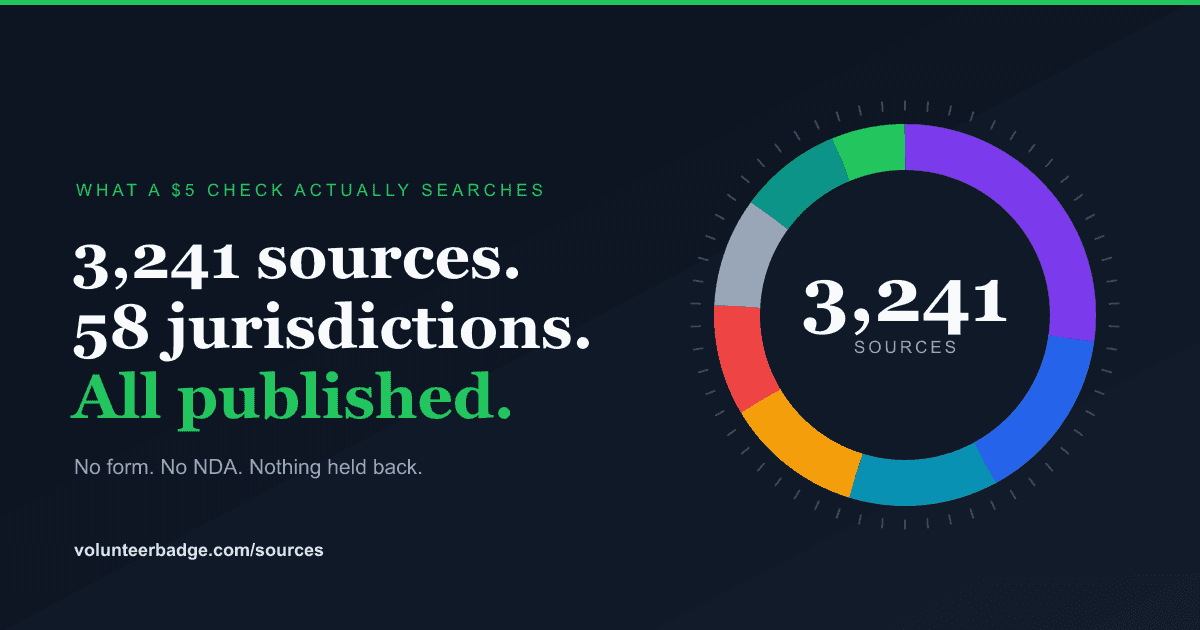
A VolunteerBadge criminal search reaches 3,241 individual data sources across 58 U.S. jurisdictions — all 50 states, the District of Columbia, and the territories. That is not a marketing round-up. It is the row count of the coverage register, and it breaks down like this:
| Source type | Count |
|---|---|
| Criminal courts | 511 |
| Arrest and warrant records | 482 |
| Municipal courts | 373 |
| Law-enforcement records | 303 |
| Federal watchlists and sanctions | 300 |
| Departments of Corrections | 283 |
| Sex-offender registries | 200 |
| District courts | 160 |
| Circuit courts | 154 |
| Mayor’s courts | 132 |
| Common pleas courts | 131 |
| Superior courts | 95 |
| Justice of the Peace courts | 70 |
| Statewide court repositories (AOC) | 33 |
| Traffic courts, parole records, other | 14 |
Add the court rows together and you get more than 1,600 court sources — just over half of everything we search. That is the figure worth holding onto, because courts are where the substance of a criminal record lives, and it is the number most national database products quietly do not have.
Coverage is not evenly distributed, and it should not be. Ohio contributes 636 sources and Texas 533, because both states devolve criminal jurisdiction across a very large number of independent courts — Ohio through mayor’s and municipal courts, Texas through Justice of the Peace courts that handle Class C misdemeanors. Georgia contributes 178, Florida 152, California 126. A further 267 are federal or nationwide. States with centralised repositories need fewer sources to achieve the same reach.
Part 2 — Frequency: a source list is only as good as its refresh cycle
Counting sources is the easy part. The harder question, and the one almost nobody asks during a vendor evaluation, is how often each source is refreshed. A county feed that was ingested once and never revisited still counts as a source. It simply stops being useful.
Across the register, 92.2% of sources sit on a monthly refresh cycle and 6.8% on a weekly cycle, with the small remainder on quarterly or longer schedules where the underlying publisher updates less often than that.
The distribution inside those numbers is the part I would want to see as a buyer. Of 200 sex-offender registry sources, 189 refresh weekly. Not monthly, not quarterly — weekly, every week, across every state registry, the District of Columbia, the territories and the national registry.
That is a deliberate allocation and it is worth being plain about why. If someone is added to a registry on a Tuesday, a monthly refresh cycle can leave that person invisible to a background check for weeks. For an organisation placing adults in unsupervised contact with children, those weeks are the entire risk. Running the registries on the fastest cycle we have is the single clearest thing we do to close that window, and if you read nothing else in this article, read that paragraph again.
Refresh cadence is a legal question, not merely an operational one. FCRA section 1681k requires that a CRA reporting public-record information likely to have an adverse effect on employment either notify the consumer at the time of reporting, or maintain strict procedures to ensure the information is complete and up to date. In Kelly v. Business Information Group (E.D. Pa.), the court read section 1681k(a)(2) as a currency requirement specifically — the question being whether the record reflects current status, with accuracy handled separately under section 1681e(b). Stale data is not just unhelpful. It is a statutory exposure.
Part 3 — Identity: matching a record to a person
Breadth and freshness are worth nothing if the record you surface belongs to somebody else. This is where inexpensive screening most often goes wrong, and where the regulatory line is clearest.
In November 2021 the Consumer Financial Protection Bureau issued an advisory opinion stating that a consumer reporting agency engaging in name-only matching — matching records to a consumer solely on first and last name, without additional identifiers — fails the section 1681e(b) obligation to follow reasonable procedures to assure maximum possible accuracy (86 Fed. Reg. 62,468).
That advisory opinion was withdrawn on 9 May 2025, as part of a broad rescission of Bureau interpretive guidance. We are telling you that rather than citing it as live authority, because you would find out, and because the point survives the withdrawal intact: rescinding an interpretation does not amend the statute. Section 1681e(b) reads exactly as it did before. What changed is that the Bureau no longer publishes its view on how that section applies to name matching, which means a CRA’s procedures are now measured directly against the statute rather than against guidance.
Our procedure does not depend on which interpretations are currently in force. Every VolunteerBadge check begins with an SSN trace that establishes the applicant’s address history, and every candidate record is resolved against date of birth and that address history before it is treated as a match. Identity is separately established up front through government photo ID and a live facial-liveness capture, so the record is anchored to a verified person rather than to a string of characters that happens to recur.
Part 4 — Review: what happens when something surfaces
A clear search completes in minutes and returns clear. That is the overwhelming majority of volunteer screening, and automating it is appropriate.
When potential records surface, the check does not resolve automatically. It moves to pending adjudication with a null result and goes to a trained reviewer, typically within three business days. The reviewer’s job is to exclude what does not belong — records for a different person with a similar name, and non-conviction material that is not reportable under the FCRA handling standard. Only what survives that review reaches the organisation.
This is deliberately the slowest part of the product, and we are not going to apologise for it. An algorithm that decides on its own whether a record belongs to your applicant is cheaper to run and produces a worse outcome for the one person in the batch whose life it gets wrong.
Part 5 — Why this shape fits nonprofits specifically
Here is the argument that actually justifies the price, and it rests on a base rate.
An Urban Institute analysis of roughly 1.7 million background checks found that about 94% returned no record at all. In volunteer populations the clear rate is higher still. Which means the dominant cost in a screening programme is not investigating records — it is confirming, over and over, that there is nothing to investigate.
That reframes the buying decision. If a check costs $30, a youth programme with 200 volunteers spends $6,000 to learn that roughly 188 of them have nothing on file. The predictable response is to screen fewer people: only those with the most contact with children, only the new ones, only paid staff. Every one of those exclusions is a gap, and gaps are where incidents happen.
At $5, or $3.75 in volume, that same programme screens everybody for $750 and re-screens on a schedule without a budget conversation. Population coverage beats per-report depth when 94% of reports are empty. A vendor optimising for maximum depth on every individual report is solving a problem most nonprofits do not have, at a price that forces them to leave people unscreened — which is the problem they do have.
Part 6 — So why is everyone else more expensive?
Not because their data costs more. Public records are public.
First Advantage, which acquired Sterling in 2024 and with it Sterling Volunteers, reported a 45.7% trailing gross margin, and in Q2 2026 revenue of $448.8M with adjusted EBITDA of $128.5M, a 28.6% margin, against a stated target range of 30 to 35%. The company runs more than 200 million screens a year at roughly 96% gross retention. Those are the economics of a business with enterprise sales, enterprise support, and public-market margin expectations. They are legitimate. They are simply not costs a summer camp benefits from funding.
There is a second cost worth naming, because it explains why claiming to search the federal courts directly is weaker than it sounds. PACER charges $0.10 per page with a $3 cap per document, waives fees under $30 per quarter, and roughly 75% of users pay nothing at all. Federal court access is cheap. But federal courts are a small slice of the picture: state courts handled 99.09% of U.S. case filings in 2019. A search that is deep in federal records and thin in county courts is deep in the wrong place for volunteer screening, where the relevant record is almost always local.
Part 7 — The questions buyers actually ask
Is a $5 check a real background check?
It is an FCRA-regulated consumer report produced by a consumer reporting agency, with disclosure and authorisation capture, human review of records, dispute rights, and an adverse-action workflow. ScreenForge Labs has obtained its FCRA Certificate from the Consumer Data Industry Association. The price reflects operating model, not scope.
Why are you cheaper than Sterling Volunteers or Checkr?
We are the CRA rather than a reseller, so there is no markup layer between you and the search, and we do not carry enterprise sales and support costs. Reported figures for others vary: Checkr’s basic package starts around $29.99 before add-ons; Sterling does not publish per-check pricing and sells through a representative, with customers reporting figures in the $19 to $39 range. Treat that last range as directional — it comes from customer reports, not from Sterling.
Does this replace a county-level courthouse search?
No, and we will not claim it does. A direct county search commissioned in every jurisdiction an applicant has lived in is the most thorough method available, and it costs accordingly. Our argument is that a broad, frequently refreshed, identity-resolved multi-source search with human review of every hit is the right instrument for screening an entire volunteer population — and that screening everybody adequately beats screening a third of them exhaustively.
How far back does the search look?
Convictions are reported without a fixed federal lookback limit, subject to state restrictions. Non-conviction items — arrests without disposition, dismissed matters, and records older than seven years — are excluded from a clear report under the FCRA handling standard for non-convictions. That standard governs what is reportable; it is not a limit on how far the search itself reaches.
What if a record is wrong?
The consumer disputes it free of charge at screenforgelabs.com/disputes, and ScreenForge Labs reinvestigates, generally within 30 days, correcting or removing anything inaccurate, incomplete, or unverifiable. An open dispute blocks the final adverse-action notice until it resolves.
Who decides whether someone volunteers?
You do, always. We deliver the report. VolunteerBadge never sets an applicant’s status, and nothing auto-declines anyone.
How to check us
Three things you can do that do not require trusting this article.
Read the source list. Every one of the 3,241 sources is published, by name, type, jurisdiction, and refresh cadence, at volunteerbadge.com/sources. No form, no NDA. Ask your current vendor for the same thing in writing and see what comes back.
Run a head-to-head. Take five people you have already screened elsewhere — same names, same dates of birth — and run them through us. Compare the results, and compare the invoice. That costs $25 and settles the question more honestly than any article can.
Read the security and compliance posture. volunteerbadge.com/trust covers encryption, retention, access control, and the FCRA workflow end to end.
We are a new name asking you to trust us with a decision that matters. The correct response to that is scepticism, and the only useful answer is to show our work.
