For CERT teams & relief organizations
Disaster relief volunteer background checks for the people who show up after the storm.
Your responders enter damaged homes, staff overnight shelters, and sit with displaced families and their data. VolunteerBadge helps you vet every CERT member, community responder, and relief volunteer for $5 — identity-verified and FCRA-compliant — with onboarding fast enough for a volunteer surge.
The access a disaster deployment hands out is real
After a hurricane, flood, or wildfire, relief volunteers get close to people at their most vulnerable — inside their homes, in the shelter, and holding their paperwork. Screening is how you make sure the people who answer the call are the people you can trust with that access.
They enter damaged homes
Muck-out crews, debris teams, and rebuild volunteers work inside private residences alongside families who have lost almost everything. That is exactly the unsupervised, in-home access screening exists to protect.
They staff emergency shelters
Shelter volunteers register evacuees, hand out supplies, and share close quarters with children, older adults, and people with disabilities — vulnerable people relying on strangers overnight.
They handle people and donations
Case-intake volunteers collect Social Security numbers and personal data; distribution teams manage cash cards, gift cards, and donor funds. Displaced families and donors expect the people representing you to be vetted.
A background check is one layer of a safe program — not a guarantee. Pair it with references, supervision, and clear policies.
What the $5 check includes
Everything a relief organization needs to vet a responder — nothing you don’t.
- National criminal search — county, state & federal court records
- Sex-offender registries in all 50 states + the national registry (NSOPW)
- Federal watchlists — OFAC, exclusion & sanction lists
- Free identity verification (government ID + live selfie)
- Free address history on every report
- Human CRA review of every high-confidence record before it reaches you
- Built-in FCRA adverse-action workflow if you ever decline someone
- Reusable badges + automatic re-screening between deployments
Send the link — even at 2am
Email a link or share a QR code at the muster point. Responders apply from their phone in minutes. No portal training, no paperwork queue.
Verify & screen in bulk
A government ID + selfie confirm the real person; the $5 national check runs with their consent. Onboard a surge of new volunteers at once.
Cleared to deploy
A verified badge lands on your roster — with adverse action handled for you if records appear, so a spontaneous-volunteer surge never becomes a liability.
Built for the surge
Screen a wave of volunteers without a bottleneck
Disaster response is spiky. You may need to onboard hundreds of people in a day, then stand down for months. VolunteerBadge is priced and built for exactly that rhythm.
Onboard a surge in minutes
When a disaster hits, hundreds of spontaneous volunteers can show up in a day. Self-serve mobile applications mean you screen the crowd without a bottleneck at the check-in table.
No contracts, no minimums
You pay $5 only when you actually run a check — no monthly platform fee, no annual seat license sitting idle between disasters. Scale up for a deployment, then stand down.
Reusable between deployments
A volunteer screened for last season stays badge-ready. Reusable badges and automatic re-screening mean your standing CERT roster is always deployment-ready.
Free guide
Screening disaster relief & CERT volunteers
A practical guide to who needs a background check on a disaster deployment, how to screen a volunteer surge without slowing the response, and how to keep the whole thing FCRA-compliant.
🛟1. Why screen disaster relief volunteers
Disaster response is one of the few volunteer settings that combines every risk factor at once: strangers, urgency, in-home access, and vulnerable people who cannot easily protect themselves. A background check will not catch everyone, but it is a defensible, consistent way to filter for accountable people before you deploy them.
- You serve people at their most vulnerable. Evacuees have lost homes, routines, and sometimes family. Children and older adults end up in shelters full of unfamiliar adults.
- Your volunteers are unsupervised. Muck-out and rebuild crews work inside private homes; drivers move people and supplies alone; intake volunteers sit one-on-one with survivors.
- Your reputation is your fundraising. Partners, the emergency-management office, and donors extend trust based on how seriously you take safety.
🧭2. Which roles need a check
Screen based on access, not job title. On a typical deployment the roles that warrant a background check include:
- Shelter staff — anyone registering, feeding, or sharing overnight space with evacuees, especially where children or older adults are present.
- In-home teams — muck-out, debris removal, tarping, and rebuild volunteers who enter damaged residences.
- Case-intake & call-center volunteers — who collect Social Security numbers, financial details, and other sensitive data.
- Distribution & finance — volunteers handling cash cards, gift cards, or donated funds.
- Drivers & transport — who move survivors or supplies without a second set of eyes.
- CERT members & team leads — your standing, deployable roster.
⚡3. Screening a volunteer surge
The hard part of disaster screening is not the check — it is doing it fast, at volume, when spontaneous volunteers arrive faster than a clipboard can handle. A few practices make it manageable:
- Go self-serve and mobile. Share one link or QR code at the muster point so each volunteer applies from their own phone in parallel, instead of queueing at a check-in table.
- Verify identity up front. A government ID plus a live selfie confirms the person is who they claim before they are ever placed — critical when you have never met them.
- Pre-screen your standing roster. Keep CERT members and repeat volunteers badge-ready between events so a deployment is a recall, not a fresh onboarding.
- Let the reusable badge do the work. Someone screened last season is still deployment-ready, with automatic re-screening handling the gaps.
Why $5, no contract, matters here: disaster orgs surge and stand down. You pay only for the checks you run during a deployment — no idle per-seat license between disasters.
⚖️4. Doing it FCRA-compliantly
A volunteer background check is a consumer report under the Fair Credit Reporting Act, and the rules apply even in an emergency. VolunteerBadge is operated by ScreenForge Labs, LLC, an FCRA-regulated Consumer Reporting Agency, and handles the compliance mechanics for you:
- Consent first. Every volunteer sees a clear disclosure and gives written authorization before any check runs.
- Permissible purpose. Checks run only for a legitimate, disclosed screening reason.
- Adverse action, handled. If you ever decline someone based on a record, the built-in workflow sends the pre-adverse notice, waits the required period, and sends the final notice.
- Apply one standard to everyone. Consistency is fair and protects you from discrimination claims.
📋5. Writing a simple screening policy
Put your approach in writing before the next disaster so your team acts consistently under pressure. A short policy should state:
- Which roles require a background check (tie it to access, per §2).
- That screening happens before deployment, and identity is verified.
- How often standing volunteers are re-screened.
- Who reviews results and how decisions are documented for your board and insurer.
- That the same standard applies to every volunteer.
Disaster relief screening questions
Do disaster relief and CERT volunteers really need a background check?
Many established relief organizations and CERT programs screen their volunteers. Disaster response puts volunteers inside damaged homes, in overnight shelters with children and older adults, and in charge of evacuees’ personal data and donated funds. A background check is a reasonable, defensible layer that protects the displaced families you serve, your other volunteers, and your organization’s standing with donors and partners.
What does the $5 check cover?
A national criminal search across county, state, and federal court records, sex-offender registries in all 50 states plus the national registry (NSOPW), and federal watchlists — with free identity verification (government ID + live selfie) and a free address-history check. Every high-confidence record is reviewed by a trained analyst before it reaches you.
Can we onboard a surge of volunteers fast?
Yes — that is the point. When a disaster brings a wave of spontaneous volunteers, you send one link or QR code and each person applies from their own phone in minutes. There is no per-seat setup and no paperwork queue, so you can screen a large surge in parallel instead of one at a time at the check-in table.
Is it really free for our relief organization?
The platform is free for nonprofits — no monthly fees, no contracts, no per-seat charges. You only pay $5 per background check when you actually run one, which is ideal for organizations that surge for a disaster and then stand down. Credits never expire.
Is it FCRA-compliant?
Yes. VolunteerBadge is operated by ScreenForge Labs, LLC, an FCRA-regulated Consumer Reporting Agency. Every check is consent-first with permissible-purpose handling and a built-in adverse-action workflow (pre-adverse notice, a waiting period, and a final notice) if you ever decline a volunteer based on a record.
What about volunteers we screened for a previous disaster?
Their verified badge is reusable, and VolunteerBadge can automatically re-screen between deployments. Your standing CERT or response roster stays deployment-ready without re-running full onboarding every time.
Give survivors the responders they deserve
Vet every CERT member and relief volunteer for $5 — free platform, no contracts, FCRA-compliant, and fast enough for a surge. Set up in minutes.
Free whitepaper PDF
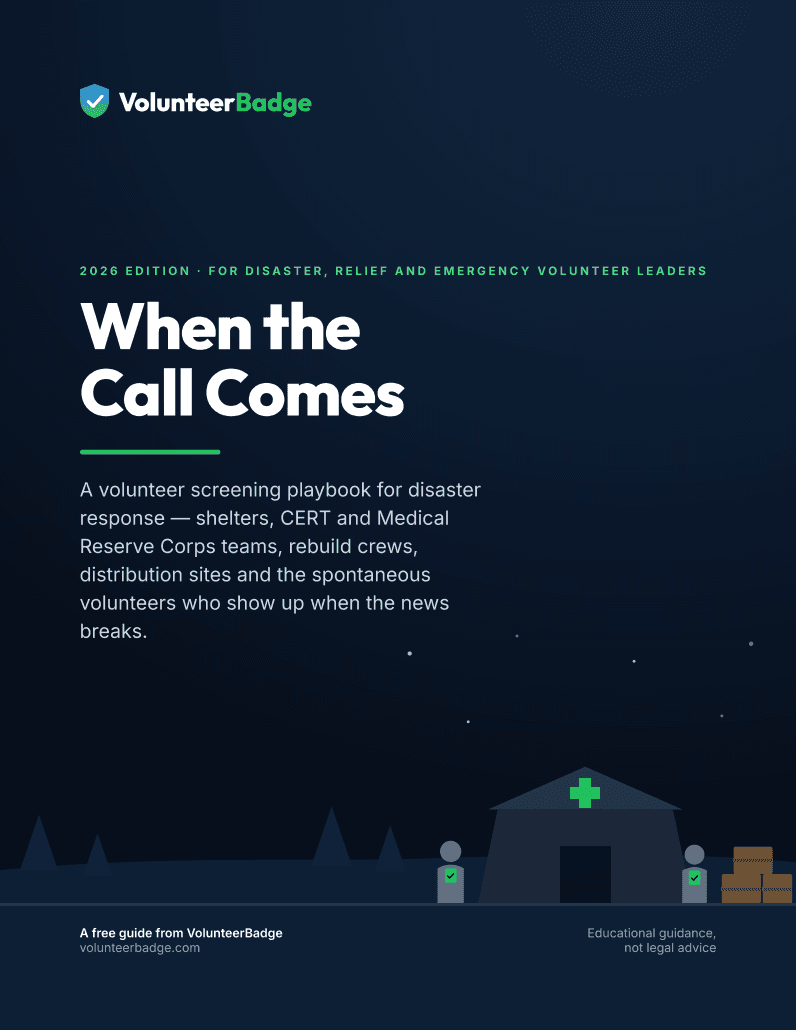
When the Call Comes: a volunteer screening playbook for disaster response and relief programs
What federal guidance says about screening spontaneous volunteers, CERT and MRC teams, shelter and rebuild crews — and how to be fast and safe when the call comes.
More volunteer screening guides
- Volunteer background checksThe complete guide to screening volunteers for $5.
- Food bank volunteer background checksScreening for food banks and pantry volunteers.
- Homeless shelter volunteer background checksVetting volunteers who serve people experiencing homelessness.
- Veterans organization volunteer background checksScreening for veteran-serving nonprofits.
- Pricing$5 per check, free platform, no contracts.
- Trust CenterHow we protect volunteer data and stay FCRA-compliant.